‘Protection of Nationals Abroad’ Ordered for Foreign Ministry
Immediate Activation of Monitoring Systems for Economy and Finance Ministries
Prime Minister Minseok Kim issued an emergency directive to all government ministries on March 1, instructing them to make every effort to ensure public safety and respond to economic shocks, as uncertainty in the Middle East has reached its peak following an Iranian airstrike by the United States and Israel that resulted in the death of Iran's Supreme Leader, Ayatollah Seyyed Ali Khamenei.
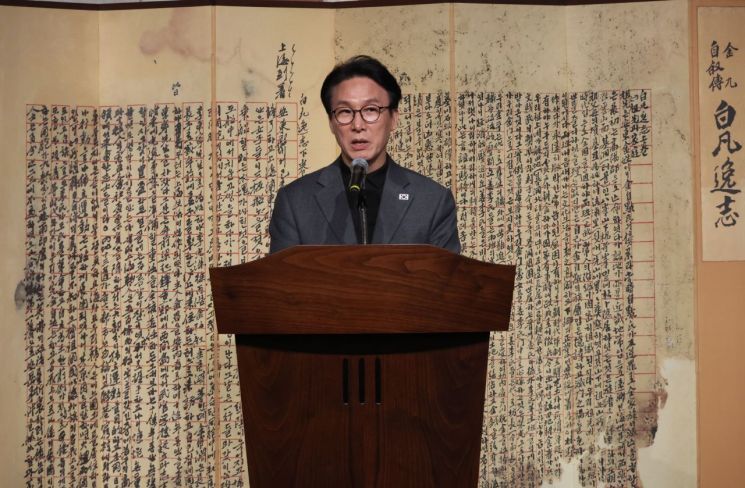 Prime Minister Kim Minseok is delivering a congratulatory speech at the creative pansori performance "Baekbeom Kim Gu" held on the 150th anniversary of Baekbeom Kim Gu's birth at the Baekbeom Kim Gu Memorial Hall in Yongsan-gu, Seoul on the 1st. Yonhap News.
In the emergency order released through the Prime Minister's Office that afternoon, Prime Minister Kim stated, "We recognize with utmost seriousness the recent escalation of military tensions in the Middle East," and added, "We will mobilize all government capabilities to secure national security and the stability of the people's economy."
First, he instructed the Ministry of Foreign Affairs to "prioritize the protection of our nationals abroad by checking the whereabouts and safety of Korean citizens residing in the Middle East and neighboring countries in real time, and by strengthening timely guidance in response to changing circumstances." He also ordered the establishment of a 24-hour foreign affairs and security crisis response system to comprehensively analyze all information and to institutionalize regular situation assessment meetings to evaluate and share security and military risk factors.
In the economic sector, he emphasized preemptive measures in response to the surge in international oil prices and increased volatility in foreign exchange and financial markets. Prime Minister Kim called on the Ministry of Economy and Finance and the Financial Services Commission to "immediately activate monitoring systems for oil prices, exchange rates, and stock markets, and proactively prepare market stabilization measures and financial policy tools."
Additionally, he requested that the Ministry of Trade, Industry and Energy and the Ministry of Oceans and Fisheries thoroughly inspect the stability of energy supplies such as crude oil and liquefied natural gas (LNG), as well as logistics and supply chain risks, in order to minimize the impact on domestic industries and households. In particular, the government plans to promptly and accurately release fact-based information to dispel excessive public anxiety.
At 6:30 p.m. that day, Prime Minister Kim will preside directly over an emergency inter-ministerial meeting at the Seoul Government Complex to review the Middle East situation. The meeting will be attended by ministers from key departments including the Ministry of Economy and Finance, the Ministry of Foreign Affairs, and the Ministry of National Defense, as well as representatives from intelligence and investigative agencies such as the National Intelligence Service and the National Police Agency, and officials from the National Security Office at the Presidential Office, to discuss concrete countermeasures going forward.
Earlier that morning, President Lee Jaemyung, who departed for official visits to Singapore and the Philippines, instructed before leaving the country, "During my trip, the Prime Minister and relevant ministries must maintain an emergency response system and provide frequent reports on the situation in the Middle East and its economic impacts," emphasizing the need for seamless governance in his absence.
© The Asia Business Daily(www.asiae.co.kr). All rights reserved.












