Spreading the February 8 Declaration While at Kyungsung Medical School
Led the March 10 Manse Demonstration in Gwangju
Devoted to "Free Medical Care" for the Poor After Liberation
Kim Beomsoo, a central figure in the Gwangju March 1st Movement and a lifelong advocate for public healthcare, has been formally recognized as a patriot for independence and will receive a national honor decades after his passing.
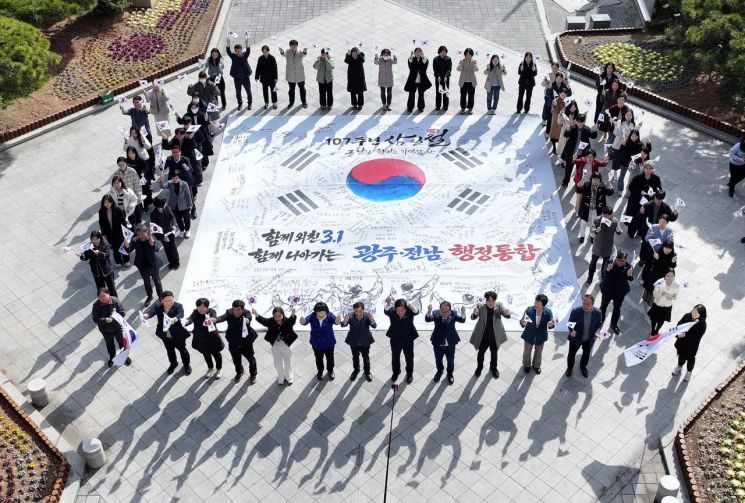 Three days before the 107th March 1st Movement Day, on the morning of the 26th, Moon In, Mayor of Buk-gu, Gwangju, Choi Moo-song, Chairman of Buk-gu Council, and others are chanting "Manse" (long live) in front of a large Taegeukgi flag at the Buk-gu Office Plaza in Gwangju. Photo by Yonhap News.
According to his surviving family members and local historians on March 1, the government has decided to award Kim Beomsoo the Order of Merit for National Foundation, 5th Class, known as the "Patriotic Medal," in commemoration of the 107th anniversary of the March 1st Movement.
In 1919, while studying at Kyungsung Medical School, Kim became involved in the anti-Japanese independence movement after relaying news of the February 8 Declaration of Independence by Korean students in Tokyo to those in Korea. He personally obtained a mimeograph to print copies of the Declaration of Independence in Jangseong, Jeollanam-do, and meticulously prepared the Manse demonstrations in collaboration with youth organizations in the Gwangju area. He led the organized protest on March 10 centered around the Gwangju marketplace and was subsequently arrested and imprisoned by the Japanese police.
After his release, Kim became a doctor and opened "Namsun Clinic" in his hometown of Gwangju, where he provided free medical care to impoverished patients and became a respected figure in the community. However, his achievements as an independence activist went unrecognized for a long time after liberation, as he participated in social movements advocating for a unified government and was later classified as a member of the South Korean Workers' Party during the Cold War era.
In particular, during the Korean War, Kim was forcibly conscripted by the North Korean army to treat wounded soldiers, and this record was later misunderstood as leftist activity, resulting in his exclusion from national honors for decades.
His contributions finally received recognition thanks to the persistent efforts of his family and local historians such as Professor Park Haehyeon of Chodang University, who unearthed objective evidence including court records and contemporary media reports. With this national honor, Kim Beomsoo and eight other independence activists from Gwangju and Jeollanam-do have been recognized as patriots for independence.
© The Asia Business Daily(www.asiae.co.kr). All rights reserved.












