February exports up 29.0%... Semiconductors surge 160.8%
Three fewer working days due to Lunar New Year... Daily average exports up 49.4%
Record-high trade surplus... 13 consecutive months in the black
Despite a decrease in the number of working days, exports in February maintained their upward trend and reached an all-time high, propelled by robust semiconductor performance. The export growth trend that began in June last year has continued for nine consecutive months.
According to the "Export and Import Trends for February" released by the Ministry of Trade, Industry and Energy on March 1, exports amounted to USD 67.45 billion, an increase of 29.0% compared to the same month last year. This is the highest performance ever recorded for the month of February.
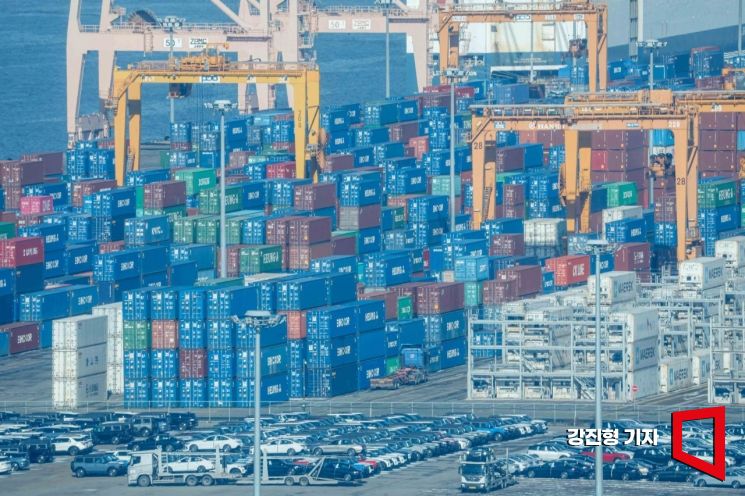
In February, due to the Lunar New Year holiday, there were three fewer working days compared to a year ago. Even when adjusting for the number of working days, daily average exports increased by 49.3% to USD 3.55 billion, surpassing the USD 3 billion mark for the first time ever.
Out of the 15 major export items, exports of five items increased in February. Semiconductor exports (USD 25.16 billion, up 160.8%) set a new monthly all-time high for all recorded periods, driven by excess demand resulting from expanded investments in artificial intelligence (AI) and a subsequent sharp rise in memory prices. Export volumes of semiconductors exceeded USD 20 billion for three consecutive months.
Wireless communication devices (USD 1.47 billion, up 12.7%) saw a positive trend for four consecutive months, mainly due to strong exports of finished mobile phones (USD 530 million, up 131.6%) following the launch of new models. Computers (USD 2.56 billion, up 221.6%) marked five straight months of growth, thanks to continued strong exports of SSDs.
Exports of automobiles (USD 4.81 billion, down 20.8%) and auto parts (USD 1.45 billion, down 22.4%) declined due to reduced production volumes caused by fewer working days associated with the shift of the Lunar New Year holiday (from January 2025 to February 2026), resulting in three fewer working days.
Exports of petroleum products increased in volume due to higher operating rates, but decreased by 3.9% to USD 3.73 billion as export prices fell amid continued global low oil prices. Bio-health exports (USD 1.31 billion, up 7.1%) continued their positive trend for four consecutive months, with both existing and new products demonstrating stable sales growth.
Exports of petrochemicals (USD 3.33 billion, down 15.4%) and steel (USD 2.36 billion, down 7.8%) decreased due to falling export prices driven by global oversupply. General machinery exports fell by 16.3% to USD 3.26 billion, impacted by fewer working days and sluggish facility investment in major countries.
By region, exports rose in seven out of nine major export regions. Exports to the United States (USD 12.85 billion, up 29.9%) achieved the highest February result on record, led by triple-digit growth rates in semiconductors and computers, with bio-health, petroleum products, and secondary batteries also showing balanced growth. Although exports to China declined for many items due to a reduction in working days caused by the Lunar New Year holiday (February 14-18) and the Spring Festival (February 15-23), exports of semiconductors, computers, and petroleum products surged, resulting in overall exports to China increasing by 34.1% to USD 12.75 billion.
Exports to ASEAN (USD 12.47 billion, up 30.4%) posted the highest February performance ever, with major items such as semiconductors, displays, and ships driving high growth. Exports to the European Union (USD 5.6 billion, up 10.3%) also recorded strong results, with semiconductors, bio-health, and ships all showing balanced increases.
Last month, imports rose by 7.5% to USD 51.94 billion. Energy imports (USD 9.29 billion, down 1.4%) decreased, but non-energy imports (USD 42.64 billion) increased by 9.6%.
Energy imports saw crude oil imports (USD 5.43 billion, down 11.4%) decrease due to lower oil prices, while gas imports (USD 2.64 billion, up 15.9%) increased. Non-energy imports saw a rise in items such as semiconductors (USD 6.76 billion, up 19.1%), semiconductor equipment (USD 2.56 billion, up 43.4%), and telephones (USD 1.03 billion, up 80.2%).
In February, the trade balance recorded a surplus of USD 15.51 billion, up USD 11.55 billion compared to the previous year. This marks the highest trade surplus ever for any period and represents 13 consecutive months of surplus since February last year.
Minister of Trade, Industry and Energy Kim Jeonggwan stated, "Recently, growing tensions in the Middle East and U.S. tariff policies are increasing external uncertainty for our exports. In order to minimize the impact of geopolitical risks originating from the Middle East, we will closely monitor export and import trends and implement necessary support measures without disruption. At the same time, we will maintain close communication with the United States to ensure that the benefits secured through the Korea-U.S. tariff agreement remain balanced and that export conditions to the U.S. are not undermined, while also making every effort to ensure the swift passage of the Special Act on Investment in the U.S. through the National Assembly."
© The Asia Business Daily(www.asiae.co.kr). All rights reserved.












