National Referendum Act Amendment Immediately Submitted to Plenary Session
Clause Punishing the Spread of False Information Removed
The Supreme Court Justices Increase Act (Partial Amendment to the Court Organization Act), the final bill of the "Three Judicial Reform Bills" led by the Democratic Party of Korea, passed the plenary session of the National Assembly on February 28, 2026.
On this day, the National Assembly held a plenary session, and the Supreme Court Justices Increase Act was passed with 173 votes in favor, 73 against, and 1 abstention out of 247 members present.
The main point of the bill is to increase the number of Supreme Court justices, currently 14, to 26 by sequentially adding four justices each year over three years. The implementation will begin two years after the law is promulgated.
This amendment is the final bill among the three judicial reform bills that the Democratic Party of Korea had pushed to pass during the February extraordinary session of the National Assembly.
The Democratic Party of Korea completed the legislative process in the National Assembly for all three bills, starting with the Law Distortion Crime Act (Criminal Act amendment) on February 25, followed by the introduction of the Constitutional Appeal System (Constitutional Court Act amendment), and finally, the Supreme Court Justices Increase Act on this day.
The People Power Party strongly opposed these bills, calling them "evil laws that destroy the judiciary to save President Lee Jaemyung," and responded with consecutive filibusters (legitimate obstruction of proceedings through unlimited debate). However, the ruling party, which holds an overwhelming majority of seats, forcibly ended the debate and put the bills to a vote 24 hours later, passing them in the plenary session.
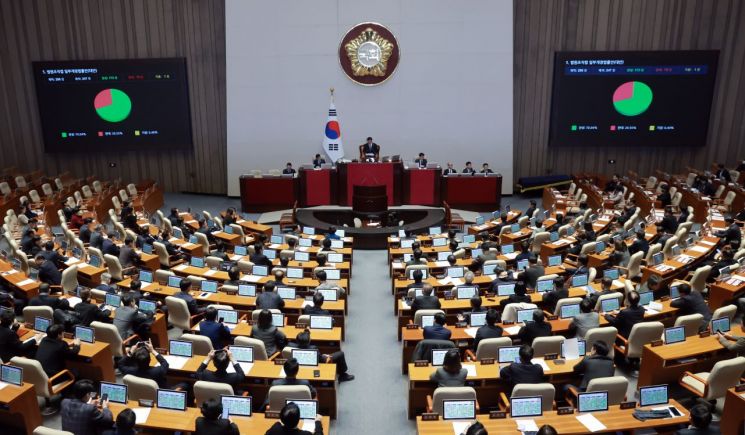 On the 28th, during the 8th plenary session of the February extraordinary session of the National Assembly, the Court Organization Act amendment bill (Supreme Court Justice Increase Act), which was submitted the previous day, was passed. Photo by Yonhap News Agency
Following the passage of the Supreme Court Justices Increase Act, the Democratic Party of Korea immediately submitted the amendment to the National Referendum Act, which guarantees the right to vote in national referendums for overseas Koreans, to the plenary session.
This bill includes those "registered in the overseas voters list" as eligible voters. The amendment to the National Referendum Act is a procedure required by a 2014 Constitutional Court decision.
At the time, the Constitutional Court ruled that the provision allowing only those with resident registration in Korea or overseas Koreans who have reported domestic residence to be listed as eligible voters in a national referendum was unconstitutional, as it restricted overseas Koreans' right to vote. The court recommended that this issue be resolved by 2015. However, due to the delay in amending the law, the legislative gap has persisted for more than 10 years.
The amendment to the National Referendum Act, which was submitted to the plenary session, originally included a provision to punish the spread of false information serious enough to interfere with election administration work. However, this clause was removed just before the bill was introduced.
The People Power Party and others criticized this provision, arguing that it would completely block public criticism of election administration work. In response, the Democratic Party of Korea decided to delete the clause just before the bill was submitted.
The People Power Party immediately began another filibuster as soon as the amendment to the National Referendum Act was introduced. It is expected that this bill will be put to a vote and processed in the evening of March 1, after 24 hours have passed.
© The Asia Business Daily(www.asiae.co.kr). All rights reserved.












