Heads of Six Local Governments Sign Joint Proposal for Metropolitan Railway
Citywide Signature Campaign Runs Until April 3
Establishing a Direct Railway Network Linking Industrial Complexes and the New Airport
All-Out Efforts to Include in the 5th National Railroad Network Plan
Gumi City in North Gyeongsang Province has launched a citizens' signature campaign urging the early promotion of the Daegu-Gyeongbuk Metropolitan Railway (Seodaegu~Uiseong) and the inclusion of the Gumi~New Airport railway in the 5th National Railroad Network Construction Plan. This move is based on the view that expanding the metropolitan transportation network is directly linked to the region's industrial competitiveness.
On the 27th, the heads of six local governments-North Gyeongsang Province, Daegu City (acting mayor), Gumi City, Gunwi County, Uiseong County (deputy governor), and Chilgok County-formally declared their commitment to the early promotion of the railway project by signing the "Joint Proposal for the Daegu-Gyeongbuk Metropolitan Railway" prior to the opening ceremony of BukSam Station on the Daegyeong Line. These local governments are now united in their joint response to the central government, emphasizing solidarity and shared understanding among the municipalities.
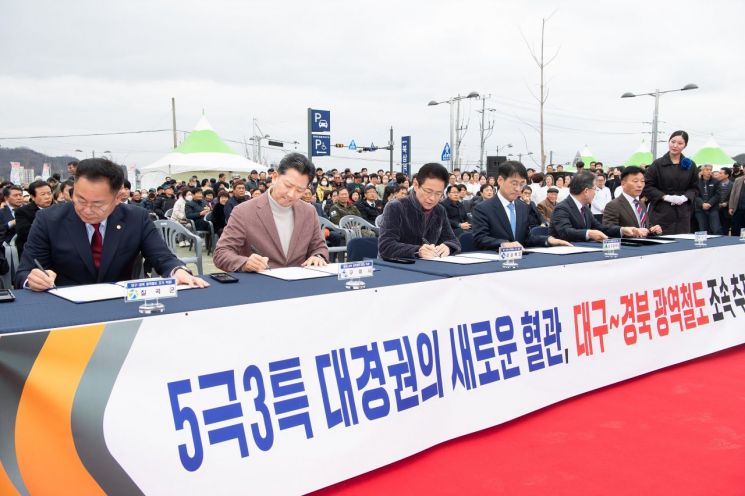 Citizen petition campaign urging the early promotion of the Daegu-Gyeongbuk Metropolitan Railroad (Seodaegu to Uiseong) and the inclusion of the Gumi to New Airport railroad in the 5th National Railroad Network Construction Plan / Provided by Gumi City Hall
The signature campaign will run until April 3. Any citizen can participate by signing at booths located at key sites such as the Eup/Myeon/Dong administrative welfare centers, Gumi Station, Sagok Station, and Gumi Intercity Bus Terminal. Online electronic signatures are also being collected via QR codes posted on the city hall website.
The Daegu-Gyeongbuk Metropolitan Railway (Seodaegu~Uiseong) line is a key axis that binds Daegu and Gyeongbuk into a single living and economic zone. By reducing regional travel times, it will improve commuting and educational conditions while also providing a foundation for stimulating industrial and logistics flows. In a situation where concentration in the capital region is intensifying, an interregional transportation network is seen as an essential prerequisite for balanced development.
The Gumi~New Airport railway is a strategic line that connects the metropolitan railway with the existing Gyeongbu Line. As a structure that directly links national industrial complexes and the new airport, it is evaluated as infrastructure that can dramatically enhance export and logistics efficiency.
Gumi is an industrial city responsible for 4.5% of national exports and 63% of North Gyeongsang's exports. Although 3,762 companies and approximately 93,000 workers are concentrated in five national industrial complexes, no new railway project has been pursued in the city since the opening of the Gyeongbu Line in 1905-over 120 years ago. With the new airport being constructed approximately 10 kilometers from the industrial complexes, there is growing consensus that now is the ideal time to establish a new railway network.
Railway accessibility is directly tied to the investment environment. Attracting companies, securing talent, and maintaining logistics competitiveness all hinge on transportation infrastructure. Concerns have been raised that if the metropolitan railway network and the new airport connection line are excluded, the region's industrial ecosystem could suffer relative disadvantages.
Gumi City plans to submit the results of the signature campaign to the government and relevant ministries, formally requesting the early promotion of the Daegu-Gyeongbuk Metropolitan Railway and the inclusion of the Gumi~New Airport railway line in the 5th National Railroad Network Construction Plan.
The local business community and civil society emphasized, "Railway infrastructure is the foundation that will determine the future of the entire Daegyeong region," adding, "Only if the railway network linking the new airport and the industrial complexes is included in the national plan can the western region of North Gyeongsang secure sustainable growth engines." They further stated, "This signature campaign is more than just a demand for expanded transportation networks-it is a choice for the survival of the region and for future generations," calling for active citizen participation.
© The Asia Business Daily(www.asiae.co.kr). All rights reserved.












