Explaining Major Special Provisions Ahead of Special Act’s Passage
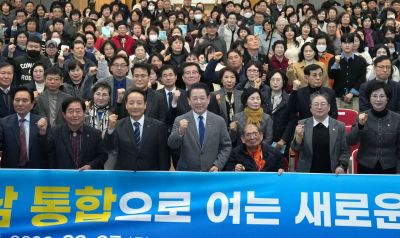 Jeollanam-do Governor Youngrok Kim is taking a commemorative photo with Im Taek, Mayor of Dong-gu, Gwangju, and other attendees at the "Jeonnam-Gwangju Administrative Integration Gwangju Autonomous District Invitation Town Hall Meeting (Dong-gu)" held at Dong-gu Office in Gwangju on the 27th. Provided by Jeonnam Province
On February 27, Jeollanam-do held a town hall meeting for the administrative integration of the Jeonnam-Gwangju Special Integrated City in the main conference room of Gwangju Dong-gu Office, sharing the vision for integration and gathering feedback from attendees.
The Dong-gu town hall meeting, which marked the first stop in a series of town hall meetings touring the five autonomous districts of Gwangju, was attended by Kim Young-rok, Governor of Jeollanam-do; Im Taek, Mayor of Dong-gu; Moon Sun-hwa, Chairperson of Dong-gu Council; district council members; and around 300 citizens of Dong-gu.
This town hall meeting was organized following the passage of the “Special Act on the Establishment of the Jeonnam-Gwangju Special Integrated City” by the National Assembly’s Legislation and Judiciary Committee on February 24, with approval by the National Assembly plenary session expected around March 2. During the event, the future vision and institutional design direction of the Jeonnam-Gwangju Special Integrated City were shared with citizens, and a variety of opinions from the field were collected.
Governor Kim Young-rok personally presented the future vision for the Jeonnam-Gwangju Special Integrated City and the major special provisions of the Special Act. The presentation included the ▲ 3+1 Axis Y4 Nomics ▲ Leap Toward a Global Cultural Capital ▲ Bid to Host the 2028 G20 Summit ▲ Attraction of Core Institutions for the Second Phase of Public Institution Relocation to Local Areas.
A Q&A and feedback session with citizens followed, providing an opportunity to share both expectations and concerns regarding administrative integration and to create a forum for public discussion to expand citizen participation.
Jeollanam-do announced that it will thoroughly review the opinions presented at the meeting and actively reflect them in the future institutional design of the Special Integrated City. In addition, the province plans to increase resident participation through both online and offline communication channels and to accelerate preparations for the launch of the Special Integrated City based on empathy and trust.
An official from Jeollanam-do stated, “Gwangju Dong-gu is the former location of the Jeollanam-do Provincial Office and has been the administrative, transportation, and commercial center of the region, leading to its reputation as ‘Honam’s No. 1 district’ and driving the growth of both Gwangju and Jeonnam. Recently, it has moved beyond its image as the old downtown to emerge as a new hub leading in AI and cultural tourism. At this pivotal moment of launching the Jeonnam-Gwangju Special Integrated City, we will achieve the greatest synergy and progress, especially with the National Asia Culture Center at its core, propelling us toward becoming a global cultural capital.”
The official added, “On July 1, the Jeonnam-Gwangju Special Integrated City, Korea’s first metropolitan integration, will be launched in a historic moment. We aim to leap from a population of 3.2 million to 4 million, ushering in a new era of grand prosperity for the Jeonnam-Gwangju Special Integrated City.”
Starting with Dong-gu, Jeollanam-do plans to continue the series of town hall meetings by visiting the five autonomous districts of Gwangju, including Seo-gu on March 3.
© The Asia Business Daily(www.asiae.co.kr). All rights reserved.












