Unifying Intelligence, Hardware, and Data:
Aiming for Global Leadership in Physical AI
The government has officially designated humanoids as a core mission of the 'K-Moonshot' initiative and has established a 'one-team' system that unites government-funded research institutes to secure global leadership. The strategy aims to consolidate previously dispersed research capabilities to accelerate progress in the field of physical AI.
On February 27, the Ministry of Science and ICT launched the 'Government-Funded Humanoid Strategy Council' and held its first meeting in Daejeon, attended by representatives from major government-funded research institutes.
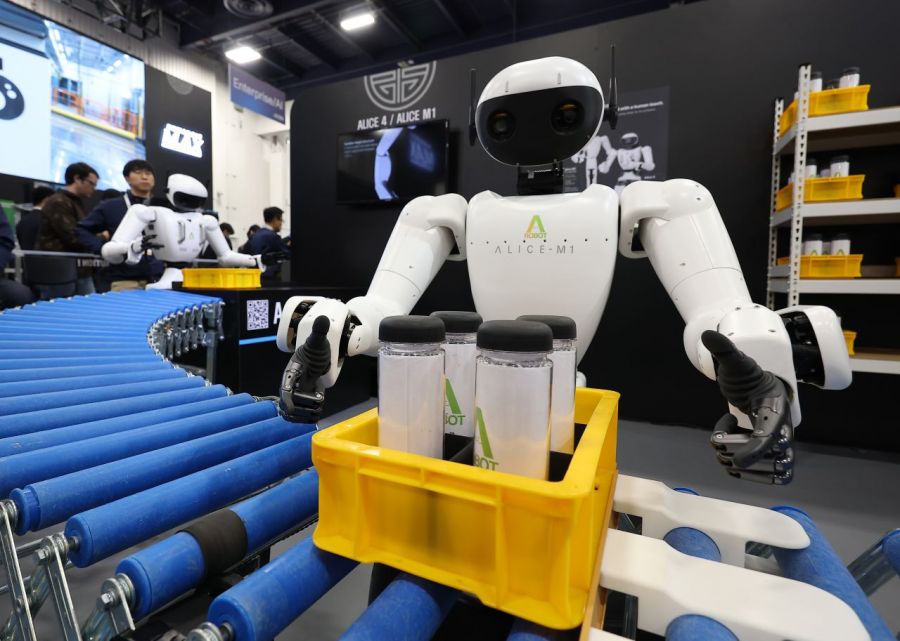 At the Las Vegas Convention Center (LVCC) in Nevada, USA, Airobot, a Korean robotics company, is demonstrating the transportation of goods using its 'Alice' robot. This is a reference photo to aid understanding of the article. Photo by Yonhap News Agency
This council functions as a control tower-type collaboration body that brings together the research capabilities of these institutes in response to the rapidly growing global humanoid market. Its objective is to integrate research efforts that have so far been conducted separately by multiple institutes, in order to rapidly secure technological competitiveness at the national level.
Recently, humanoids have emerged as a flagship area of 'physical AI'-where artificial intelligence is combined with physical robotics-and have become a strategic national technology. In the United States, commercialization is being driven by the private sector, while China is pushing 'embodied AI' as a core national agenda. This reflects an intensifying race for technological supremacy.
In response, the government has selected humanoids as a core mission (proposal) of the 'K-Moonshot'-a national strategic project that seeks to solve 12 key national missions across 8 major areas by combining science, technology, and AI. To support this, the government will fully implement a 'One-Team' system that breaks down silos between research institutes.
To enhance expertise, the council will focus on three core areas: ▲ Intelligence (Brain), ▲ Hardware (Body), and ▲ Data. Initially, it will be comprised mainly of key researchers from government-funded institutes, but will later expand into an open collaborative system that includes academia and industry.
At the meeting, participants finalized plans for the council's operation and held in-depth discussions on establishing and jointly utilizing data, which is crucial for advancing humanoid intelligence. They agreed on the need for each institute to actively share and connect data resources, and to supplement any gaps in key data through new data generation and the establishment of integrated management infrastructure.
The Ministry of Science and ICT stated, "To gain a lead in the global humanoid competition, breaking down barriers between government-funded institutes and consolidating capabilities is of utmost importance," and added, "If there are needs for generating core data or building infrastructure, we encourage you to make proactive proposals."
Starting with this meeting, the Ministry plans to develop detailed action plans for each subgroup and, within the first half of the year, incorporate joint research projects and new business initiatives into its agenda for government-funded institutes.
© The Asia Business Daily(www.asiae.co.kr). All rights reserved.












