"If Included in MSCI Developed Markets Index, 12,000 Is Within Reach"
Still 10% Undervalued Compared to Emerging Markets Index
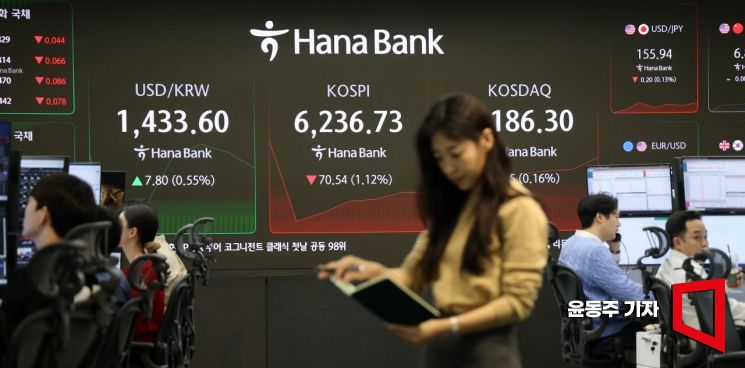 On the 27th, when the KOSPI index started the trading day in a bearish trend for the first time in seven sessions, the exchange rate, KOSPI, and KOSDAQ indices were displayed on the index status board at the Hana Bank dealing room in Jung-gu, Seoul. 2026.02.27 Photo by Dongju Yoon
As the KOSPI surpassed 6,000 points, expectations for further gains are rising. In the securities industry, there is growing belief that not only will the KOSPI settle above 6,000 points, but it might even challenge 8,000 points within the year. The upcoming inclusion of Korea as a "watch list" candidate for the Morgan Stanley Capital International (MSCI) Developed Markets Index in June is seen as an additional catalyst for the KOSPI’s rise. Furthermore, if Korea is officially included in the index next year, some analysts predict the KOSPI could reach as high as 12,000 points.
Impact of Nvidia: KOSPI Drops After Seven Sessions
On February 27, the KOSPI opened at 6,197.49, down 1.74% from the previous trading day. Although the index had risen for six consecutive sessions through the previous day, it is undergoing a correction today. This was influenced by the Nasdaq index falling 1.18% in the overnight New York session.
Nvidia fell by more than 5%, dragging down the overall indices. Although Nvidia reported better-than-expected quarterly results the previous day, investors used this as an opportunity to take profits. The surge in long-term mandatory purchase amounts for memory semiconductors and growing skepticism over overheating in the artificial intelligence (AI) industry are also seen as factors fueling the sell-off.
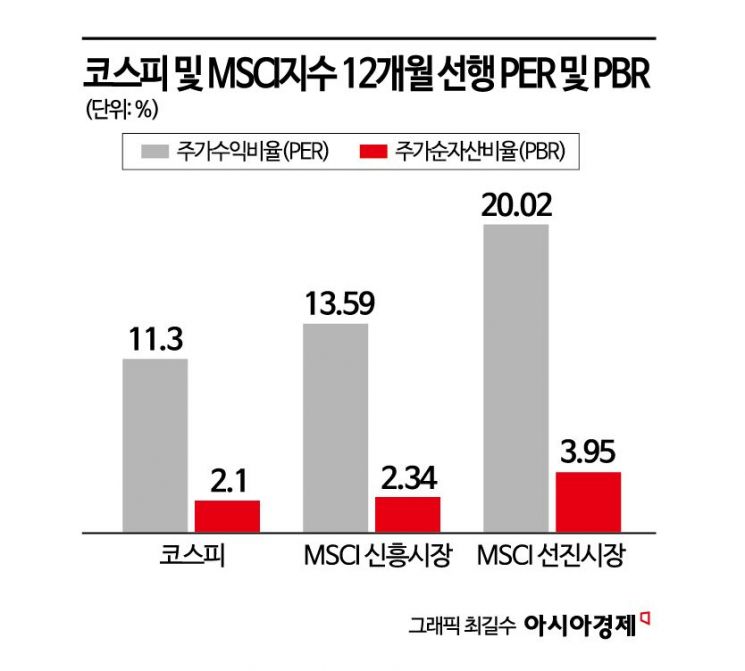
While the KOSPI is undergoing a correction, optimism still prevails in the securities industry. This is due to ongoing earnings improvements in the memory semiconductor sector, including Samsung Electronics and SK hynix, and the fact that the KOSPI’s valuation remains lower than that of developed markets. Domestic and international securities firms estimate that, given this year’s projected net profit for the KOSPI, the 12-month forward price-earnings ratio (PER) will remain at around 11, and the price-to-book ratio (PBR) at around 2.1.
With expectations of undervaluation being resolved, some predict the KOSPI could rise as high as 8,000 points within a year (Nomura). Hana Securities (7,900), J.P. Morgan (7,500), and NH Investment & Securities (7,300) have also successively raised their KOSPI targets.
There are also projections that the target could be raised further if the Korean stock market is successfully included in the MSCI Developed Markets Index. The MSCI Index, managed by global investment bank Morgan Stanley, is a global equity index referenced by institutional investors worldwide to allocate investment funds to different countries. The government is pushing for Korea to be put on the watch list in MSCI’s annual market classification announcement in June this year. If Korea is added to the watch list, a decision on inclusion in the Developed Markets Index could come as early as next year.
Currently, Korea is included in the MSCI Emerging Markets Index. If it enters the Developed Markets Index, massive foreign investment inflows and further index gains can be expected. According to the Korea Economic Research Institute, if Korea is included in the MSCI Developed Markets Index, up to 54.7 billion dollars (78 trillion won) in foreign investment could flow into the market.
If Included in MSCI Developed Markets Index, a 'Big Bang' for the Index
If the KOSPI catches up to the valuation levels of the MSCI Developed Markets Index, its upper limit could easily exceed 10,000 points. The 12-month forward PBR of the MSCI Developed Markets Index is 3.95, while the KOSPI stands at only about half that level. If the KOSPI’s PBR rises to 3.95, the index could theoretically approach 12,000 points.
Even compared to the MSCI Emerging Markets Index, the KOSPI remains undervalued. The 12-month forward PBR for the MSCI Emerging Markets Index is 2.34, but the KOSPI is at 2.1-about 10% cheaper.
Lee Youngwon, a researcher at Heungkuk Securities, emphasized, "Based on the 12-month forward earnings per share (EPS), the valuation of the Korean market remains undervalued, to the extent that it is below the 10-year historical average," adding, "The Korean market is still below not only the developed market average but also the emerging market average, so there is little burden from further upside."
The key to further KOSPI gains lies in semiconductor earnings. The prevailing view is that as long as the improving performance of Samsung Electronics and SK hynix-which are leading KOSPI gains-continues and their share prices keep rising, the KOSPI’s upper limit will open up further.
In particular, Samsung Electronics recently ranked 12th in global market capitalization among listed companies due to its rapid stock price rise. According to CompaniesMarketCap, a U.S. market capitalization ranking site, as of the morning of February 27, Samsung Electronics’ market capitalization, including preferred shares, stood at 1,416 trillion won. Its ranking rose from 14th place last week to 12th in just one week.
The world’s largest market cap is Nvidia, at 6,426 trillion won. Apple is second at 5,741 trillion won, and Alphabet, Google’s parent company, is third at 5,324 trillion won. Among Asian companies, Taiwan’s TSMC is the only one ahead of Samsung Electronics, ranking 6th with a market cap of 2,776 trillion won.
U.S. big tech companies such as Meta (7th), Tesla (9th), and Broadcom (10th) are ahead of Samsung Electronics in market capitalization, while Warren Buffett’s Berkshire Hathaway holds 11th place. As Berkshire Hathaway’s market cap stands at 1,554 trillion won, if Samsung Electronics’ share price rises by just 8-9% more, it could overtake Berkshire Hathaway.
This month alone, Samsung Electronics’ share price has surged by 38%, adding nearly 400 trillion won to its market capitalization. The securities industry expects Samsung Electronics’ earnings to surpass expectations, making further stock price gains likely. Global investment bank Macquarie has set a target price for Samsung Electronics at 340,000 won per share, projecting an increase of over 50% from the current price. Macquarie predicted, "With the spread of AI services, memory semiconductors are gaining prominence, leading to unprecedented increases in DRAM and NAND flash prices," adding, "Samsung Electronics stands to benefit significantly."
Among domestic securities firms, Han Donghee, a researcher at SK Securities, set the highest target price of 300,000 won for Samsung Electronics, emphasizing, "Considering available capacity to meet demand, the recovery of competitiveness in high bandwidth memory (HBM4), and the rebound in foundry utilization rates, Samsung Electronics deserves a revaluation." Ryu Hyungkeun, a researcher at Daishin Securities, also stated, "Taking into account the sharp rise in memory semiconductor prices, we are raising our operating profit forecast for Samsung Electronics this year from 171 trillion won to 201 trillion won and increasing our target price to 270,000 won."
© The Asia Business Daily(www.asiae.co.kr). All rights reserved.













