Production of Standard Memory Falls Amid Surging AI Data Center Demand
Low-End Android Smartphone Manufacturers Face Major Setbacks
Market Share Opportunities Emerge for Apple and Samsung
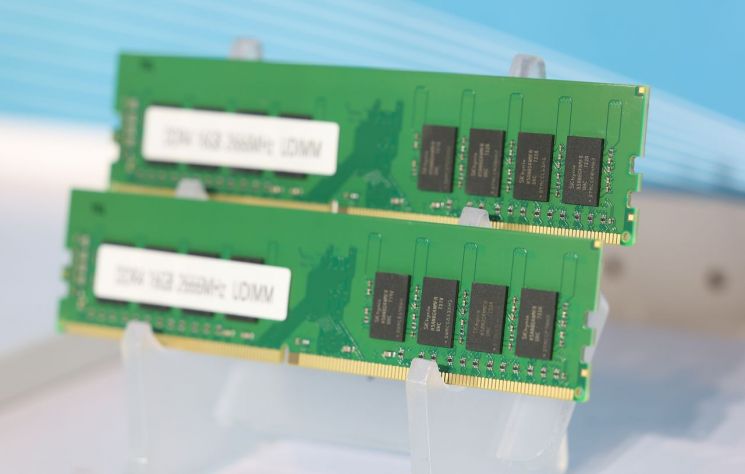 RAM equipped with SK Hynix memory exhibited at CES. There are concerns that the unprecedented memory supply shortage will significantly shrink not only the laptop market but also the smartphone market. Photo by Yonhap News.
It has been forecast that the global smartphone market will contract significantly this year due to the ongoing memory semiconductor supply shortage.
On February 26 (local time), U.S. market research firm IDC announced that smartphone shipments are expected to decrease by 12.9% year-on-year to 1.12 billion units this year. This would represent the lowest level in a decade. IDC also projected that revenue will decline by 0.5%.
IDC identified the increased demand for artificial intelligence (AI) data centers as the primary cause for the decrease in shipments. As manufacturers focus on producing advanced memory to meet AI demand, the supply of standard memory used in smartphones and other devices has become insufficient. IDC explained, "Investment and production are being prioritized for AI memory, which is impacting smartphones and other devices that rely on standard memory."
In particular, IDC expects low-end Android smartphone manufacturers to be hit hardest. Given their low-margin business models, these companies are unlikely to withstand the burden of sharply rising memory prices. IDC noted that while manufacturers will attempt to maintain prices, there is a high likelihood they will not succeed.
As a result, the Middle East and Africa markets, where low-end smartphones are popular, are projected to contract by about 20.6% this year. According to the report, the Chinese market is expected to shrink by 10.5%, while the Asia-Pacific region excluding Japan will see a 13.1% decline. Last year, shipments of low-end smartphones priced below $150 amounted to 360 million units, representing a substantial portion of global shipments. In key emerging markets such as Africa and India, these devices accounted for as much as 60% and 30% of market share, respectively.
There are also projections that low-end smartphone manufacturers may raise prices to above $200 per device in the future. Alternatively, they may downgrade memory specifications to maintain prices while protecting profitability. IDC predicted that the trend of being able to buy better smartphones at lower costs, which has persisted for the past decade, is unlikely to return anytime soon.
In contrast, premium products such as Apple’s iPhone and Samsung Electronics’ Galaxy are expected to further expand their influence. As low-cost phone makers withdraw from the market, there will be opportunities for premium brands to gain market share. IDC stated, "The era of low-cost smartphones is over. Consumers will either continue using their current devices without upgrading or turn to the secondhand smartphone market."
Additionally, IDC pointed to U.S. tariff policy as an added risk factor. According to IDC, the tariff policies of U.S. President Donald Trump introduce uncertainty into the device industry, noting, "A 15% tariff on finished products and components will add to the already rising memory prices and further drive up costs."
The memory supply issue is expected to remain unresolved through next year. IDC concluded, "Even if the supply normalizes, it will be difficult for memory prices to return to last year's levels."
© The Asia Business Daily(www.asiae.co.kr). All rights reserved.












