Pilot launch of cabin optimal temperature control system in May
Seoul Transportation Corporation announced on February 27 that it has declared this year as the first year of implementing its artificial intelligence (AI) transition and will fully push ahead with 28 AI projects across three areas: customer convenience, safety management, and work innovation.
The corporation stated on February 27 that, after launching the “AI Innovation Promotion Team” last year for the first time among all urban rail operators nationwide and introducing initiatives such as smart stations, a simultaneous foreign-language conversation system, and a 24-hour civil complaint response chatbot, it will begin in earnest this year to build an AI-based management environment.
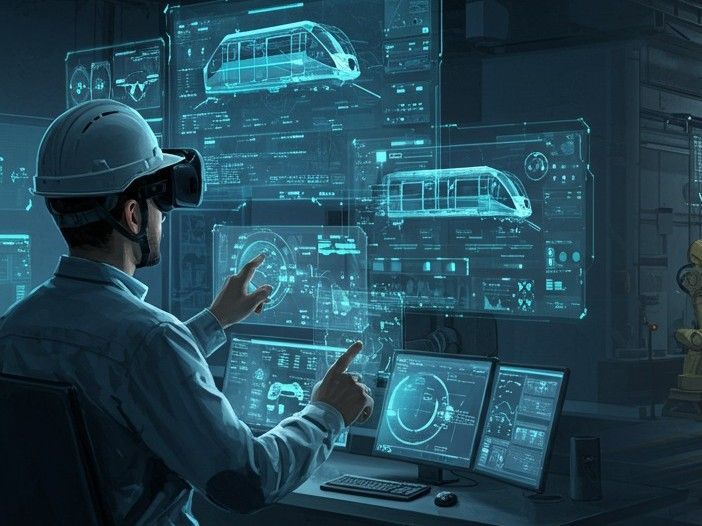 Winning entry of the "AI-Drawn Future Subway" in-house contest held by Seoul Metro in 2025. Provided by Seoul Metro.
Targeting 80% reduction in cooling-related complaints
The corporation handles about 1.1 million civil complaints annually, of which 80% (approximately 880,000 cases) are related to heating and cooling. To resolve this chronic issue, starting in May this year it will pilot an AI-based cabin optimal temperature control system on 26 new train sets on Line 4.
The AI model will analyze temperature data in real time by congestion level, season, day of the week, and time of day, and automatically adjust when to start cooling and at what temperature. Previously, air conditioning only started operating after a certain temperature threshold was exceeded, frequently causing discomfort for passengers, but the new system will enable preemptive cooling operations. The subway station cooling control system will also be optimized to reflect each station’s structural characteristics, with pilot operations set to begin in July.
The speed of handling civil complaints will also improve. The corporation plans to pilot an AI-based automatic complaint distribution system in the second half of the year, under which AI will automatically review the content of each complaint and immediately assign it to the relevant department.
AI for track inspection and congestion management
In the safety management area, 11 projects will be implemented. The deep-learning-based intelligent track inspection advancement project aims to overcome the limitations of nighttime visual inspections by expanding inspection items to include contact wire height, deviation, and wear, as well as sleeper cracks and fasteners.
In addition, the corporation will establish an AI and big-data-based integrated congestion management system for trains and stations, and will introduce a system that analyzes sensor data and closed-circuit (CC)TV footage inside trains in real time to immediately send alerts to the control center in the event of an accident. It will also promote initiatives such as strengthening AI-based responses to cyberattacks, upgrading intelligent CCTV monitoring on Line 7, and developing a model to predict human error by train crew members.
Training 600 AI professionals
In the work innovation area, the corporation will pilot an AI work assistant to support administrative work such as generating draft reports, intelligent search, and document summarization. It will also build a digital platform for employees to share work-related information and plans to link it with AI. To ensure a successful transition, it will train more than 600 AI professionals, including AX leaders.
Han Younghee, Head of Planning at Seoul Transportation Corporation and Acting President, said, “This year, as we fully accelerate AI-based work innovation, will be a critical turning point that will determine the future competitiveness of the Seoul subway,” adding, “We will go beyond merely introducing technology to redesign our organizational culture and ways of working, transform into a future-oriented organization, and deliver tangible changes that citizens can feel in their daily lives.”
© The Asia Business Daily(www.asiae.co.kr). All rights reserved.












