Specific lawful and unlawful cases of generative AI copyright infringement
Acts that substitute the market for original works deemed copyright infringement
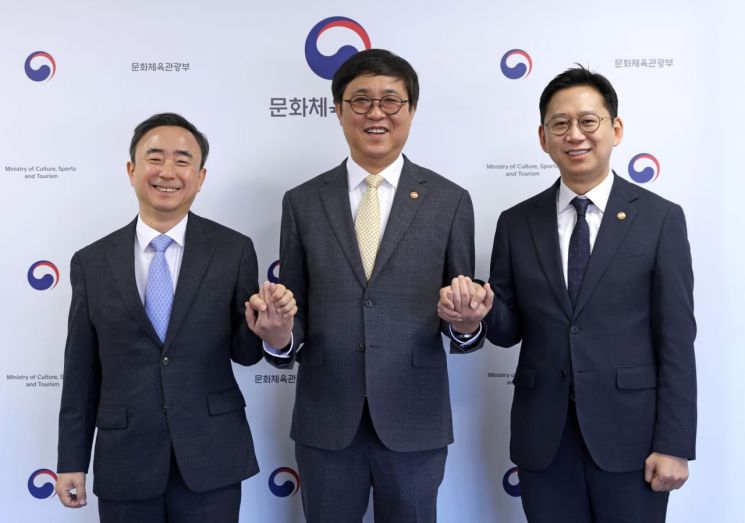 Choi Hwiyoung, Minister of Culture, Sports and Tourism, Bae Kyunghun, Minister of Science and ICT, and Lim Munyoung, Vice Chair of the National Artificial Intelligence Strategy Committee, agreed on the 26th at the National Museum of Modern and Contemporary Art, Seoul, to jointly pursue the regulatory improvements and support programs needed for the mutual growth of the AI and cultural industries.
To prevent copyright disputes that arise when generative artificial intelligence (AI) learns from data, the government has presented concrete examples of lawful and unlawful practices. The "Guidelines on Fair Use under Copyright Law for Learning Works by Generative Artificial Intelligence," published on the 26th by the Ministry of Culture, Sports and Tourism and the Korea Copyright Commission, define acts that substitute the market for original works for commercial purposes as clear copyright infringement.
A representative example is automatically providing a news-summary service by crawling entire news articles without permission from media companies. Because this uses works that contain reporters' interpretations and commentary, it pursues the same or similar purposes as the media outlets' own services. It is not recognized as fair use, because it causes users to consume information without accessing the original articles and thereby directly undermines media companies' subscription and advertising revenues.
Unauthorized collection is not the only criterion. Even if a work has been lawfully purchased with appropriate payment, using it to generate commercial outputs that compete with the original work does not escape the bounds of infringement. The report explains, "If an edtech company purchases hundreds of paid digital textbooks from multiple publishers, trains an AI on them, and then compiles new textbooks or workbooks, it could erode the existing educational publishing market."
Businesses that develop commercial models by collecting high-resolution photos without permission from paid image websites and then generate and sell images based on those models are likewise regarded as illegal. Training on thousands of tracks purchased through music distribution channels and then offering a paid voice-conversion service is also deemed a rights infringement that harms the music market. The same applies when data is collected without authorization for training by circumventing technological protection measures applied by paid platforms, such as watermarks or the robots exclusion standard.
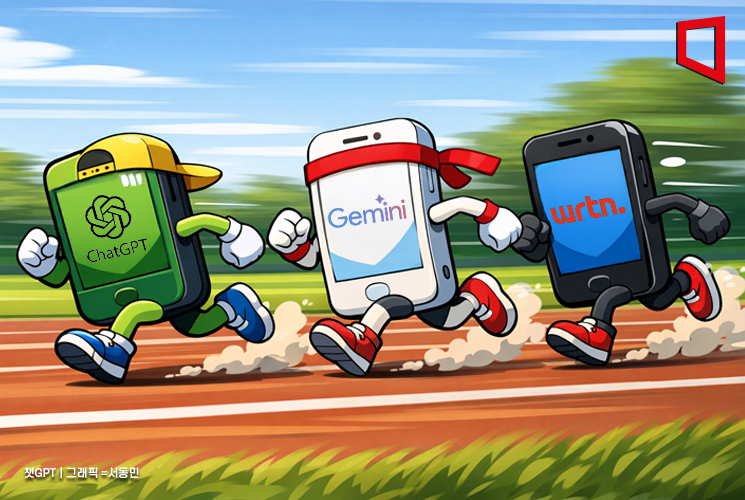
By contrast, uses that create new value distinct from the original work and do not cause harm to the existing market are broadly permitted as fair use. A typical exempt case is nonprofit use by a state-funded research institute that trains a natural language processing (NLP) model on public data to study social inequality.
Collecting open-access papers to develop a model that summarizes scientific and technological research, or using science and engineering papers to study new methods of automatic data analysis, is also treated as lawful. In both cases the full text of the papers is reproduced, but only ideas and data are extracted without imitating the creative expression, so these uses are deemed to serve a transformative purpose.
The same exemption criteria apply to the analysis of video data beyond text. A representative example is using lawfully purchased movies or dramas to analyze criminal movement patterns and develop crime-prevention technologies. The report evaluates that "even if a commercial company develops such tools for profit, as long as the expressive elements of the video are not reproduced and the works function only as objects of analysis, the original works' market is not harmed at all."
© The Asia Business Daily(www.asiae.co.kr). All rights reserved.













