Enshrinement of the Royal Portrait of King Taejo Yi Seonggye... Full-Fledged Move to Make It a Historical and Cultural Asset
Three-Part Ritual Consisting of Historical and Cultural Forum, Goyuje, and Enshrinement Ceremony
Produced as a "Young Taejo," Distinct from the Version Enshrined at Gyeonggijeon Shrine in Jeonju
City Identity to Be Developed as a Historical and Cultural Asset... Plans to Link It with Cultural Tourism
Step-by-Step Discovery of Follow-Up Cultural Projects Based on Research Grounded in Historical Verification
On the 26th, Uijeongbu City in Gyeonggi Province officially announced the completion of the royal portrait of King Taejo through the "2026 Uijeongbu Taejo Royal Portrait Ritual," hosted by the Uijeongbu Cultural Foundation and organized in cooperation with Hoeryongsa Temple of the Jogye Order of Korean Buddhism.
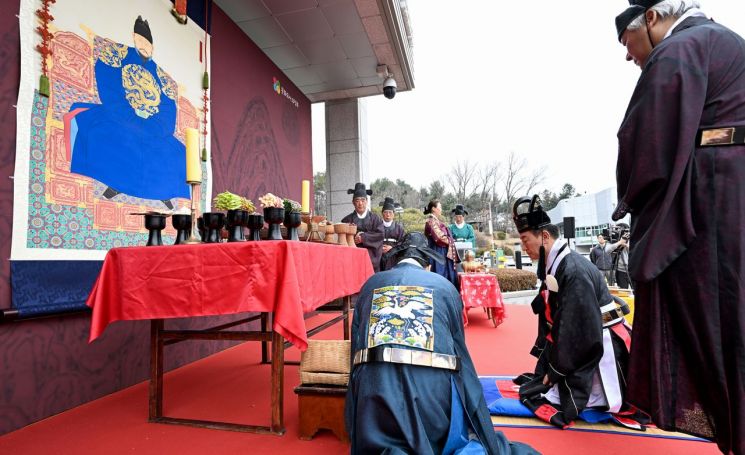 Kim Donggeun, mayor of Uijeongbu City, is attending a goyuje at the main entrance of Uijeongbu City Hall on the 26th to mark the completion of the production of the Taejo royal portrait. Provided by Uijeongbu City
This event was prepared to shed new light on the historical significance of King Taejo Yi Seonggye, who had a deep connection with Uijeongbu, and to use the completion of the royal portrait of Taejo as an opportunity to expand the city's identity into a historical and cultural asset.
The event consisted of three parts. The first part was held at Taejo Hall in Uijeongbu City Hall under the theme "Uijeongbu Historical and Cultural Forum: The Significance of the Reunion of Joseon Taejo and Taejong." Painter Kwon Ochang, who participated in the production of the royal portrait of King Taejo Yi Seonggye, presented a completion report, followed by presentations and discussions highlighting the significance of producing the Uijeongbu Taejo royal portrait. In addition, the Uijeongbu Cultural Foundation announced plans to produce an original musical on the reunion of Taejo and Taejong.
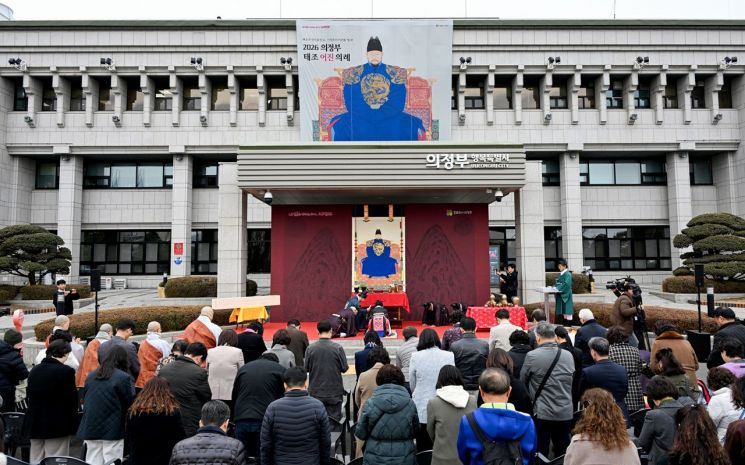 On the 26th, a goyuje ceremony announcing the completion of the production of the royal portrait of Taejo is being held at the main entrance of Uijeongbu City Hall's main building. Photo by Uijeongbu City
The second part of the event was held as a Goyuje at the main entrance of City Hall to announce the completion of the royal portrait of Taejo. A Goyuje is a traditional ritual in which one informs the divine spirits or the sages of the commencement or completion of an important undertaking, and on this day the ritual was solemnly held as a ceremony commemorating the completed royal portrait of Taejo.
After the Goyuje, the royal portrait was moved to Hoeryongsa Temple for the third part of the event. Under the guidance of Venerable Inmuk, a leading authority on Buddhist ritual ceremonies of the Jogye Order of Korean Buddhism, an enshrinement ritual for the royal portrait of Taejo was held at the main hall (Daeungjeon) of Hoeryongsa Temple, bringing the event to a close.
In particular, the ceremony carried added significance as Lee Jun, chairman of the Uichinwang Memorial Association (born in Deoksugung Palace in 1961), the 23rd-generation descendant of King Taejo Yi Seonggye and great-grandson of Emperor Gojong, participated as the second libation officiant (Aheongwan, the role of offering the ceremonial cup during the rite) in his capacity as the eldest grandson of the imperial family and personally offered the ritual wine.
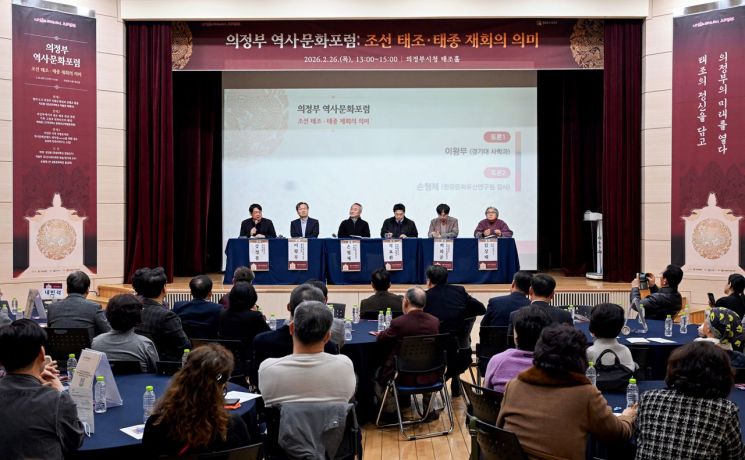 On the 26th, the "Uijeongbu History and Culture Forum: The Significance of the Reunion of Joseon Kings Taejo and Taejong" is being held at Taejo Hall in Uijeongbu City Hall. Provided by Uijeongbu City.
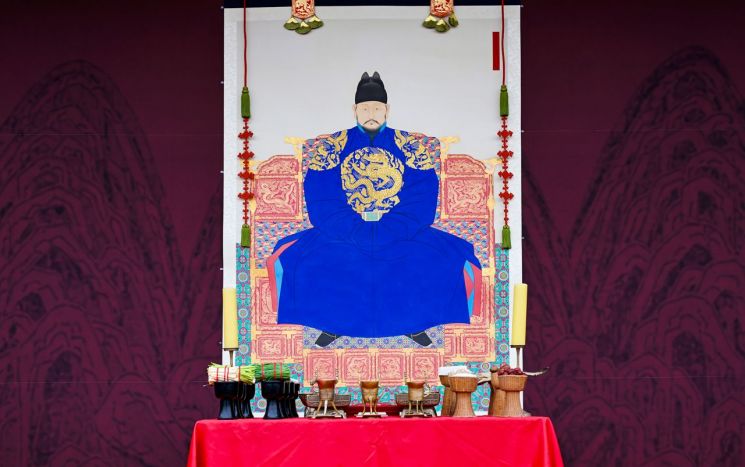
The royal portrait of Taejo unveiled at the event was produced in a different image from the widely known depiction of him as an elderly monarch enshrined at Gyeonggijeon Shrine in Jeonju.
An official from the Uijeongbu Cultural Foundation explained, "With this royal portrait, we sought to embody a historical symbol that harmonizes with the identity of Uijeongbu as a 'young and vibrant city,'" adding, "We reinterpreted King Taejo Yi Seonggye as a figure symbolizing challenge, determination, and dynamism, and, reflecting the dynamic atmosphere of the early days of the Joseon founding, we focused on his appearance at the time of the founding (1392, at age 57), capturing his younger years in the portrait."
Meanwhile, painter Kwon Ochang, who participated in the production of this royal portrait, is a leading authority in the field of spirit tablets and portrait painting. The royal portraits he painted of Seol Chong (designated in 1992), Kim Busik (1993), Jeong Dojeon (1994), Lee Jiham (1998), Gangsu (2003), Kim Yunhu (2003), King Seong of Baekje (2004), Maeng Saseong (2008), Isabu (2011), and King Danjong (2021) have all been designated as standard portraits of the Government of the Republic of Korea.
An official from Uijeongbu City stated, "The identity of Uijeongbu is not established by declaration, but is formed through diligent historical verification efforts and accumulated research," and added, "Taking the production of this royal portrait of Taejo as a starting point, we plan to promote the use of the portrait as cultural and historical material, link it with cultural tourism content, and gradually identify and develop related follow-up projects."
© The Asia Business Daily(www.asiae.co.kr). All rights reserved.














