Korea Real Estate Board Weekly Apartment Price Trends
Previously Soaring Prime Districts Turn Down First
Seoul Apartment Prices Up 0.11%...Pace of Increase Slows
Statistics show that apartment prices in the three Gangnam districts of Seoul and in Yongsan-gu have fallen compared with a week earlier. These areas led last year's rise in home prices in Seoul, and this is the first time in about two years that they have simultaneously turned downward in the weekly data. Despite stringent lending regulations and transaction restrictions last year, prices had steadily climbed, but as market conditions for multiple-home owners have turned unfavorable, the upward trend has stalled and early signs of a downturn are emerging.
According to the weekly apartment price trend data released by the Korea Real Estate Board on the 26th, as of the fourth week of this month (the 23rd), apartment sale prices in Seoul rose 0.11% from a week earlier. After the growth rate reached 0.31% in late January, the weekly increase has been narrowing this month, coming in at 0.27% (first week of February), 0.22% (second week of February), and 0.15% (third week of February).
While the pace of increases has slowed across Seoul overall, it is notable that apartment prices in the three Gangnam districts and Yongsan-gu have actually turned downward. Prices in Gangnam-gu fell 0.06%, Seocho-gu 0.02%, and Songpa-gu 0.03%. Yongsan-gu recorded a 0.01% decline. This is the first time since the first week of February 2024 (the 5th) that all four of these districts have posted negative growth together.
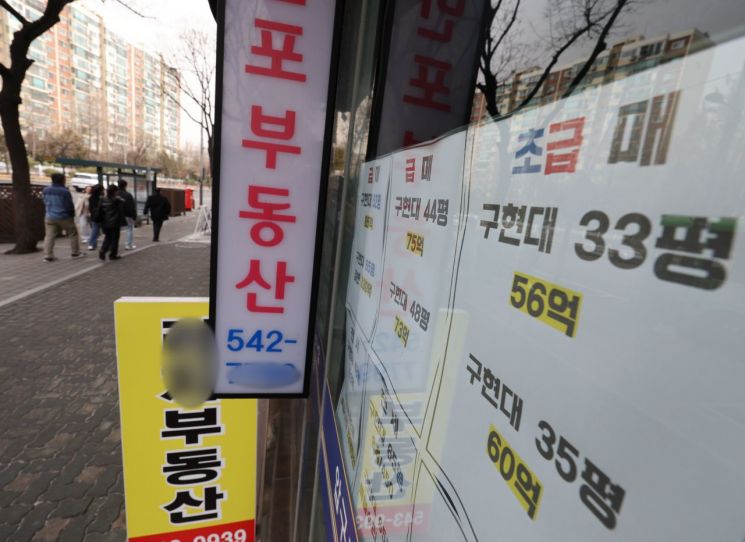 Listings for apartments marked as urgent sale and super-urgent sale are displayed at a real estate agency in Gangnam-gu, Seoul. Yonhap News Agency
In Gangnam-gu, prices fell notably in Daechi-dong and Cheongdam-dong, while in Songpa-gu the declines were concentrated in Bangi-dong and Sincheon-dong. In Yongsan-gu, older apartment complexes in Hannam-dong and Ichon-dong were mainly affected. The Korea Real Estate Board explained, "There is a mixed trend by area and complex, with some complexes seeing transactions concluded at reduced asking prices," adding, "Overall prices in Seoul still rose as demand remained focused on large, highly preferred complexes and those near subway stations."
The three Gangnam districts and Yongsan-gu are cited as the areas that led last year's uptrend in home prices in Seoul. Based on the Board's data, the overall apartment price increase in Seoul last year was around 8.71%. By district, Songpa-gu rose 20.92%, the highest increase among all 25 autonomous districts. Gangnam-gu (13.59%), Seocho-gu (14.11%), and Yongsan-gu (13.21%) also exceeded the citywide average. Concerns over a supply shortage had persisted for several years, and last year the lifting and re-designation of land transaction permit zones, combined with various regulatory measures, exacerbated supply-demand instability and pushed prices higher.
Recently, however, the mood has shifted. President Lee Jaemyung has pledged to restore heavier capital gains taxation on multiple-home owners under the banner of "normalizing the real estate market," and has been sending repeated signals that loan benefits will also be withdrawn. The market expects that, once the heavier capital gains tax on multiple-home owners takes effect from May, tax burdens will surge, prompting some owners to start moving to sell in advance, even if that means lowering their asking prices.
On top of this, the government has formalized plans to overhaul holding taxes, so even if they do not sell, multiple-home owners are highly likely to face higher tax burdens. Although the authorities have yet to present detailed measures on the tax reform, the broad direction is to lower transaction taxes (acquisition tax) while raising holding taxes (property tax and comprehensive real estate tax). Tax benefits from the long-term holding special deduction for non-residents are also expected to be reduced.
In Seoul, with the exception of districts such as Eunpyeong-gu, Yangcheon-gu, and Geumcheon-gu, all areas saw their weekly rate of increase slow compared with the previous week. Gwacheon continued to decline this week (-0.10%) following last week, with the drop widening. Jeonse prices are relatively stable. The weekly increase in Seoul apartment jeonse prices was 0.08%, the same level as a week earlier.
© The Asia Business Daily(www.asiae.co.kr). All rights reserved.












