Business Labor Force Survey for January 2026
Average Monthly Wage per Worker at 4.75 Million Won
Construction Sector Seeing a Narrower Decline in Employment
The number of employees at domestic businesses increased year-on-year in January this year, following an increase in December last year. In manufacturing, the number of employees rebounded for the first time in 28 months. In construction, the number of employees fell for the 20th consecutive month, but the decline narrowed.
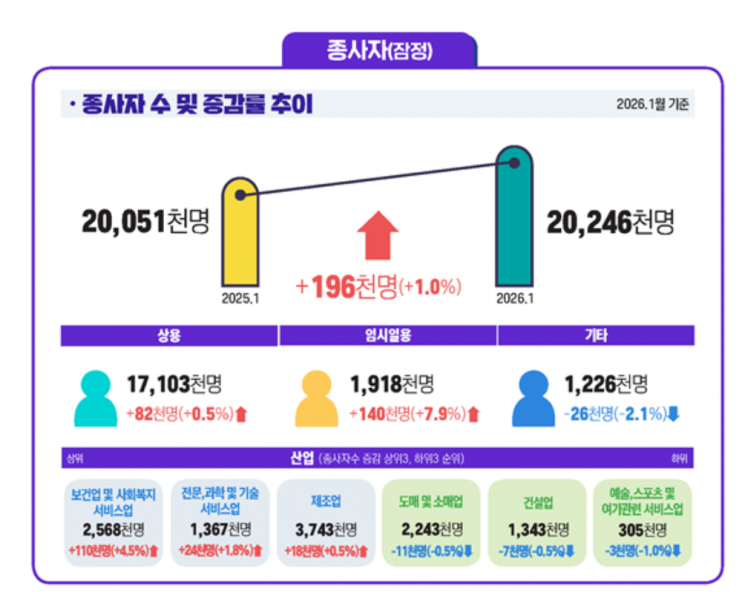
According to the "Business Labor Force Survey for January 2026" released by the Ministry of Employment and Labor on the 26th, the total number of employees at businesses with at least one employee stood at 20,246,000 as of the last business day of January this year. This represents an increase of 196,000 people (1.0%) from the same month a year earlier. The number of employees has been on a modest upward trend since October last year.
By industry, the number of employees in health and social welfare services increased by 110,000 (4.5%) year-on-year, marking the largest gain. Professional, scientific and technical services (24,000 people, 1.8%) and manufacturing (18,000 people, 0.5%) also saw increases. The number of employees in manufacturing returned to growth for the first time in 28 months since October 2023.
In contrast, wholesale and retail trade saw a decrease of 11,000 people (-0.5%), and construction also declined by 7,000 people (-0.5%). Arts, sports and leisure-related services fell by 3,000 people (-1.0%). However, in construction, the scale of the decline has been narrowing since October last year.
Labor mobility indicators for January were mixed. New hires totaled 1,063,000, up 10,000 people (0.9%) from a year earlier, while separations came to 982,000, down 156,000 people (-13.7%). Over the same period, the hiring rate was 5.6%, similar to a year earlier, while the separation rate was 5.2%, down 0.9 percentage points. This suggests that the slowdown in labor market mobility is continuing.
Wages continued to rise. As of December last year, the average monthly total wage per worker at businesses with at least one regular employee was 4.75 million won, up 3.1% (142,000 won) from the same month a year earlier. Real wages, adjusted for price levels, were 4.04 million won, an increase of 0.7% (30,000 won).
The average total wage per worker at businesses with fewer than 300 regular employees was 4.167 million won, up 2.9% (116,000 won), while at businesses with 300 or more employees it was 7.511 million won, up 2.6% (192,000 won).
Working hours increased. Over the same period, the average monthly working hours per employee were 163.2 hours, up 5.4 hours (3.4%) from a year earlier. This reflects the impact of one additional working day in the calendar month.
Meanwhile, according to the Regional Business Labor Force Survey as of October last year, among businesses with at least one employee, the number of employees was highest in Gangnam-gu, Seoul (723,000) and Hwaseong-si, Gyeonggi Province (527,000), and lowest in Ulleung-gun, North Gyeongsang Province (3,800) and Yeongyang-gun, North Gyeongsang Province (4,000).
© The Asia Business Daily(www.asiae.co.kr). All rights reserved.













