Province Launches 6 Billion Won K-Salmon Production Base
Aiming to Become Asia's Largest Salmon Hub
Establishing a System to Produce 2 Million Salmon Fry
Announces Vision and Strategy for the K-Salmon Industry
Gangwon Special Self-Governing Province (Governor Kim Jintae) held a completion ceremony for the “K-Juvenile Salmon Production Center” at the provincial Inland Fisheries Resources Center on the 26th as the first step in establishing a Gangwon-style K-salmon ecosystem.
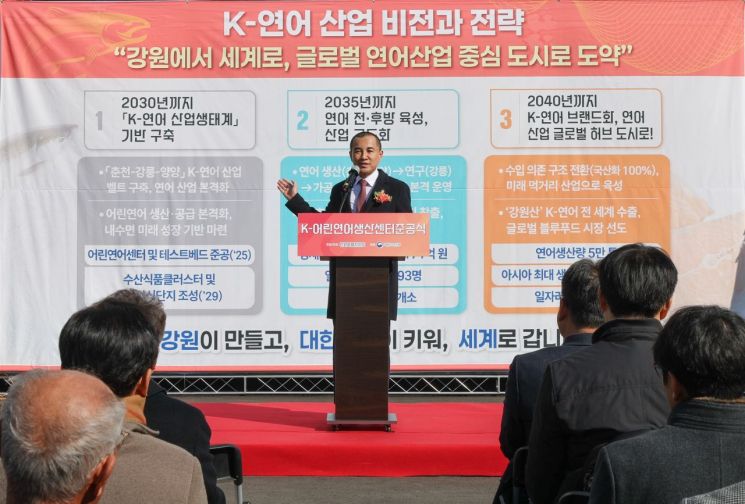 Kim Jintae, Governor of Gangwon Province, is holding the completion ceremony for the "K-Young Salmon Production Center" on the 26th at the provincial Inland Aquatic Resources Center. Provided by Gangwon Province.
About 100 people attended the event, including Governor Kim Jintae, officials from the Ministry of Oceans and Fisheries, related organizations, and provincial assembly members, where the province announced its vision for the K-salmon industry and plans for the full-scale operation of the center.
The K-Juvenile Salmon Production Center is a project with a total budget of 6 billion won (3 billion won from the national government and 3 billion won from the provincial government). It was built after being selected in a public contest for the “Eco-Friendly Aquaculture Promotion Project” organized by the Ministry of Oceans and Fisheries.
The center has a total floor area of 1,599 square meters and consists of two above-ground stories. It is equipped with 7 recirculating aquaculture system modules and 30 rearing tanks, as well as a hatching room, laboratory, and analysis room, and is capable of producing 2 million 5-gram salmon fry per year.
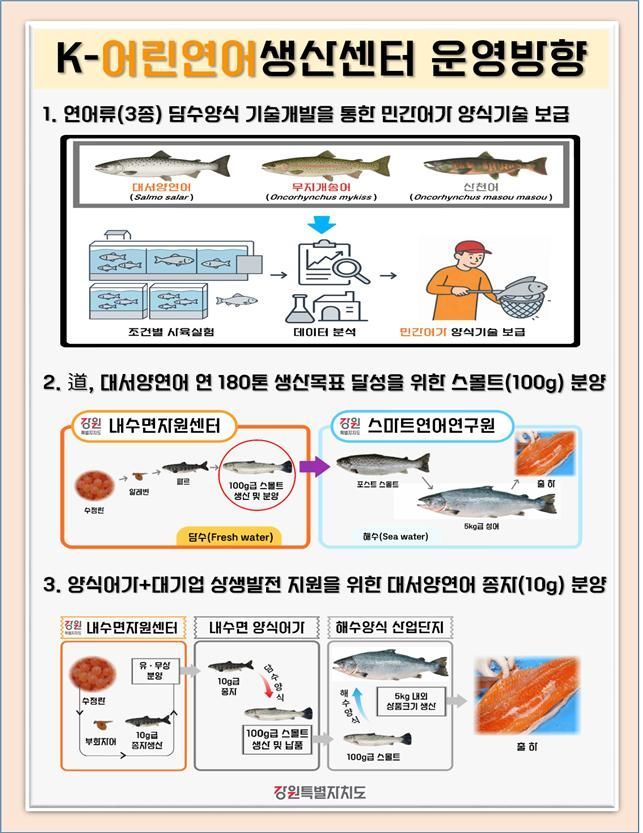
The province plans to establish a step-by-step production system in which healthy salmon fry produced at the center are supplied to inland fish farmers in the province, the fish farmers grow them into 100-gram smolt, and then these are raised to 5-kilogram adult salmon at a marine aquaculture industrial complex before final shipment.
Previously, the province became the first local government in Korea to introduce research-use eyed eggs, achieving a hatching rate of over 97 percent in freshwater and successfully producing juvenile salmon (150-gram grade) in 2023.
Among them, 2,000 fish were transferred to the provincial Hanhaeseong Fisheries Resources Center in Goseong, where they were grown into market-size salmon weighing 5 to 8 kilograms in seawater. The province also laid the foundation for mass production of juvenile salmon by filing and registering four patents, including methods for managing salmon fertilized eggs and hatchlings.
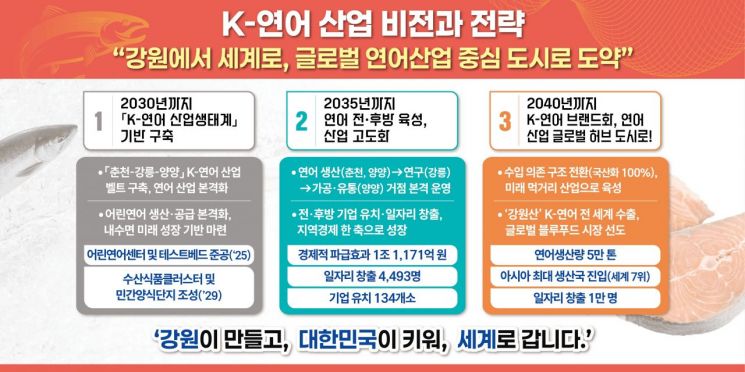
On the same day, the province announced the “K-Salmon Industry Vision and Strategy” with the goal of “From Gangwon to the World: Leaping Forward as a Global Hub City for the Salmon Industry.”
The plan will be implemented in stages: establishing the foundation of the K-salmon industrial ecosystem by 2030; fostering upstream and downstream salmon-related industries and advancing the industry by 2035; and branding K-salmon and emerging as a global hub city for the salmon industry by 2040.
Through this, the province aims to achieve salmon production of 50,000 tons by 2040, grow into the largest production base in Asia, and lead the global blue food market.
Kim Jintae, governor of Gangwon Special Self-Governing Province, said, “Among Gangwon Province’s seven future industries, the salmon industry is establishing itself as the fifth core industry,” adding, “Just as salmon are born in rivers, go out to sea, and then return to rivers over their life cycle, the salmon industry will also follow a full-cycle collaborative structure in which the public sector first lays the groundwork, and later fish farmers and companies participate together.”
He continued, “Without this Juvenile Salmon Production Center, the Gangneung-Yangyang seafood cluster could not exist,” and added, “We will do our utmost to foster a Gangwon-style K-salmon industry, including passing the preliminary feasibility study for the seafood cluster.”
© The Asia Business Daily(www.asiae.co.kr). All rights reserved.














