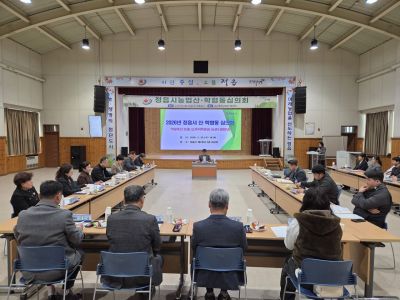
 Jeongeup City held the "Jeongeup City Agriculture Industry-Academia Cooperation Deliberation Council" on the 25th at the main auditorium of the Agricultural Technology Center Building No. 2, where it reviewed and finalized the selection of project beneficiaries to be implemented this year. Provided by Jeongeup City
Jeongeup City has finalized the selection of recipients for 51 customized agricultural pilot projects, into which a total of 6.3 billion won will be invested, to enhance the future competitiveness of its agriculture, and has begun full-scale support.
Jeongeup City announced that on the 25th it held the "Jeongeup City Agricultural Industry-Academia Cooperation Deliberation Committee" at the main auditorium of the Agricultural Technology Center's Annex Building No. 2, where it rigorously reviewed and made final selections of the project recipients to be implemented this year. Twenty deliberation committee members, including city council members, officials from the National Agricultural Cooperative Federation, university professors, and heads of farmers' organizations, attended the meeting. The committee members examined the suitability and feasibility of the projects proposed by the applicant farms, as well as their potential ripple effects, from multiple perspectives.
The 51 pilot projects to be carried out this year are organized with a focus on disseminating the latest agricultural technologies, fostering professional farmers, and supporting agricultural product processing technologies. Looking at the details by sector, 16 projects will be implemented in the food and livestock sector, including the creation of base complexes for producing seeds of new varieties of food crops.
In the income crop sector, 12 projects are included, such as pilot projects for ecological integrated management to increase the productivity of horticultural crops. In addition, the rural society sector will see the largest number of projects, with 23 initiatives allocated, including support for young farmers to introduce advanced farming technologies, which is expected to inject new vitality into local agriculture.
The head of the Agricultural Technology Center emphasized, "The core of these pilot projects is to help the selected farms stably establish new technologies in the field," adding, "We will further strengthen close on-site guidance until the projects are successfully completed, and we will actively resolve the difficulties faced by farms so that this leads to tangible increases in their income."
© The Asia Business Daily(www.asiae.co.kr). All rights reserved.












