February Statement on the Direction of Monetary Policy
After freezing the base rate at 2.50% per annum on the 26th, the Monetary Policy Board of the Bank of Korea stated, "While the inflation rate is maintaining a stable trajectory near the target level, growth is expected to continue a better-than-expected improvement, and risks from the perspective of financial stability are also persisting," adding, "We judged it appropriate to maintain the current level of the base rate while monitoring domestic and external policy conditions." The decision was made unanimously by all seven members of the Monetary Policy Board.
In the statement on the Monetary Policy Board meeting on the direction of monetary policy, which was released in the morning of the same day, the Bank of Korea said, "Going forward, although sluggish construction investment is expected to continue, the recovery in private consumption will likely be sustained, and the increases in exports and facility investment will also be greater than initially expected, supported by the favorable semiconductor cycle and solid global economic growth."
However, it noted, "This growth path is subject to both upside and downside risks related to the semiconductor cycle and the pace of domestic demand recovery, the monetary and fiscal policies of major countries and U.S. tariff policy, as well as geopolitical risks."
In its economic outlook released that day, the Bank of Korea raised this year's growth forecast to 2.0%, while lowering next year's growth forecast to 1.8%. In its economic outlook last November, the Bank of Korea had projected growth of 1.8% for this year and 1.9% for next year.
This year's forecast for consumer price inflation was revised up by 0.1 percentage point from the November projection to 2.2%. Next year's inflation forecast was kept unchanged at 2.0%. The Monetary Policy Board stated, "This year, the inflation rates for both headline and core consumer prices are expected to slightly exceed the November projections (2.1% and 2.0%, respectively), due to cost pressures on some items such as electronic devices," and added, "The future inflation path is expected to be affected by movements in international oil prices and the exchange rate, domestic and global economic conditions, and the government's price stabilization measures."
Regarding financial stability, which was a factor behind the rate freeze, it said, "The won-dollar exchange rate fluctuated, affected by supply and demand pressures such as residents' overseas securities investment and foreign investors' stock selling, as well as movements in neighboring currencies including the yen, before recently falling significantly," and added, "Stock prices have continued a marked upward trend, supported by expectations of strong earnings in major sectors and improvements in capital market regulations, but volatility has increased in line with global equity market movements."
On household lending, it explained, "Household loans recorded only a slight increase, as the government continued to strengthen its macroprudential policy stance, and although housing prices in the Seoul metropolitan area have seen their upward trend slow due to government measures, it is necessary to continue to closely monitor future developments."
The Monetary Policy Board said, "In the domestic economy, although the inflation rate is expected to rise slightly, it is projected to maintain a stable trajectory near the target level, and growth is expected to continue its improving trend. From the perspective of financial stability, it remains necessary to pay close attention to risks related to housing prices in the Seoul metropolitan area, household debt, and the impact of exchange rate volatility," adding, "Going forward, monetary policy will be managed in a way that supports the recovery of growth momentum, while carefully assessing changes in domestic and external policy conditions, the resulting inflation trends, and financial stability conditions in the process."
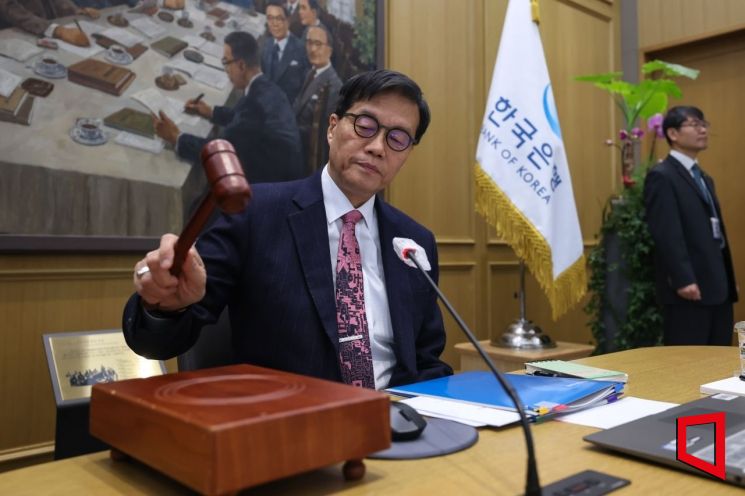 Lee Changyong, Governor of the Bank of Korea, struck the gavel at the Monetary Policy Board meeting held at the Bank of Korea headquarters in Jung-gu, Seoul on Feb. 26, 2026. Photo by Joint Press Corps
The full text of the statement on the Monetary Policy Board meeting on the direction of monetary policy is as follows.
The Monetary Policy Board decided to conduct monetary policy by maintaining the Bank of Korea Base Rate at the current level of 2.50% until the next decision on the monetary policy stance. While the inflation rate is maintaining a stable trajectory near the target level, growth is expected to continue a better-than-expected improvement, and risks from the perspective of financial stability are also persisting. Accordingly, the Board judged it appropriate to maintain the current level of the base rate while monitoring domestic and external policy conditions.
The global economy is expected to continue a solid growth trend, supported by increased investment related to artificial intelligence and expansionary fiscal policies in major countries, despite uncertainties surrounding U.S. tariff policy, while the inflation path is likely to differ across countries. In the global financial markets, overall risk-off sentiment has somewhat strengthened. Long-term government bond yields rose, affected by concerns over fiscal soundness in major economies and changing expectations regarding the U.S. Federal Reserve's monetary policy, before subsequently declining, while the U.S. dollar weakened due to factors such as yen appreciation and a U.S. Supreme Court ruling invalidating reciprocal tariffs. Stock prices have generally continued to rise, reflecting improved corporate earnings, but volatility has increased due to concerns over excessive AI investment and the potential displacement of existing industries. Going forward, the global economy and international financial markets are expected to be affected by changes in the monetary and fiscal policies and trade environments of major countries, developments in AI investment, and the evolution of geopolitical risks.
The domestic economy has continued to improve, supported by a recovery in private consumption and strong exports. Employment has continued to increase, mainly in the services sector. Looking ahead, although sluggish construction investment is expected to persist, the recovery in private consumption will likely be sustained, and the increases in exports and facility investment are expected to be greater than initially projected, supported by the favorable semiconductor cycle and solid global economic growth. As a result, this year's growth rate is expected to reach 2.0%, exceeding the 1.8% projection made last November. However, this growth path is subject to both upside and downside risks related to the semiconductor cycle and the pace of domestic demand recovery, the monetary and fiscal policies of major countries and U.S. tariff policy, as well as geopolitical risks.
Regarding prices, the consumer price inflation rate fell to 2.0% in January, due to factors such as a slowdown in the pace of increases in prices of petroleum products and agricultural, livestock, and fisheries products, while the core inflation rate (excluding food and energy) remained at 2.0%, the same as the previous month. The short-term inflation expectations of the general public stood at 2.6%, unchanged from the previous month. This year, the inflation rates for both headline and core consumer prices are projected to be 2.2% and 2.1%, respectively, slightly exceeding the November projections (2.1% and 2.0%) due to cost pressures on some items such as electronic devices. The future inflation path is expected to be affected by movements in international oil prices and the exchange rate, domestic and global economic conditions, and the government's price stabilization measures.
In the financial and foreign exchange markets, volatility in key price variables has increased. The won-dollar exchange rate fluctuated, affected by supply and demand pressures such as residents' overseas securities investment and foreign investors' stock selling, as well as movements in neighboring currencies including the yen, before recently falling significantly. Stock prices have continued a marked upward trend, supported by expectations of strong earnings in major sectors and improvements in capital market regulations, but volatility has increased in line with global equity market movements. Yields on Korean Treasury bonds rose significantly due to weakened expectations of interest rate cuts and supply and demand pressures stemming from money moves, before partially retracing. Household loans recorded only a slight increase, as the government continued to strengthen its macroprudential policy stance, and although housing prices in the Seoul metropolitan area have seen their upward trend slow due to government measures, it is necessary to continue to closely monitor future developments.
The Monetary Policy Board will continue to conduct monetary policy with a view to ensuring that the inflation rate stabilizes at the target level over the medium term, while paying close attention to financial stability, as it assesses the pace of economic growth. In the domestic economy, although the inflation rate is expected to rise slightly, it is projected to maintain a stable trajectory near the target level, and growth is expected to continue its improving trend. From the perspective of financial stability, it remains necessary to pay close attention to risks related to housing prices in the Seoul metropolitan area, household debt, and the impact of exchange rate volatility. Accordingly, going forward, monetary policy will be managed in a way that supports the recovery of growth momentum, while carefully assessing changes in domestic and external policy conditions, the resulting inflation trends, and financial stability conditions in the process.
All seven members of the Monetary Policy Board voted in favor of the decision to keep the base rate unchanged this time.
© The Asia Business Daily(www.asiae.co.kr). All rights reserved.












