On Nvidia's strong earnings, Samsung Electronics and SK Hynix hit fresh record highs
Government-led push for corporate governance reform seen as another driver of further KOSPI gains
Rally in semiconductors spreads warmth to other sectors such as au
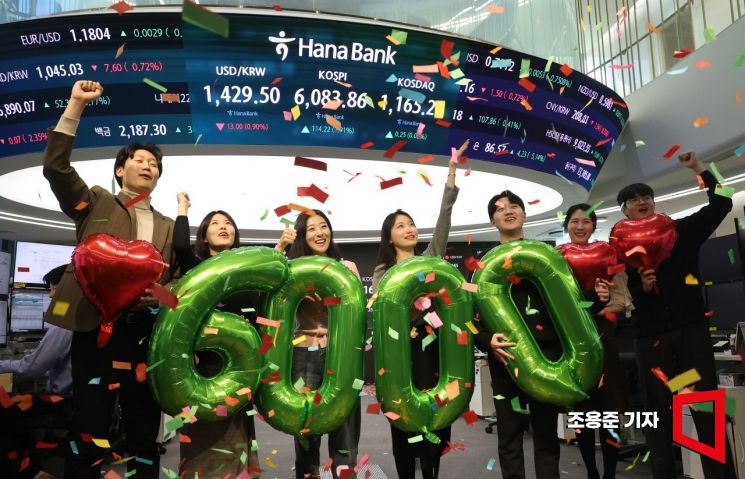 Employees celebrate in the dealing room at Hana Bank's head office in Jung-gu, Seoul, on the 25th as the KOSPI closed above 6,000 for the first time in history. The KOSPI index closed at 6,083.86, up 114.22 points (1.91%) from the previous session. Feb. 25, 2026 Cho Yongjun, Reporter
As the KOSPI has rapidly broken through the 6,200-point mark, expectations are rising that it could reach 7,000 points. The securities industry projects that continued profit growth in semiconductors, along with corporate governance restructuring and sector rotation, will push the index higher.
Strong Nvidia earnings lift Samsung Electronics and SK Hynix again
On the 26th, the KOSPI opened at 6,121.03, up 0.61% from the previous session, and then extended its gains to reach 6,200.93 as of 9:47 a.m., up 1.92%. After breaking through 6,000 points for the first time the previous day, it surpassed 6,200 points for the first time on this day.
Overnight gains on the New York stock market also affected the KOSPI. On the 25th (local time), the Dow Jones Industrial Average rose 0.63% from the previous session, and the Nasdaq Composite jumped 1.26%. Ahead of Nvidia's earnings release, artificial intelligence (AI) and semiconductor-related stocks showed an upward trend.
After the New York market closed, Nvidia's earnings beat market expectations, giving additional momentum to semiconductor stocks on the Korean market. Samsung Electronics broke through an intraday all-time high of 210,000 won, and SK Hynix climbed to a record high of 1,062,000 won.
Securities firms expect the earnings of Samsung Electronics and SK Hynix to improve further from current levels and their share prices to continue rising. Global investment bank Macquarie raised its target prices for Samsung Electronics and SK Hynix the previous day to 340,000 won and 1,700,000 won, respectively. These are the highest target prices among domestic and foreign brokerages. Macquarie projected that "memory semiconductors have come to the fore with the spread of AI services, and as a result, DRAM and NAND flash prices will see an unprecedented surge."
As the share prices of Samsung Electronics and SK Hynix climb, expectations are also growing that the KOSPI will break through 7,000 points. Nomura Financial Investment has suggested an upper band of 8,000 for the KOSPI, while Hana Securities (7,900), JPMorgan (7,500), NH Investment & Securities (7,300), Kiwoom Securities (7,300), and Korea Investment & Securities (7,250) have also raised their KOSPI targets.
Yang Ji-hwan, head of research at Daishin Securities, said, "Earnings forecasts for semiconductors are being revised upward, and the government is providing substantial policy support to revitalize the stock market, so there is ample room for further gains in the KOSPI," adding, "It is also positive for the market that short-term negative factors are limited, such as the easing of tariff risks from Trump."
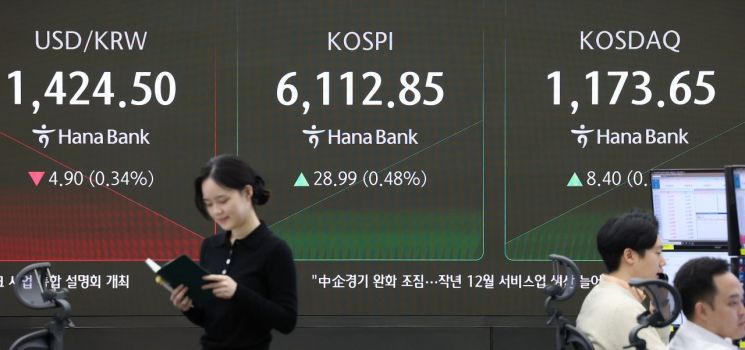
Corporate governance reforms and sector rotation as additional drivers for the market
The securities industry also cites corporate governance restructuring and sector rotation, in addition to semiconductors, as other key drivers of the market rally. In Japan’s case, the stock index experienced a more than two- to three-fold surge in the past through corporate governance reforms, and there are projections that a similar process will unfold in Korea. Historically, Japanese companies hoarded large amounts of cash yet were stingy with dividends, and they maintained a closed structure by holding cross-shareholdings among companies to defend management control.
To break this, the Shinzo Abe administration introduced two key guidelines in 2014. One was the Stewardship Code, which forces institutional investors to raise their voices as shareholders by setting guidelines for the exercise of voting rights, and the other was the Corporate Governance Code, which expands the proportion of outside directors and emphasizes capital efficiency (ROE). Thanks to these guidelines, the perception that companies belong to their shareholders became widespread for the first time in the Japanese stock market.
The Tokyo Stock Exchange also contributed to revitalizing the market. In 2023, the Tokyo Stock Exchange pressured listed companies with a price-to-book ratio (PBR) of below 1 to disclose concrete plans to raise their share prices. A PBR below 1 means that a company’s share price is lower than the value of its assets, which the Tokyo Stock Exchange regarded as "management negligence." In response, major Japanese companies such as Toyota and Sony rushed to announce share cancellations and dividend hikes, sending their share prices sharply higher.
As efforts by the government and the exchange continued, the Nikkei index, which was in the 14,000-point range in 2014, has now soared to 58,000 points, more than quadrupling. In Korea as well, amendments to the Commercial Act are underway, led by the government and the ruling party, while the Financial Services Commission and the Korea Exchange are announcing various market-boosting measures, including the delisting of zombie-listed companies.
Expectations are also growing for sector rotation into other industries such as securities, automobiles, shipbuilding, and defense. Some securities stocks, including Mirae Asset Securities, have more than doubled in just one month. This reflects expectations that securities firms’ earnings will improve in line with the stock market rally. Hyundai Motor has also seen its share price surge on rising expectations for new technologies such as robotics and autonomous driving.
Lee Hyosub, senior research fellow at the Korea Capital Market Institute, emphasized, "Beyond semiconductors, earnings forecasts in other sectors are also being continuously revised upward, which is driving the rise in the KOSPI," adding, "It is a positive sign that the chronic undervaluation of our stock market is being resolved."
© The Asia Business Daily(www.asiae.co.kr). All rights reserved.