Limited Perceived Differentiation to Drive Switching
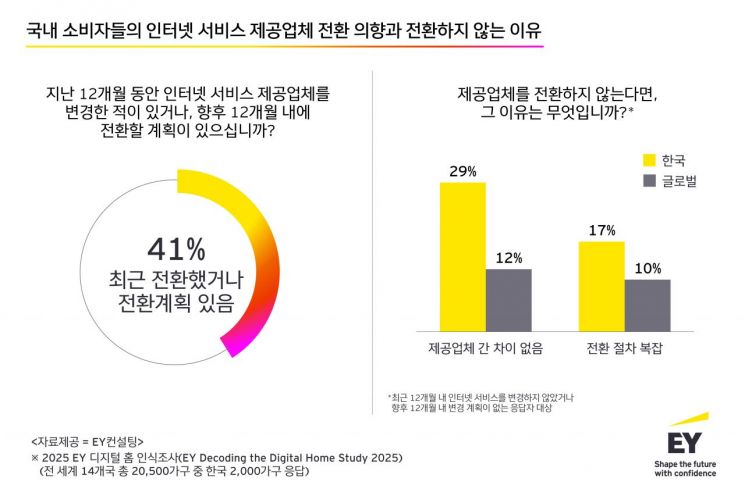
Four out of ten consumers in Korea are willing to switch their Internet Service Provider (ISP). However, many respondents said they do not feel a significant difference between providers, indicating a gap between their intention to switch and their actual behavior.
EY Consulting, the consulting arm of the global accounting and consulting firm EY Korea, announced on the 26th the Korea results of its latest annual "EY Decoding the Digital Home Study." The survey examined consumer perceptions of digital services such as internet, mobile networks, and content streaming services, targeting a total of 20,500 households in 14 countries including North America, Europe, and Australia, among them 2,000 households in Korea.
The proportion of Korean consumers who said they had changed their ISP in the past year or planned to do so in the future reached 41%. The main reason for considering a switch was cost savings (39%). More than half of respondents also felt burdened by monthly fee increases, both for internet (55%) and streaming services (60%).
Despite this growing price burden, 59% of respondents said they had not changed providers recently and had no plans to do so. Among them, 29% cited "no difference between providers" as the reason. As consumers do not perceive clear differentiation between providers in terms of pricing plans, service bundles, and content, the level of perceived differentiation that would actually drive switching appears to be limited.
Meanwhile, the Korean market showed distinct characteristics in content consumption patterns. Among Korean consumers, 30% preferred video-based platforms such as YouTube as their primary content channel, more than double the global average of 13%. This is interpreted as reflecting a tendency among consumers, even in an environment where multiple online video services (OTT) compete, to consume a wide variety of content such as news, reviews, summaries, and short-form videos in an integrated way on a single platform.
Korean consumers' receptiveness to new technologies such as artificial intelligence (AI) also exceeded the global average. The share of respondents who perceived AI functions to be useful when using content and internet services averaged 53%, 10 percentage points higher than the global figure of 43%. In particular, 62% viewed AI-based smartphones as useful, a gap of 12 percentage points compared to the global average of 50%.
Regarding low-Earth-orbit (LEO) satellite-based internet services, which are attracting attention as a next-generation internet option, 48% of respondents said they would be willing to replace their existing fixed-line internet if certain conditions were met, confirming an openness to adopting new technologies.
However, 60% still said they prefer human agents when dealing with service disruptions or problem resolution. Despite the expansion of technology-based services, consumers were shown to value trust and direct communication at critical problem-solving stages.
Lee Donghyun, Head of Digital Innovation at EY Consulting and Technology, Media and Telecommunications Industry Leader for EY Asia East, said, "Korea's digital home market is a highly mature market where both receptiveness to new technologies and expectations for services are high," adding, "Even as consumers become more price-sensitive, telecommunications and content companies need a strategic approach that goes beyond simple price and terms competition, focusing instead on consistent user experiences and trust."
© The Asia Business Daily(www.asiae.co.kr). All rights reserved.












