Lower Share Than Advanced Economies... Ample Room for Growth
Strategic Nurturing at the National Level... "Need to Learn from Japan and Singapore"
 Foreigners choosing cosmetics at an Olive Young store in Seoul on November 24 last year. Photo by Yonhap News
The number of foreign tourists visiting Korea last year surpassed pre-COVID-19 pandemic levels and hit an all-time high. Analysts say that tourism should be actively nurtured as a key national strategic industry that drives the overall economy and revitalizes regional economies.
On the 26th, Samil PwC published a report titled "Tourism Industry Development Strategy: The Next Growth Engine of the Korean Economy" containing this analysis.
Tourism as a New Growth Engine Amid Protectionism
The report diagnosed that as global protectionism intensifies and a survival-of-the-fittest environment deepens, the existing growth model centered on manufacturing and exports has reached its limits. It stressed that for the Korean economy to escape low growth and achieve balanced development between regions, as well as balanced growth between exports and domestic demand, a strategic advancement of the service industry is necessary.
The report stated, "As the spread of K-culture, the weak won, and the improvement in Korea-Japan relations combine to create positive spillover effects, optimal conditions are being created for fostering the tourism industry," adding, "The tourism industry can serve as a key growth engine within the service sector."
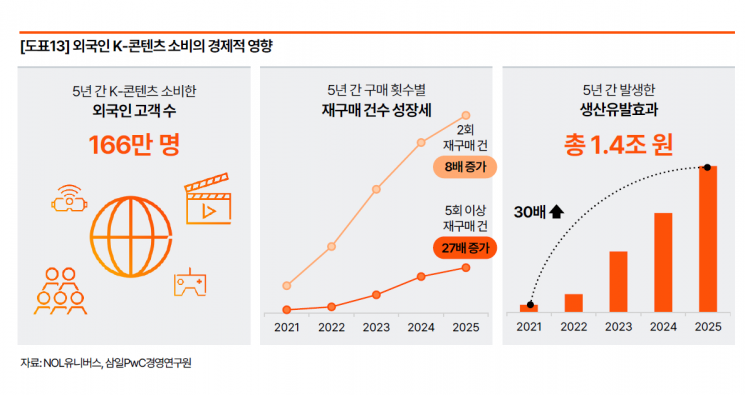
This also implies that the Korean tourism industry still has shortcomings despite its growth potential. The report pointed out that although Korea has competitiveness such as the influence of K-culture and unique cultural heritage, it faces structural limitations, including a relatively low economic contribution compared with the global average, a concentration of tourists in Seoul, and insufficient convenience infrastructure for foreign tourists.
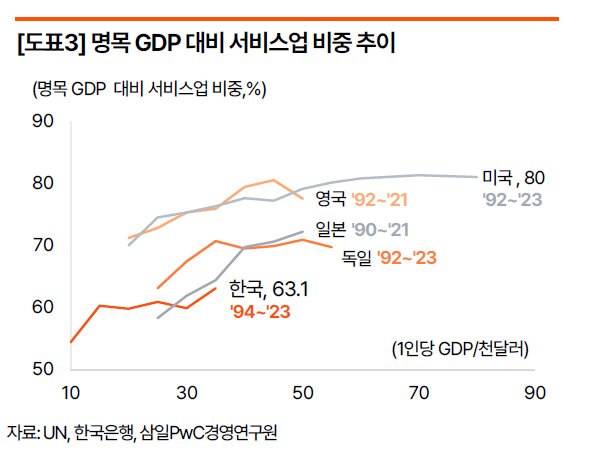
According to the report, Korea’s economic contribution from the service industry is relatively low compared with other countries. Since the 2000s, the share of the service industry in nominal gross domestic product (GDP) has risen to the 60% range, but this remains low compared with advanced economies, where the figure stands at 70-80%.
Need to Benchmark Japan and Singapore
The report analyzed global tourism trends and presented successful overseas cases such as Japan and Singapore as benchmarks. It cited Japan and Singapore as cases where tourism has been nurtured as a national strategic industry with tangible results, and pointed to Japan and Spain as examples that have successfully dispersed tourist demand across regions and revitalized local economies.
In Japan’s case, after defining tourism in 2003 as the "third growth engine," the Abe administration in 2012 actively supported the tourism industry as a strategic industry. The Singaporean government also incorporated tourism into the category of national growth industry policy through its "Tourism 2015" initiative in 2005, under which it developed integrated resorts and legalized casinos.
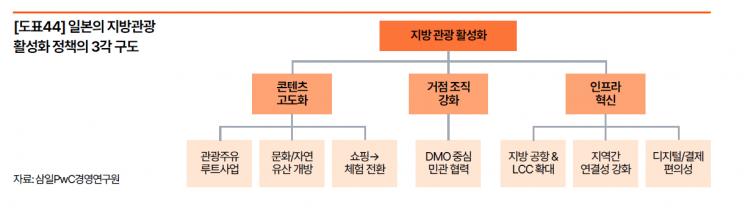
The report also stated that public-private cooperation and linkage with other industries are essential for tourism industry growth, and evaluated Singapore’s policies, which systematically build and operate such collaborative frameworks, as a representative case.
In addition, the report concluded that fostering high value-added tourism is necessary to expand the tourism industry’s economic contribution. It explained that Korea should develop high value-added tourism segments characterized by longer stays and higher per-capita spending. Sectors that typically involve longer stays and larger spending include MICE (meetings, incentives, conferences, and exhibitions), wellness and resort tourism, medical tourism, and education. In particular, the medical tourism market has grown rapidly since COVID-19, reaching the 2 trillion won level in 2025, which is 5.3 times larger than in 2019. However, the report cited the high proportion of cosmetic and plastic surgery treatments and the severe concentration in Seoul as challenges that must be addressed.
Urgent Need for Active Nurturing at the National Level
The report stressed that for Korea’s tourism industry to make a qualitative and quantitative leap, tourism must be redefined as a national strategic industry and more active promotion policies are required. It argued that, in line with the government’s stance on balanced regional development, regional tourism industries should be systematically managed and developed. To this end, it highlighted the importance of strengthening the role of destination management organizations (DMOs), which serve as regional-level implementation bodies.
It also proposed the need to foster high value-added tourism, develop unique Korean content, carry out strategic marketing, improve the user-friendliness of tourism infrastructure, and utilize artificial intelligence (AI) across the tourism industry. The full report is available on the Samil PwC website.
Yu Okdong, a public sector partner at Samil PwC, said, "In overseas cases where countries have succeeded in becoming tourism powerhouses, a common factor is that they promoted tourism as a strategic industry at the national level," adding, "Korea must reinvent itself as a major tourism destination through policy support from the government, active content development, and improved convenience in using tourism infrastructure."
© The Asia Business Daily(www.asiae.co.kr). All rights reserved.














