Elderly Lining Up at Tapgol Park for "Free Meals"
Poverty-Rate Improvement Is a Statistical Illusion as Baby Boomers Join In
"Do Not Lump All Seniors into One Group; Detailed Policies Are Needed"
"Hurry up and grab your lunch tickets before they run out!"
At around 7:00 a.m. on the 20th, in the alley in front of the East Gate of Tapgol Park in Jongno-gu, Seoul, 75-year-old Mr. Seo, whose hair had turned white, held up a paper ticket marked "No. 29" and a red sticker marked "No. 91" while pushing the person in front of him forward. They were two free meal tickets. Behind him, a long line of elderly people waiting for breakfast stretched from the North Gate all the way along the wall by the West Gate.
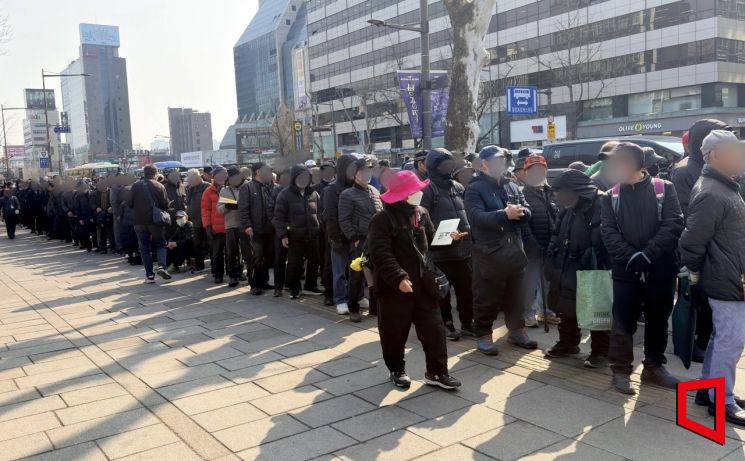 Around 11:20 a.m. on the 20th, elderly people were lining up in front of the Samilmun gate at Tapgol Park in Jongno-gu, Seoul to receive free lunch boxes. Photo by Lee Jiye
The day of the seniors at Tapgol Park flows along what they call a "three-meal map." If they secure two lunch tickets at dawn, they line up at the Wongaksa free meal center to take care of breakfast. At lunchtime, they exchange the two tickets for seasoned vegetable rice and a lunchbox, and they save the lunchbox for "dinner." In effect, they divide one free meal service into three meals to fill their stomachs.
Park Janghee (69), who lined up again for lunch after breakfast, was here even during the Lunar New Year holidays. He said he divorced about 20 years ago and began coming for free meals because it was difficult to manage his household on his pension alone. It is said that, like Mr. Seo and Mr. Park, there are hundreds of seniors in their 70s and 80s who spend the day following this "three-meal map."
After finishing their meal, the elderly picked up their now-cooling lunchboxes and headed one by one to the Anguk Station Senior Welfare Center. Tapgol Park had been their favorite gathering place, but after the use of game boards was banned there, they moved to this new haven. Pointing to various spots along the alley leading to the center, Mr. Park rattled off the menus of what he called "best value-for-money restaurants." He said, "Here, bean sprout soup is 3,000 won, and if you go to Cheonsa Free Meal Center over there, they give you seolleongtang," adding, "Sometimes churches hand out food too."
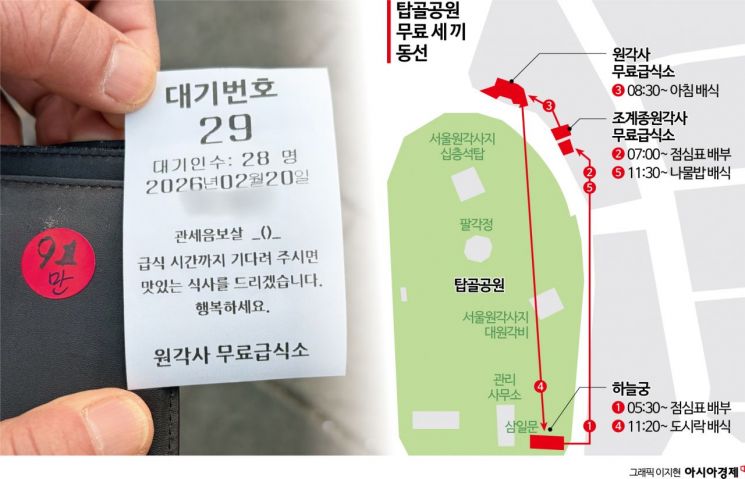 On the 20th at around 11:30 a.m., an elderly man encountered in front of the Jogye Order Wongaksa free meal center located in Tapgol Park, Jongno-gu, Seoul, is holding up a meal ticket. Photo by Lee Jiye
Although some analyses suggest that the elderly poverty rate has eased, it appears that the impoverished lives of many seniors have not actually improved in real terms. Analysts say this is a statistical illusion caused by the entry of the economically active baby boomer generation into the ranks of the "elderly." This has prompted calls for more fine-tuned policies targeting low-income seniors.
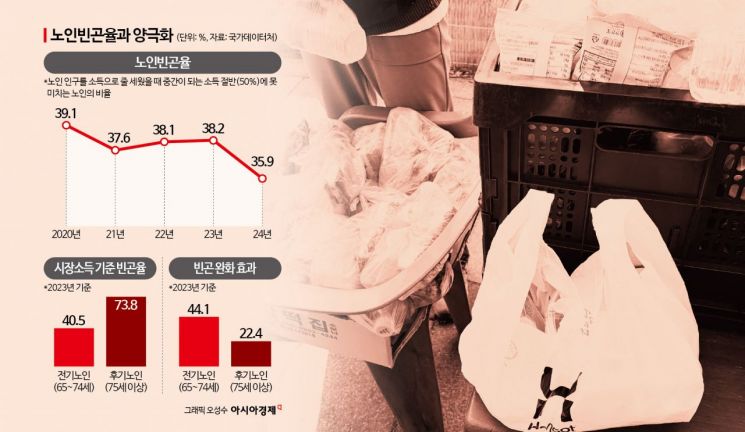
According to the results of the Household Finance and Welfare Survey recently released by the National Data Office on the 25th, the elderly poverty rate in 2024 (the relative poverty rate among people aged 65 and older) stood at 35.9% based on disposable income, the lowest level on record. Compared with 38.2% in 2023, this is a decline of 2.3 percentage points, raising expectations that the trend may be turning downward.
 At around 11:30 a.m. on the 20th, elderly people at the Jogye Order Wongaksa free meal center in Tapgol Park, Jongno-gu, Seoul, were eating free meals with the boxed lunches they had set aside for dinner placed at their feet. Photo by Lee Jiye
In this survey, "disposable income" refers to the amount obtained by adding pensions and various subsidies received from the state and then subtracting taxes and other mandatory payments. In other words, it is the amount of money that can actually be spent. However, when the standard is switched to market income, the elderly poverty rate rises to 54.9%. Market income refers to income earned without any assistance from the state.
Some analysts also argue that the inclusion of the relatively "better-off" second baby boomer generation (those born between 1964 and 1974) in the elderly population has distorted the statistics. According to recent social trends data released by the National Statistical Research Institute, in 2023 the poverty rate based on market income among households headed by early elderly people (aged 65 to 74) was 40.5%, while for late elderly people (aged 75 and older) it reached 73.8%. The poverty alleviation effect was also 44.1% for the early elderly, but only 22.4% for the late elderly.
Experts argue that, to solve problems facing the elderly, policymakers must move away from a design that lumps all older people together as "one group." Jung Soondool, a professor in the Department of Social Welfare at Ewha Womans University, said, "As baby boomers who prepared for old age have entered the senior population, disparities among older people have widened," adding, "If you treat all seniors as a single group, the problems behind the statistics are hidden." She stressed, "The basic pension should focus more on the poorest seniors, and a foundation for 'Active Aging' should be created so that healthy older adults can continue to participate in economic activities."
© The Asia Business Daily(www.asiae.co.kr). All rights reserved.














