Participatory Exhibition for Experiencing Emotional Change
Featuring Jung Seungwon and Baek Inkyo
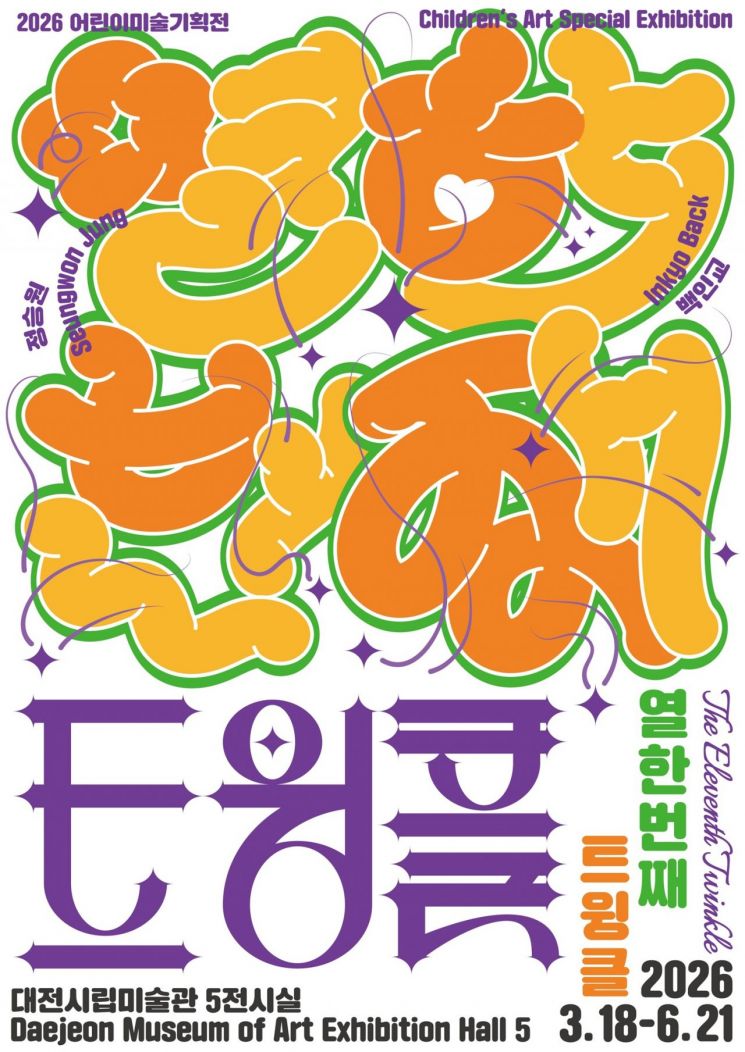
The Daejeon Museum of Art will hold its 11th children's art project exhibition, "Eleventh Twinkle," from March 18 to June 21, featuring structures in the exhibition hall that children can climb, slide on, touch, move, and experience.
This exhibition begins from a perspective that does not limit children to objects of protection or education, but instead views them as independent beings who form relationships with the world. Rather than trying to understand or explain children, the exhibition is designed so that visitors can directly experience in the exhibition space how a child's state emerges and changes.
A child's daily life is maintained through rules and repetition, but emotional changes do not always fit neatly into that order. "Eleventh Twinkle" focuses on these gaps and boundaries, viewing emotions not as fixed outcomes but as processes of emergence and change, and invites children to feel them physically through form, color, and movement.
The exhibition title "Twinkle" does not refer to any specific emotion. It denotes a surplus of feeling that briefly surfaces before rules and meanings are fully solidified, and the exhibition allows this state, which gradually disappears in the course of growing up, to remain once again within the exhibition space.
Participating artist Jung Seungwon realizes painting as an actual slide structure through the "Playground" series. The repeated figures and scenes are transformed into play equipment that children can physically climb and slide on, so visitors go beyond simply looking at the work and instead experience it by moving their bodies.
Artist Baek Inkyo uses everyday materials such as thread and textiles to realize the generation and transformation of forms. The participatory act in which visitors directly touch, move, and change the shapes of the works is absorbed as a part of the artwork itself, and this very process of participation is completed as an integral component of the work.
The artworks function not as objects kept at a distance from the audience, but as devices through which children collide with them physically and bring about change. Rather than searching for predetermined answers, children form relationships with the works at their own pace and in their own way.
This exhibition is not intended to correct emotions or guide them in a particular direction. Instead, it focuses on creating an environment in which children can recognize their own state and physically experience the process of change, and it is arranged so that guardians can stay together and observe the children's movements.
Yoon Uihyang, Director of the Daejeon Museum of Art, said, "Rather than correcting children's emotions, this exhibition is designed to create an environment in which they can recognize and experience their feelings on their own," adding, "We look forward to the time that children and their guardians will spend together here."
© The Asia Business Daily(www.asiae.co.kr). All rights reserved.












