Medical Professors Warn: "Return of Students on Leave Would Exceed Educational Capacity"
Medical school professors across the country stressed that the government’s decision to increase the medical school enrollment quota should be verified based on the actual feasibility of running medical education, not merely on whether statutory standards are met.
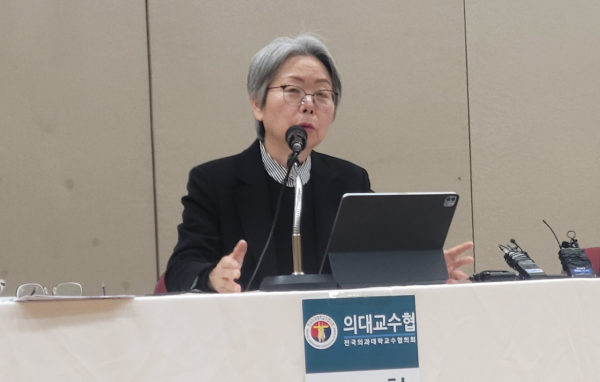 Jo Yoonjung, chair of the National Association of Medical School Professors, is speaking at a press briefing held at Korea University School of Law in Seongbuk-gu, Seoul, on the 13th. Photo by Jo Inkyung
The National Association of Medical School Professors (hereinafter referred to as the Association) held a press briefing on the 13th at Korea University School of Law in Seongbuk-gu, Seoul, and stated, “Although the government says it decided on the expansion based on ensuring the quality of medical education, the statutory standards it presents are nothing more than the minimum conditions for what is ‘possible.’”
Previously, the Ministry of Health and Welfare decided to increase, by an annual average of 668 students, the enrollment quota of 32 medical schools outside the Seoul metropolitan area for the 2027-2031 academic years. One of the five criteria set by the Health and Medical Policy Deliberation Committee for determining the scale of physician training was “ensuring the quality of medical education.”
Jo Yoonjung, chair of the Association and a professor in the Department of Laboratory Medicine at Korea University Anam Hospital, said, “Ensuring the quality of education, which is one of the principles for deliberating on physician training at the Health and Medical Policy Deliberation Committee, is determined by who the actual learners are and to what extent the instructors have educational competence,” adding, “It must also be examined whether there are concrete plans for running lectures and practical training, and whether the capacity for patient-contact education and residency training is secured.”
Chair Jo said, “If these four conditions are not verified, it is difficult to use the phrase ‘ensuring the quality of education’ as a basis for policy,” and added, “Enrollment quotas are a long-term variable, and if the government adopts ensuring educational quality as a principle of deliberation, it must first release the verification data for year-by-year scenarios.”
For example, if students who are currently on a leave of absence return all at once, overcrowding at educational sites will be unavoidable immediately. According to the Association, there are 1,586 students from the 2024 and 2025 cohorts on leave, and among them, 749 are scheduled to return in the 2027 academic year.
The Association explained, “Even if we only factor in this return, we already collide with the maximum limit discussed at the Health and Medical Policy Deliberation Committee, even without any additional quota increase,” and added, “If we judge educational feasibility based solely on the registered enrollment quota, bottlenecks will in reality occur in lecture rooms and practical training rooms.”
The Association also stated, “We do not deny the very discussion of enrollment quotas,” but urged, “If educational quality is the basis for policy, that quality must be verified in a measurable way. The government should therefore disclose the raw data used for its projections and start by validating the policy scenarios for 2027-2031.”
© The Asia Business Daily(www.asiae.co.kr). All rights reserved.












