25 m² Solar Sail Deployed Without Propellant...Reusable Cleanup-Satellite Architecture Boosts Cost-Effectiveness
The Korea Aerospace Research Institute has developed a solar-sail-based deorbit device capable of capturing and removing the rapidly increasing volume of space debris in low Earth orbit, and has successfully demonstrated it on the ground. Observers say this presents a "reusable removal model" that overcomes the limitations of the existing approach, which required the one-off deployment of expensive satellites.
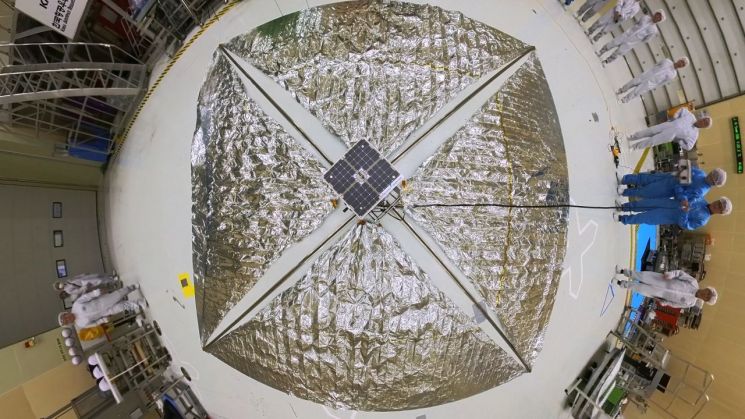 This is a plan view photograph of the fully deployed drag sail of the deorbit device after its deployment in the launch-environment test chamber at the Satellite Testing Facility of the Korea Aerospace Research Institute. Provided by Korea Aerospace Research Institute.
Conventional space-debris removal involves a cleanup satellite directly approaching a target, capturing it, and then guiding it to reenter the atmosphere, which means a single satellite is consumed in a single mission. The Korea Aerospace Research Institute applied a method that separates the deorbit device, which actually removes the space debris, from the cleanup satellite, which carries and deploys it. When one cleanup satellite carries multiple deorbit devices and deploys them sequentially, the satellite can be operated repeatedly, greatly improving both cost-effectiveness and reusability.
The newly developed device is a compact unit about the size of an electric rice cooker. It approaches space debris after attaching a towing plate and has a capture function that allows it to secure the debris stably. When deployed, it unfurls a solar sail of about 25 square meters and, by using the interaction between solar radiation pressure and the thin residual atmosphere in low Earth orbit, guides the target into the atmosphere without any separate propellant.
The Korea Aerospace Research Institute expects that this technology can be expanded beyond space-debris removal to rendezvous and docking, as well as deep-space solar-sail propulsion technologies.
Lee Sangchul, President of the Korea Aerospace Research Institute, said, "Solar-sail-based deorbit device technology will contribute to sustainable space-environment management," adding, "We will continue our research to secure technologies for responding to the future space environment."
© The Asia Business Daily(www.asiae.co.kr). All rights reserved.












