BOK, Money and Liquidity in December 2025
New M2 Excluding Beneficiary Certificates... Old M2 Up 0.5%
In December last year, the amount of money in circulation increased by more than 23 trillion won, with the money supply turning upward after just one month.
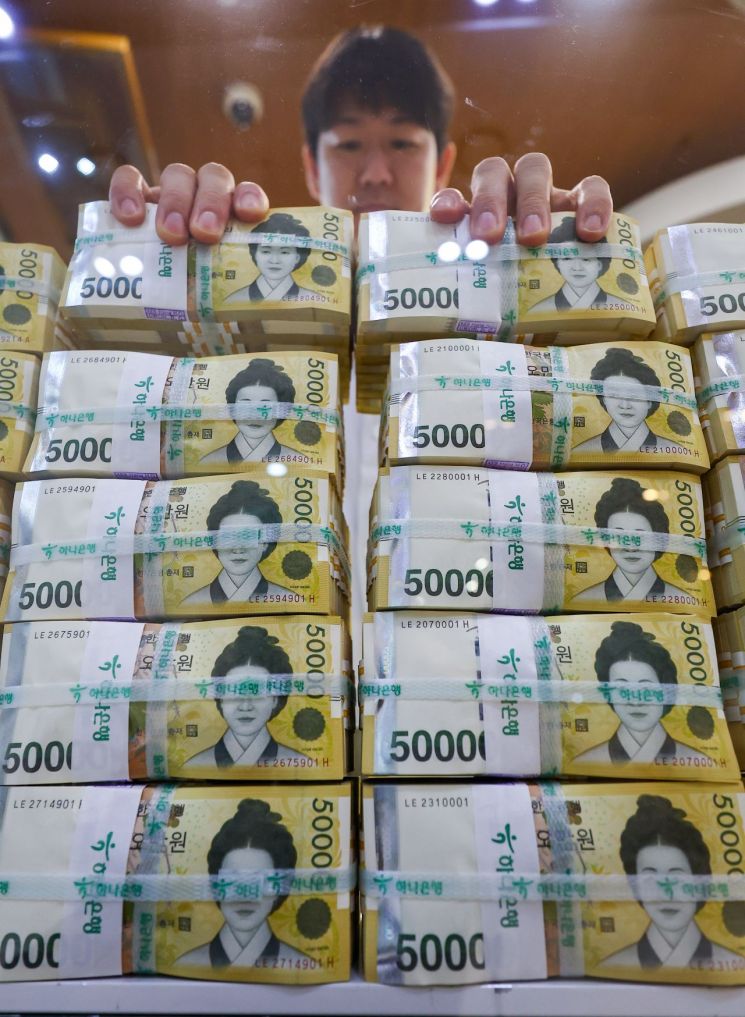 An employee sorts 50,000-won bills at Hana Bank's Counterfeit Response Center in Jung-gu, Seoul. Yonhap News
According to the Bank of Korea on the 13th, the average balance of broad money (M2) in December last year, on a seasonally adjusted basis, was 4,080.7 trillion won, up 23.4 trillion won (0.6%) from the previous month. On an unadjusted basis, it increased by 4.7% compared with the same month a year earlier. M2 is a broad money indicator that includes narrow money (M1) such as cash, demand deposits, and passbook savings deposits withdrawable at any time, as well as money market funds (MMFs), time deposits and installment savings with maturities of less than two years, certificates of deposit (CDs), and repurchase agreements (RPs).
The average balance of the old M2, which includes beneficiary certificates, rose by 0.5% from the previous month and by 8.1% from a year earlier. Beneficiary certificates increased by 37.4% year-on-year, contributing 3.4 percentage points to the 8.1% growth rate of the old M2. This means that excluding beneficiary certificates, the old M2 increased by about 4.7% compared with the same month a year earlier.
By product, other financial products increased by 10.9 trillion won due to higher foreign currency deposits of corporations and households, and passbook savings deposits withdrawable at any time increased by 7.3 trillion won due to temporary deposits of corporate funds for year-end financial ratio management and the inflow of surplus household funds such as bonuses.
By sector, non-financial corporations increased their holdings by 12.9 trillion won, mainly in passbook savings deposits withdrawable at any time and other financial products, while households and non-profit organizations increased their holdings by 10.4 trillion won, mainly in passbook savings deposits withdrawable at any time. Other financial institutions also increased their holdings by 2.3 trillion won, again mainly in passbook savings deposits withdrawable at any time. In contrast, the other sectors reduced their holdings by 5.4 trillion won, mainly in time deposits and installment savings with maturities of less than two years. An official at the Bank of Korea pointed out that this was "due to withdrawals of fiscal execution funds by local governments at the end of the year."
The average balance of M1 on a seasonally adjusted basis was 1,342.9 trillion won, up 0.6% from the previous month. The average balance of financial institution liquidity (Lf) was 6,029.9 trillion won, up 0.1% from the previous month, and broad liquidity (L), measured as the end-of-month balance, was 7,732.2 trillion won, up 1.4% from the end of the previous month. The scope of Lf includes not only M2 but also long-term financial products with maturities of two years or more and financial products issued by non-deposit-taking institutions, while L includes Lf as well as other financial institution products, government bonds, local government bonds, corporate bonds, and commercial paper.
© The Asia Business Daily(www.asiae.co.kr). All rights reserved.












