Validation of Proprietary Mechanism Through 5-Meter-Class Antenna Test
Participation in Next-Generation Satellite Development, Including Ultra-High-Resolution Satellites and 6G Communications
Korean Air said on the 12th that it had successfully completed a development test of a large antenna deployment system for satellite payloads in collaboration with the Defense Technology Promotion Research Institute. Building on this success, the company plans to focus on securing core technologies for next-generation satellite development that are directly linked to national security.
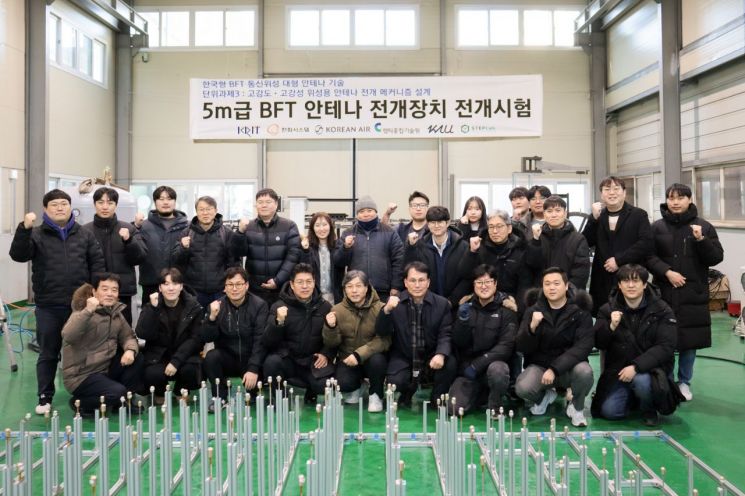 Korean Air said on the 12th that it succeeded in a development test of a large antenna deployment system for satellite payloads in partnership with the Defense Technology Promotion Research Institute. Officials who participated in the test pose for a commemorative photo. Photo by Korean Air
In January, Korean Air conducted a test of a 5-meter-class antenna deployment system at the CAMTIC Institute of Technology in Jeonju, North Jeolla Province. The test was carried out as part of the Defense Technology Promotion Research Institute's core defense technology project, the "deployment system for large deployable satellite payload antennas," and was attended by industry-academia-research representatives, including Korea Aerospace University.
The key aspect of this technology is folding the antenna into a stowed configuration at launch to reduce volume, and then deploying it in the target orbit. Because it must deploy in the space environment without any error, it is regarded as a major factor that determines the performance of the satellite. In the test, Korean Air confirmed that the 5-meter antenna operated according to the deployment mechanism and proved that it can maintain its shape even under extreme conditions.
The success of this test is significant in that it verified the effectiveness of the deployment mechanism independently designed and manufactured by Korean Air. The company is expected to play a key role in the development of next-generation satellites, including ultra-high-resolution Earth observation satellites capable of distinguishing objects as small as 10 centimeters on the ground and 6G satellite communications.
A Korean Air official said, "Based on our accumulated technological capabilities, we will do our utmost to advance the nation's space assets and help the country emerge as a major space power," adding, "We will focus on securing a wide range of technologies to prepare for the future space era."
© The Asia Business Daily(www.asiae.co.kr). All rights reserved.












