Bioink-Based Technology with Potential for Expansion into Customized Tooth-Regeneration Therapies
Published in the January Issue of the International Polymer Journal "Polymer Testing"
A tooth-regeneration bioink that utilizes natural bone components has demonstrated the potential to regenerate actual tooth tissue.
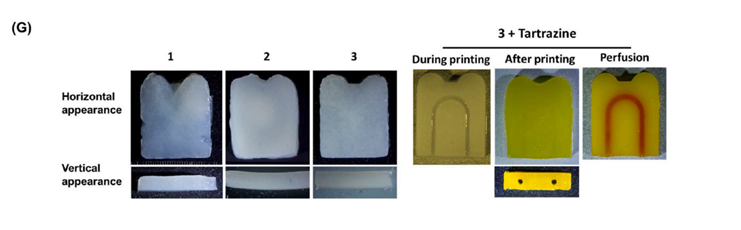 A tooth construct 3D-printed using a bioink based on natural bone components with added tartrazine. A microchannel approximately 0.7 mm in diameter was formed inside, and dye perfusion experiments confirmed that the structure can function as a blood vessel. Hallym University Chuncheon Sacred Heart Hospital
Hallym University Chuncheon Sacred Heart Hospital announced on February 11 that the research team led by Otorhinolaryngology Professor Park Chanheum had confirmed that the bioink they developed can induce the differentiation of stem cells into tooth tissue even without additional growth-inducing factors. The study results were published last month in the international journal Polymer Testing.
The newly developed bioink is a material in which demineralized bone powder derived from natural bone is endowed with photocurable properties, and it is designed to enable 3D printing while preserving as much as possible of the bio-signals inherent in real bone. It is characterized by overcoming the difficulties that conventional artificial scaffolds have faced in forming tooth tissue due to insufficient bio-signals and limitations in structural precision.
To preserve key proteins in bone and components related to cell growth, the research team selected only fine powders smaller than 90 micrometers to produce the bioink. Through this, they created a biological environment in which stem cells can grow into actual tooth tissue.
In experiments to optimize 3D bioprinting conditions, a bioink concentration of 20% was found to most evenly satisfy structural stability, precision, and cell compatibility. At a concentration of 10%, the printed structures collapsed easily, while at 30%, shape stability was high but cell proliferation and structural refinement were reduced.
The research team also succeeded in fabricating a tooth construct containing blood vessels by adding 0.1% tartrazine dye to the bioink. The printed construct formed an internal microchannel with a diameter of 0.7 mm, and dye flow experiments confirmed that fluid could move through it without obstruction. This demonstrated the potential to create functional vascular structures capable of supplying nutrients and oxygen to cells.
In addition, when stem cells derived from dental nerves were encapsulated in the bioink and cultured, differentiation into tooth cells was observed even without additional growth factors. In effect, the bioink itself functioned as a microenvironment that provides tooth-tissue differentiation signals to stem cells.
Professor Park Chanheum said, "This study is a pilot study for the development of a bioink that can be printed and can induce the differentiation of periodontal-tissue-derived stem cells, and the materials used in this study still have limitations for immediate application to tooth fabrication, so further refinement and follow-up research are needed." He added, "This study is meaningful in that it has established a bioink platform that enables high-precision 3D printing while preserving the bioactivity of naturally derived bone tissue," and continued, "We plan to expand this technology not only to customized tooth-regeneration therapies but also to various fields of regenerative medicine in the future."
© The Asia Business Daily(www.asiae.co.kr). All rights reserved.












