At least 15 deaths over 10 years linked to door issues
Door unlocking difficult if low-voltage battery fails
Ongoing concerns over autonomous driving and quality issues
Tesla, the electric vehicle maker led by Elon Musk, is once again facing a lawsuit over an incident in which a passenger reportedly died because he was unable to open the vehicle door after a crash triggered a fire.
On the 6th, Yonhap News, citing Bloomberg News, reported that Tesla has become entangled in litigation following a series of accidents. According to a complaint obtained by Bloomberg News that was filed in federal court in Massachusetts, in October last year, a Tesla Model Y driven by 20-year-old Samuel Tremblay crashed into a tree on a road in Easton, Massachusetts, about 30 miles from Boston.
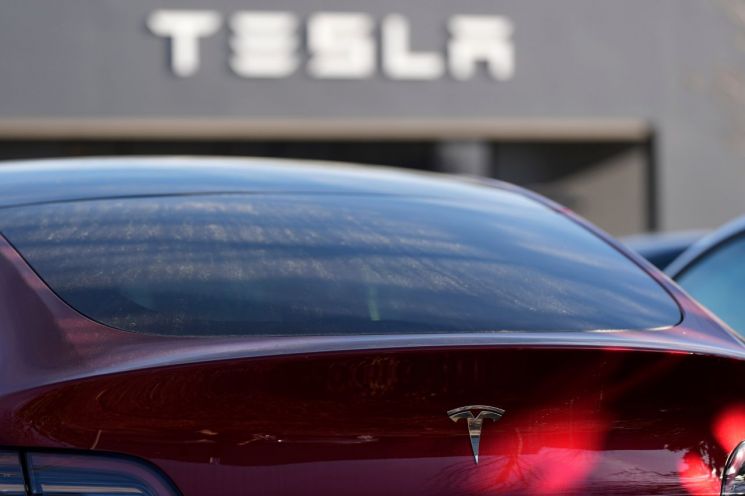 In addition, Tesla vehicles are equipped with a low-voltage battery that controls interior functions such as windows, doors, and the touchscreen, and a high-voltage battery for vehicle propulsion. AP Yonhap News Agency
Tremblay was conscious immediately after the accident and called 911, reporting that he was trapped in the car after the crash and that the vehicle was on fire. However, he ultimately failed to escape from the vehicle and was found dead in the back seat when rescuers arrived. The plaintiff argued in the complaint that Tremblay died from burns and smoke inhalation after being trapped inside because he could not open the car door.
Recurring controversy over locked doors
Bloomberg reported that the electronic door system in Tesla vehicles may become inoperable after a crash, and that at least 15 people have died in more than 10 accidents over the past decade as a result. Tesla vehicles are each equipped with a low-voltage battery that controls interior functions such as windows, doors, and the touchscreen, and a high-voltage battery that powers the vehicle. If the low-voltage battery fails due to a collision or fire, it may become difficult to unlock the doors. Although there is a mechanical manual release device inside the vehicle, many drivers and passengers do not know its location or how to operate it, which has also been cited as a problem. Tesla has previously been sued over similar accidents in Washington State and Wisconsin.
 Tesla has been repeatedly embroiled in safety controversies over its driver-assistance system "Autopilot" and its Full Self-Driving (FSD) feature. Reuters and Yonhap News
The U.S. National Highway Traffic Safety Administration (NHTSA) in December last year accepted a consumer petition requesting a defect investigation into the door release mechanism of the Tesla Model 3 and began reviewing it. The petitioner argued that the mechanical release device in the 2022 Model 3 is not easily visible and is difficult to locate intuitively in an emergency.
Debate in South Korea over EV fires and escape problems
Safety concerns over electric vehicle fires are continuing in South Korea. In an electric vehicle fire last year at a parking lot in Gangnam-gu, Seoul, battery thermal runaway prolonged firefighting efforts, forcing nearby residents to evacuate urgently. In addition, some electric vehicle accidents have prompted criticism that rescue operations were delayed because the doors would not open after a collision or because it was difficult to open the doors from outside. Fire authorities are strengthening their response system by introducing EV-specific suppression manuals and fire-blanket-style smothering covers.
 Safety concerns over electric vehicle fires are continuing domestically. Last year, an electric vehicle fire in a parking lot in Gangnam-gu, Seoul involved battery thermal runaway, which prolonged firefighting efforts and forced nearby residents to evacuate. AP Yonhap News
In addition to the door system, Tesla has repeatedly been embroiled in safety controversies surrounding its Autopilot driver-assistance system and its Full Self-Driving (FSD) feature. In the United States, class-action lawsuits have been filed over accidents that occurred while Autopilot was in use, and some functions have been subject to recalls. Consumers have also consistently raised complaints about battery fires, quality defects, and malfunctions after software updates. As electric vehicle adoption accelerates, ensuring the possibility of escape after a collision and implementing intuitive safety-oriented design are emerging as key challenges for the entire industry. Tesla has not issued an official statement regarding this latest lawsuit.
© The Asia Business Daily(www.asiae.co.kr). All rights reserved.














