Meeting of Insurance Industry Executives to Eradicate Insurance Fraud
Strengthening Ongoing and Planned Investigations into Indemnity Insurance Fraud
"It Cannot Be Done Without Whistleblowers"...Calling for Active Participation in the Reward Program
The Financial Supervisory Service will significantly strengthen its ongoing and planned investigations to prevent leakage of indemnity and automobile insurance payouts, and will also step up crackdowns on acts of arranging or inducing insurance fraud. The aim is to preemptively block new and organized forms of insurance fraud, focusing on indemnity health insurance and automobile insurance.
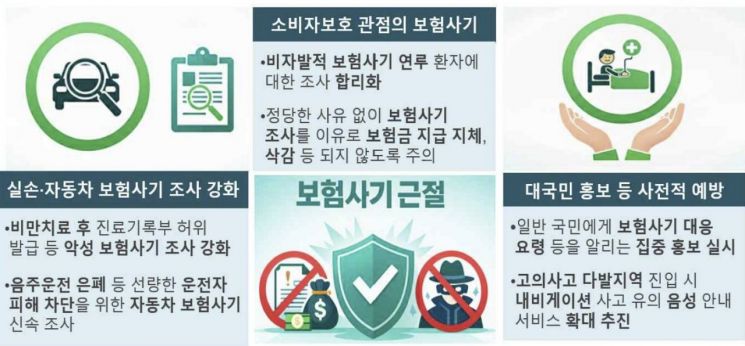
On the 5th, the Financial Supervisory Service held a meeting of executives in charge of Special Investigation Units (SIUs), the insurance fraud response organizations, presided over by Vice Governor for Civil Finance Kim Hyeongwon, and discussed the "2026 Key Work Plan for Combating Insurance Fraud," which includes these measures. About 70 people attended the meeting, including officials from the life and non-life insurance associations and executives and department heads in charge of SIUs at insurance companies.
In his opening remarks, Vice Governor Kim Hyeongwon emphasized, "Insurance fraud is a financial crime that harms people’s livelihoods by increasing their economic burden through higher insurance premiums, so the Financial Supervisory Service and the insurance industry must work together to detect and punish it without fail."
Vice Governor Kim Hyeongwon also noted, "Recently, some medical institutions have been deceiving good-faith patients and manipulating medical records to falsely make it appear that indemnity insurance benefits should be paid, showing that methods of insurance fraud are becoming more intelligent," and urged, "We must respond strictly by applying a zero-tolerance policy to such malicious insurance fraud."
This year, in relation to indemnity health insurance, the Financial Supervisory Service plans to concentrate its ongoing and planned investigations on acts in which some hospitals and clinics disguise cosmetic procedures or non-reimbursable treatments as manual therapy and other reimbursable treatments to siphon off insurance payouts, or lure patients by claiming that the high costs of non-reimbursable treatments can be covered by indemnity insurance. In addition, as cases of insurance fraud have recently been identified in which patients are enticed by claims that they can file indemnity insurance claims for expensive non-reimbursable obesity treatments amid growing demand for such drugs, the authority will strengthen investigations and detection in this area as well. It will also tighten investigations and enforcement against automobile insurance fraud, including staged car accidents through collusion between perpetrators and victims and concealment of drunk driving.
The authority also called for active participation in the "special reporting and reward program" that is being operated to eradicate indemnity insurance fraud. The reporting period runs from January 12 to March 31, and rewards of up to 50 million won will be paid to hospital and clinic staff who report fraud, 30 million won to brokers, and 10 million won to patients and other users of hospitals and clinics.
An official at the Financial Supervisory Service said, "Since indemnity insurance fraud is evolving into an organized crime involving internal hospital staff, patients, insurance planners, and brokers, it is difficult to detect without internal whistleblowing," and asked the industry for active interest and cooperation.
Consumer rights protection will also be strengthened. For good-faith patients who are involuntarily involved in insurance fraud, the Financial Supervisory Service will make its investigation methods more reasonable, and will proactively refund automobile insurance premiums that have been unjustly surcharged due to insurance fraud. In fact, since 2009, about 2,200 victims of automobile insurance fraud have received refunds totaling 9.9 billion won in surcharged premiums.
The Financial Supervisory Service stated that it will continue to strengthen its cooperative framework with investigative and health authorities, respond to insurance fraud under a zero-tolerance policy, and at the same time carry out public awareness campaigns and prevention activities.
© The Asia Business Daily(www.asiae.co.kr). All rights reserved.












