Samsung Asset Management announced on the 5th that the exchange-traded funds (ETFs) it released at the beginning of this year under the investment theme of "Dae-Ban-Jeon," which it proposed as the ETF investment keyword expected to drive a takeoff in the Korean stock market this year, have generated an average return of about 32% since the start of the year.
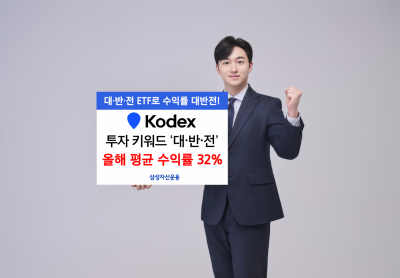
Following last year, Samsung Asset Management carefully selected investment keywords that could lead to a major turnaround in returns this year and chose "Dae-Ban-Jeon." The keyword "Dae-Ban-Jeon" stands for: (1) flagship indices & monthly dividends, (2) semiconductors & robots, and (3) power & infrastructure.
As flagship index products, Samsung Asset Management selected KODEX 200 and KODEX KOSDAQ 150, and for monthly dividend products, it chose KODEX 200 Target Weekly Covered Call and KODEX Financial High Dividend TOP10 Target Weekly Covered Call. For semiconductors and robots, it recommended KODEX Semiconductor, KODEX AI Semiconductor, and KODEX Robot Active. As power & infrastructure investment products, it presented KODEX AI Power Core Facilities and KODEX K-Nuclear SMR as core ETFs that can drive a major turnaround in portfolio returns for investors.
The nine KODEX ETFs selected under the "Dae-Ban-Jeon" investment keyword have delivered strong performance, recording an average return of 32.1% since the beginning of the year. In particular, ETFs related to semiconductors & robots and power & infrastructure have posted returns of over 36%, standing out in performance. As of the 4th, KODEX Semiconductor, KODEX AI Semiconductor, and KODEX Robot Active have each recorded year-to-date returns of 43.5%, 40.1%, and 36.8%. The KODEX K-Nuclear SMR ETF has returned 44.2%, while the KODEX KOSDAQ 150 ETF has also continued its upward trend with a 29.7% gain.
Samsung Asset Management explained that it was effective to select "Dae-Ban-Jeon" as a domestically focused equity investment keyword by closely analyzing major stock market variables such as changes in the macroeconomic environment, country- and industry-specific fundamentals related to the artificial intelligence (AI) revolution, and investor fund flows, while also taking into account the solid profit growth trend of domestically listed companies.
Recently, the Korean stock market has shown differentiated trends by industry, centered on technological innovation and corporate earnings. With expectations for an improvement in business conditions driven by rising AI-related demand, semiconductors have established themselves as a key sector of interest for investors. In addition, as the adoption of humanoid robots in industrial sites and expectations for expanded government investment in new large-scale nuclear power infrastructure are reflected in the market, investor interest in the robotics and nuclear power industries has increased.
Furthermore, following the KOSPI surpassing the 5,000-point level, the KOSDAQ market has also broken through the 1,000-point mark, leading to improved investor sentiment centered on growth companies. As a result, investment capital is flowing into a broad range of industries with high growth potential.
Kim Dohyung, Head of ETF Consulting at Samsung Asset Management, said, "The semiconductor shortage triggered by the AI revolution is heading beyond a 'super cycle' toward a 'mega cycle,' and the structural benefits for Korean shipbuilding, defense, and nuclear power companies are also expected to continue this year." He added, "We foresee a structurally upward trend in the Korean stock market, powered by Korea's solid economic fundamentals and strong liquidity, as evidenced by investor deposits surpassing 100 trillion won. Rather than frequent trading, we hope investors will achieve a true turnaround in returns through steady investment in the 'Dae-Ban-Jeon' themes."
© The Asia Business Daily(www.asiae.co.kr). All rights reserved.












