Average annual 23 births before the program ... 36 last year
Cumulative 13.4 billion won paid out, 11 multiple-child families supported
Renews proposal to re-designate "United Nations Day" as a public holiday
"I am here to receive my 100 million won."
On the 5th, at Booyoung Group's New Year's kickoff ceremony held at the group's headquarters in Jung-gu, Seoul, employees holding their babies went up on stage and received childbirth incentive payments of 100 million won per child. On this day, Booyoung Group held its 2026 New Year's ceremony and paid a total of 3.6 billion won in childbirth incentives to 36 employees who gave birth to children last year. The "100 million won per child" program, introduced in 2024, has now entered its third year. Compared with the average of 23 births per year in the company between 2021 and 2023, before the system was implemented, the number has increased by 57 percent. It is also a 28 percent increase compared with the first year of the program, when there were 28 births.
At the New Year's ceremony in February 2024, Booyoung Group first announced the childbirth incentive system and paid a total of 7 billion won to 70 employees who had children since 2021. The following year, it paid an additional 2.8 billion won to 28 employees who had given birth the previous year, bringing the cumulative total to 9.8 billion won. Including this year, the cumulative amount paid has reached 13.4 billion won.
Increase in multiple-child births and participation by long-serving employees
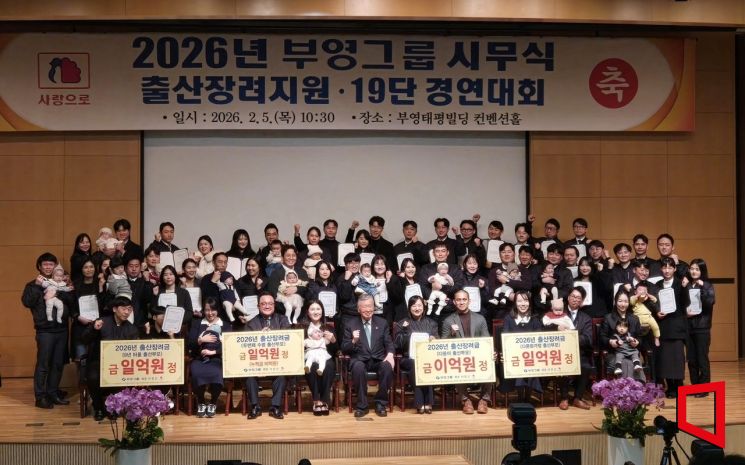 Lee Joonggeun, Chairman of Booyoung Group, is awarding childbirth incentive payments to employees who gave birth last year and posing for a commemorative photo at the '2026 Opening Ceremony' held on the 5th at the Booyoung Taepyeong Building Convention Hall in Jung-gu, Seoul. Photo by Choi Seoyun
Since the system was introduced, 11 employees have received 200 million won or more by having a second or subsequent child, or by giving birth to multiple children. There have also been cases of an employee having a second child nine years after the first, and of births in multicultural families. Analysts say that the 100 million won in financial support has helped lower the psychological barriers to having a second or third child.
Lee Joonggeun, chairman of Booyoung Group, said, "In the midst of the low birthrate crisis that threatens the very survival of the nation, the program we launched based on the belief that companies must act as a priming pump is showing visible results," adding, "I find it meaningful that our company's example has spread like a butterfly effect, with many companies voluntarily joining in, much like the National Debt Repayment Movement or the Gold Collection Campaign."
Booyoung's childbirth incentive program has even led to a revision of the tax law. The government and the National Assembly passed an amendment to the Income Tax Act that makes corporate childbirth support payments fully tax-exempt, and it is applied retroactively to payments made on or after January 1, 2024. As a result, Booyoung employees are now able to receive the full 100 million won even for births in 2021.
On the back of this, the introduction of childbirth incentive programs is spreading across the business community. Agricultural machinery company TYM (100 million won for a third child), and game company Krafton (60 million won in childbirth incentives and up to 40 million won in childcare support) have introduced similar systems. Last year, the Presidential Committee on Aging Society and Population Policy presented Chairman Lee with a plaque of appreciation for "contributing to reversing the low-birthrate trend."
"We must not forget the grace of the United Nations"
Meanwhile, Chairman Lee also proposed on this day that "United Nations Day (October 24)" be re-designated as a public holiday. As president of the Korean Senior Citizens Association, he said, "Thanks to the help of 60 United Nations member states during the Korean War, including 16 combat troop contributors, 6 medical support countries, and 38 countries providing material aid, today's Republic of Korea has grown into a top-10 global economic power," adding, "We need an attitude of repaying the sacrifices and grace of the UN forces."
United Nations Day, which commemorates the founding of the United Nations in 1945, was designated as a public holiday in Korea from 1950 to 1975. It was abolished in 1976 in protest after North Korea joined UN-affiliated organizations. Chairman Lee said, "Re-designating it as a public holiday would serve as an opportunity to improve diplomatic relations with the 60 countries that participated in the war and to enhance our national standing."
In 2015, Chairman Lee supported the construction of a monument symbolizing the UN member states that participated in the war at the War Memorial of Korea in Yongsan, and in 2023 he donated 10 billion won to the Air Force Sky Love Scholarship Foundation. He also authored the Korean War history book "The 1,129 Days of the Korean War" and has distributed more than 10 million copies free of charge in Korea and abroad.
© The Asia Business Daily(www.asiae.co.kr). All rights reserved.












