18th Residents' Sangsaeng Talk... "Final Chapter of the Long Journey"
Promotion of the Southern Inland Railway and the Dalbit Railway
Fostering Hapcheon as a central inland transportation and tourism hub through expansion of the wide-area expressway network
South Gyeongsang Province (Governor Park Wansu) announced on February 4 at the Hapcheon Culture and Arts Center during the "Residents' Sangsaeng Talk" that it will foster Hapcheon as a transportation and tourism hub connecting the Seoul metropolitan area with South Gyeongsang Province, as well as the Yeongnam and Honam regions.
About 250 people, including Governor Park Wansu, Hapcheon County Mayor Kim Yooncheol, and local residents, attended the event to share local pending issues and discuss plans for mutually beneficial development between South Gyeongsang Province and Hapcheon County. This Sangsaeng Talk was organized for the first time in three years since the "Dialogue with Hapcheon Residents" held in 2023.
Governor Park said, "Hapcheon is a region with a long history," adding, "It has great potential for development as a center of outstanding history and culture and as a tourism hub." He also referred to Hapcheon as a key transportation point in the central inland region, stating that its role as a transportation hub will grow through the commencement of construction on the Southern Inland Railway, the promotion of the Dalbit Railway, and the expansion of the wide-area expressway network, including the Hamyang-Ulsan Expressway and the expressway connecting Jincheon-Hapcheon-Haman.
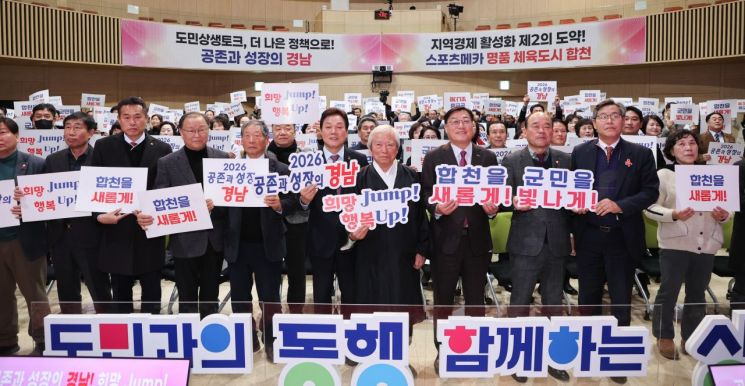
At the Sangsaeng Talk site, a wide range of proposals were made, from mid- to long-term regional tasks such as transportation, urban planning, and industrial policy to everyday issues closely related to residents' lives, including sports and tourism infrastructure.
First, in relation to expanding the transportation network, participants called for the early start of construction on the Hapcheon-Haman section and emphasized the need to improve wide-area accessibility. A provincial official explained plans to expand the expressway network in conjunction with the promotion of the Southern Inland Railway and the Dalbit Railway, and expressed the intention to reflect local opinions in the process of promoting related projects.
There were also calls for institutional improvements to respond to population decline and revitalize the region. Participants pointed out that, in the process of promoting tourism and recreation development, the separation of authority between district unit planning and zoning decisions is restricting project implementation, and they proposed delegating zoning decision authority to cities and counties. In response, Governor Park said he would consult with relevant ministries and review delegation measures so that cities and counties can jointly participate in the planning process.
Discussions then moved on to strategies for attracting industries and companies. One resident suggested that, in line with changes in energy infrastructure such as pumped-storage power generation, there is a need to diversify policies to attract high-tech and energy companies. Governor Park stated that it is necessary to proactively prepare measures such as converting the use of industrial sites and to improve systems and ordinances so that greater incentives can be provided to areas facing population extinction.
Proposals for expanding public facilities were also presented. When the need to install an auxiliary athletics stadium was raised ahead of the joint hosting of the Provincial Sports Festival next year, Governor Park said, "The Provincial Sports Festival is something the province must take responsibility for and support," and added, "We will support the necessary sports facility budget, including the installation of an auxiliary stadium that is essential for operating track and field events."
Regarding tourism infrastructure, the need to expand wastewater treatment facilities in response to the increase in visitors to Hwangmaesan County Park was discussed. A provincial official explained that, in addition to the current daily treatment capacity of 70 tons, an expansion of about 30 tons is needed, and said that although this is an independent project of the city and county, the province will actively review support measures, including sharing part of the financial burden with the county.
Along with this, proposals were made to improve the livestock industry and living environment. Suggestions included expanding support for building a foundation for high-quality cow production and expanding projects to reduce odors in pig-farming areas. The province said it would examine the necessity of the projects and on-site conditions and review support measures. In addition, there were requests to improve aging infrastructure, such as replacing the old trash rack at the Daebu drainage pumping station.
Regarding local cultural facilities, there were requests for the establishment of a Confucian Scholars' Hall and for improved treatment of Confucian scholars. Governor Park said that if the county prepares and submits a utilization plan for new construction or remodeling, the province will review support measures at the provincial level.
This event marked the final leg of the Residents' Sangsaeng Talk series that began in January last year. The Residents' Sangsaeng Talk, which started in Goseong County on January 14, 2025, concluded its long journey with Hapcheon County on this day. More than 5,000 residents participated across 18 cities and counties, and over 360 opinions were delivered to the province.
Meanwhile, on the same morning, Governor Park visited the Hapcheon County Integrated Food Support Center to encourage on-site workers and check its operational status. The Hapcheon County Integrated Food Support Center is evaluated as a representative case of mutually beneficial regional agriculture, as it links the production, processing, supply, and consumption of local agricultural products to establish a virtuous cycle system, increase farm household income, and provide high-quality food ingredients for supplied meals.
© The Asia Business Daily(www.asiae.co.kr). All rights reserved.