Companies with Shorter Audit Input Hours to Be Prioritized for Inspection and Review
Scope of Auditor Designation by Authority Expanded for Unlisted Companies to Enhance Fairness
The Financial Services Commission will introduce a measure that restricts those who order accounting fraud from taking executive positions at domestically listed companies for up to five years. The aim is to break the practice in which individuals who committed accounting fraud are rehired as executives at listed companies.
Executives Involved in Accounting Fraud to Face Up to 5-Year Ban on Executive Positions at Domestic Listed Companies
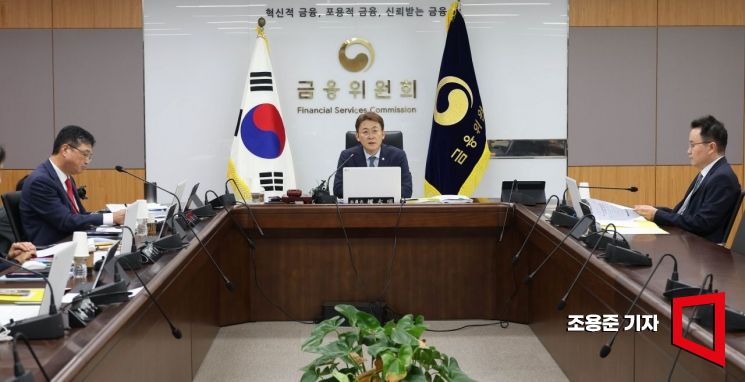 Kwon Daeyoung, Chairman of the Securities and Futures Commission (Vice Chairman of the Financial Services Commission), speaks at a regular meeting held at the Government Complex Seoul in Jongno-gu, Seoul, on August 27, 2025. Photo by Cho Yongjun
At its 3rd regular meeting on the 4th, the Securities and Futures Commission of the Financial Services Commission announced a set of measures titled "Plan to Enhance Accounting and Audit Quality." This is a follow-up to the "Plan to Strengthen Sanctions on Accounting Fraud," which the government released in August last year to resolve the so-called Korea Discount by improving accounting transparency.
The plan stipulates that executives who have committed accounting fraud, as well as work-execution directors who ordered such fraud, will be restricted from taking executive positions at all domestic listed companies for up to five years. This is because many work-execution directors who committed accounting fraud were being rehired as executives at other listed companies.
If a person who committed accounting fraud is already serving as an executive at another company, that person must be dismissed immediately. Listed companies that fail to comply with this requirement will face an administrative fine of up to 100 million won.
The plan also includes measures to strengthen the management and supervision of inadequate audits. The Financial Services Commission will prioritize for inspection and review those accounting firms whose audit input hours fall short of standard audit hours or the actual audit hours spent in the previous year. If inadequate auditing is confirmed through this process, the government will replace the auditor of the relevant company, and for companies that allowed such practices, it will conduct designated audits and financial statement reviews to determine whether accounting fraud has occurred.
This measure comes in response to concerns that competition among accounting firms to win clients has reduced audit input hours, increasing the risk of deteriorating audit quality. According to a survey by the Financial Services Commission, the average audit input time for listed companies decreased from 2,458 hours in 2022 to 2,348 hours last year, declining every year.
 Kwon Daeyoung, Chairman of the Securities and Futures Commission (Vice Chairman of the Financial Services Commission), is speaking at a regular meeting held at the Government Complex Seoul in Jongno-gu, Seoul on August 27, 2025. Photo by Cho Yongjun
Penalties for violating obligations to maintain audit quality will also become heavier. Previously, when violations were detected, only exclusion points were imposed, which reduced the number of companies that could be designated for audit. Going forward, the authorities will introduce sanctions equivalent to business suspension depending on the severity of the violations. In addition, unlike before, even in cases involving fewer than three minor violations, exclusion points will be imposed, while voluntary self-reporting will allow those exclusion points to be reduced to 50% of the original level.
More Unlisted Companies to Become Subject to Auditor Designation... Mandatory Oversight Bodies for Large Accounting Firms
Through this plan, the Financial Services Commission will increase the scope of unlisted companies subject to auditor designation by authority. Unlike listed companies, for which the Financial Services Commission can designate auditors ex officio if the auditor has changed at least twice in the past three years or if embezzlement or breach of trust cases involving officers or employees have occurred, unlisted companies have not been subject to such regulation. Going forward, unlisted companies with assets of at least 500 billion won, whose largest shareholder has changed at least three times in the past three years or where embezzlement or breach of trust has occurred, will be subject to auditor designation by authority.
The plan also includes a measure to mandate the establishment of independent audit quality oversight committees to improve the audit quality of large accounting firms. These committees must be composed of a majority of independent external experts, including the chair, who have no affiliation with the accounting firm. This measure addresses the problem that accounting firms have been operating oversight bodies with internal personnel and prioritizing short-term profits over audit quality management.
The plan also calls for reforming the auditor designation system so that mid-tier accounting firms can audit large listed companies. Accounting firms are classified into Groups A through D based on their size and ability to cover damages, and large listed companies have so far only been allowed to be audited by large accounting firms in Group A. The Financial Services Commission will allow mid-tier accounting firms that achieve top-tier scores in audit quality assessments to audit listed companies belonging to the higher groups.
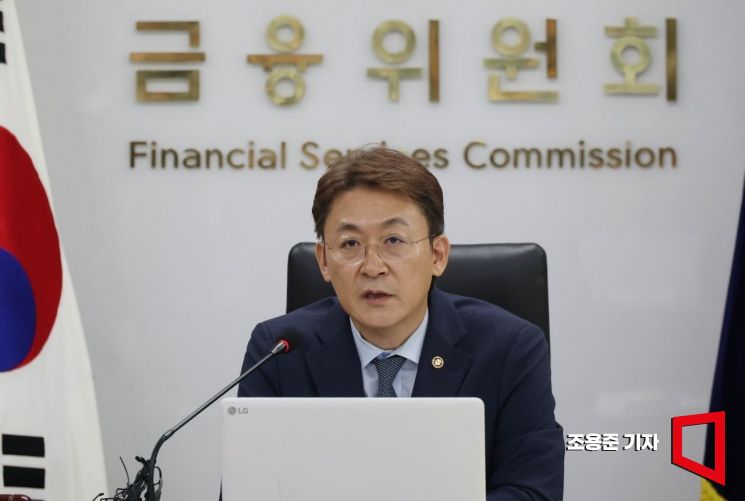 Kwon Daeyoung, chairman of the Securities and Futures Commission (deputy chairman of the Financial Services Commission), is speaking at a regular meeting held at the Government Complex Seoul in Jongno-gu, Seoul on Aug. 27, 2025. Photo by Cho Yongjun
In addition, taking into account the growth of the capital market and the increase in litigation amounts, the plan will double across the board the criteria for accounting firms' liability coverage capacity. Accordingly, the liability coverage thresholds will be raised from 100 billion won to 200 billion won for Group A, from 10 billion won to 20 billion won for Group C, and from 1 billion won to 2 billion won for Group D. Furthermore, new deduction items will be introduced when scoring auditors, and the results of operations, opinions from audited companies, and domestic and international research findings will be reflected to enhance the reliability of quality assessments.
An official from the Financial Services Commission said, "We aim to implement these measures within this year and will push ahead with the necessary institutional improvements," adding, "We plan to submit the relevant amendment bills to the National Assembly in the first half of this year, and for matters that can be implemented without amending laws such as enforcement decrees, we will proceed with the legislative notice of the amendments within the first half of this year."
© The Asia Business Daily(www.asiae.co.kr). All rights reserved.














