SNE Research Forecasts for the Humanoid Robot and Battery Market
Robot Battery Demand Seen Reaching 138 GWh by 2040
All-Solid-State Batteries to Become the Core Pillar...Market Size to Hit About 15 Trillion Won
A forecast has been released that the global number of humanoid robots will reach 53 million units in 2040, with corresponding battery demand rising to 138 gigawatt-hours (GWh). Analysts expect humanoid robots in particular to drive demand for all-solid-state batteries.
On the 4th, secondary battery market research firm SNE Research stated in its report titled "Status of Technology Development and Market Outlook for Humanoid Robots and Robot Batteries (~2040)" that the cumulative number of humanoid robots in operation worldwide is projected to increase from about 23,000 units in 2025 to 690,000 units in 2030, 6.79 million units in 2035, and approximately 53.3 million units in 2040.
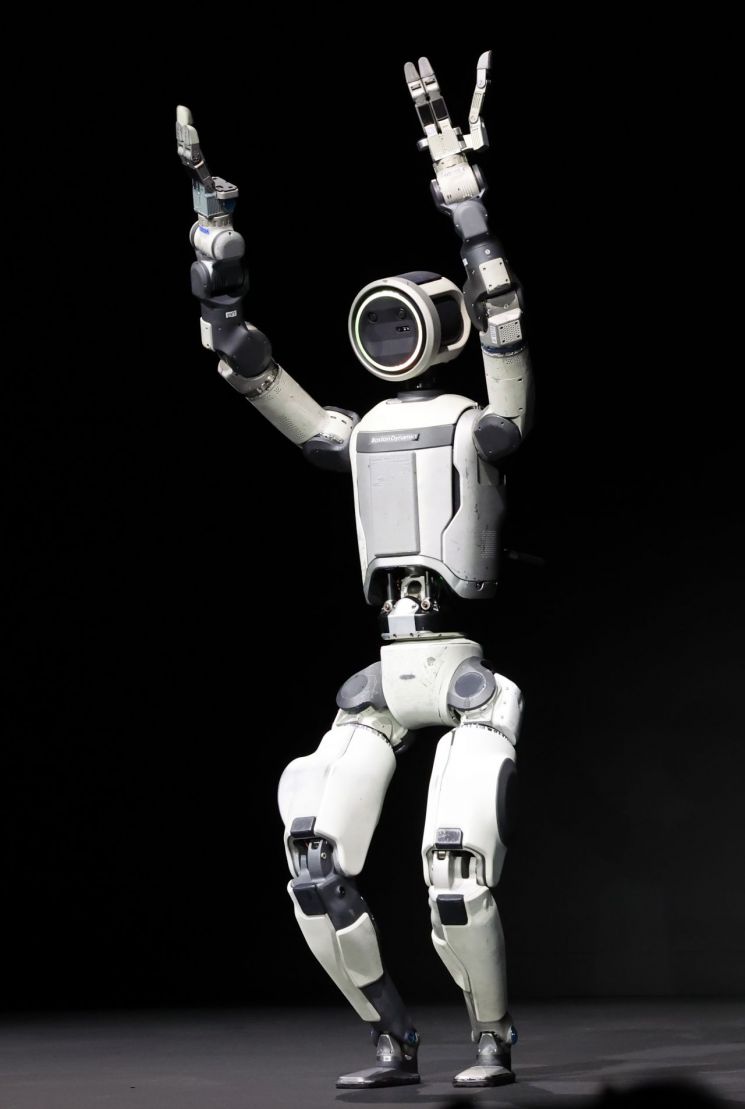 At a Hyundai Motor Group press conference held at Mandalay Bay in Las Vegas, Nevada, on Jan. 5 (local time), one day before the opening of the world's largest consumer electronics and information technology (IT) exhibition CES 2026, the humanoid robot Atlas was unveiled. Jan. 6, 2026 Yonhap News
Humanoid robots are expected to be adopted first and most rapidly at industrial and logistics sites. As of 2030, the penetration rate at industrial and logistics workplaces is forecast to reach about 1%, and 0.7% in the service and retail sectors, expanding further to 25% and 15%, respectively, by 2040.
For household humanoid robots, the initial adoption pace will be slower, but the penetration rate is expected to rise to 0.01% in 2035 and 0.95% in 2040, entering a full-fledged expansion phase. As of 2040, the cumulative number of household robots is projected to reach about 28.2 million units, accounting for more than half of total humanoid robot deployment.
The spread of humanoid robots is also expected to bring structural changes to the battery industry.
The average battery capacity installed per humanoid robot is projected to increase from 1.35 kilowatt-hours (kWh) in 2025 to 1.98 kWh in 2030 and 2.6 kWh in 2035, peaking at 2.74 kWh in 2038. Thereafter, as the share of household robots, which have relatively smaller battery capacities, increases, the average capacity is expected to edge down to 2.59 kWh in 2040.
Total battery capacity (demand) for humanoid robots worldwide is estimated to grow from 0.03 GWh in 2025 to 1.37 GWh in 2030, 17.67 GWh in 2035, and approximately 138.3 GWh in 2040.
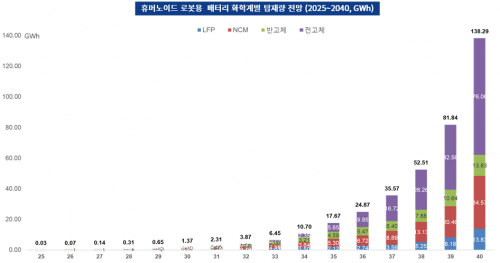
SNE Research expects that in the early stage of humanoid robot deployment, batteries such as nickel-cobalt-manganese (NCM) and lithium iron phosphate (LFP), which offer price competitiveness, will be mainly installed. However, after 2030, the share of semi-solid-state batteries and then all-solid-state batteries is projected to expand rapidly. This is because batteries for humanoid robots must simultaneously satisfy requirements for energy density, safety, and structural batteries (structural batteries are next-generation batteries that serve both as energy storage and load-bearing components).
The company projected that the installed capacity of all-solid-state batteries will surge from 0.04 GWh in 2030 to 5.65 GWh in 2035 and 76.1 GWh in 2040, making them a core pillar of the humanoid robot battery market.
SNE Research estimated that the global market for battery cells for humanoid robots will reach 1.4 billion dollars in 2035 and approximately 10.5 billion dollars (about 15 trillion won) in 2040. A company representative explained, "Compared with electric vehicles, robots are operated under higher load conditions, so their battery replacement cycles are likely to be shorter," adding, "Actual battery demand could grow far beyond current projections."
© The Asia Business Daily(www.asiae.co.kr). All rights reserved.