Cho and Rubio hold first talks since wording of Korea-U.S. JFS was finalized last November... diplomatic circles on alert over possible fallout for "security agreements"
As the United States demanded the implementation of investment commitments in the U.S. and ramped up pressure with a threat to reimpose a 25% tariff, even a visit by South Korea’s top diplomat to Washington failed to produce a solution. With the timing of publication in the U.S. Federal Register seen as imminent, additional consultations between the trade authorities of the two countries are expected to be necessary.
According to the Ministry of Foreign Affairs on the 4th, Minister of Foreign Affairs Cho Hyun held talks with U.S. Secretary of State and National Security Advisor Marco Rubio on the afternoon of the 3rd (local time) in Washington D.C., U.S. After explaining the domestic efforts being made to implement the tariff agreement and the investment commitments in the U.S., he proposed that the two sides continue to cooperate at the diplomatic level so that consultations between the trade authorities can move forward. In connection with this, Yeo Han-gu, Chief Negotiator for Trade at the Ministry of Trade, Industry and Energy, met with Korean reporters at Union Station in Washington D.C. the same day and said, “The U.S. side has not fully understood the parts where our system differs from theirs, and it appears we will have to continue our outreach toward the U.S.”
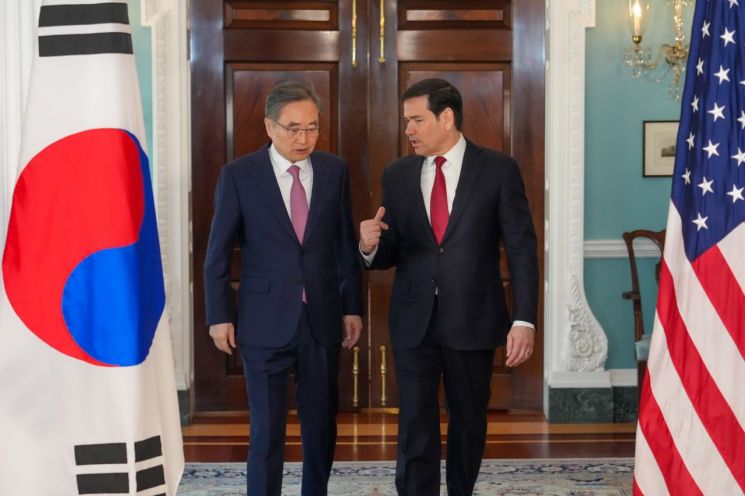 Cho Hyun, Minister of Foreign Affairs (left), and Rubio Marco, U.S. Secretary of State and National Security Advisor, are holding talks in Washington D.C., U.S., on the afternoon of the 3rd (local time). Photo by Ministry of Foreign Affairs
This was the first official meeting between the South Korean and U.S. foreign ministers since the wording of the Joint Fact Sheet (JFS), which reflects the agreement reached at the South Korea-U.S. summit last November, was finalized. Minister Cho asked Secretary Rubio to play a leading role in implementing the nuclear energy-related agreements, such as on uranium enrichment and spent nuclear fuel reprocessing, as well as the security-related agreement on the introduction of nuclear-powered submarines. In response, Secretary Rubio was quoted as saying, “I will encourage the relevant departments so that substantive discussions can take place as soon as possible.”
The diplomatic community is on high alert, concerned that the tariff issue could spill over and affect the security-related agreements, including those on nuclear energy and nuclear-powered submarines. The Ministry of Foreign Affairs’ explanation that “the two ministers agreed to work to expand the positive atmosphere and momentum to ensure faithful implementation of the security-related agreements, while managing the situation in a stable manner” is also seen as reflecting this awareness.
On this point, Min Jeonghoon, professor at the Korea National Diplomatic Academy, said, “Tariff negotiations and the modernization of the alliance should be treated as separate issues,” adding, “An agreement has already been reached at the summit level, and the United States is not trying to scrap the agreement itself, as it wants ‘investment outcomes.’ Rather, it is using tariff pressure as a means to encourage more investment.” He went on to criticize, “While the U.S. is faulting us for delays in our legislative process, it is taking a slow ‘rules-for-thee-but-not-for-me’ approach when it comes to issues that we are trying to push forward, such as the introduction of nuclear-powered submarines or negotiations on enrichment and reprocessing.”
Ha Sang-eung, professor in the Department of Political Science and International Relations at Sogang University, pointed out that the situation should be viewed with caution, saying, “From President Donald Trump’s remarks about raising tariffs onward, everything has proceeded only verbally, so nothing is certain.” However, he also drew a line, saying, “Security agreements such as those on nuclear-powered submarines are not the kind of matters that can be easily brushed aside by saying, ‘Let’s pretend they never happened’ because of the impact of tariff hikes,” and “There is no reason to link the security agreements to the tariff issue.”
Meanwhile, the U.S. Department of State stated that the two sides “reaffirmed their commitment to the complete denuclearization of North Korea.” However, in the materials distributed by the South Korean Ministry of Foreign Affairs, there was no mention of “denuclearization”; instead, it said that “South Korea and the United States agreed to continue sending messages in favor of dialogue toward North Korea and to work to induce North Korea’s return to talks.”
© The Asia Business Daily(www.asiae.co.kr). All rights reserved.