Korea Corporate Governance Forum Seminar
Companies Expected to Fully Mobilize Bypass Strategies Ahead of Amended Commercial Act
Active Proposals by Ordinary Shareholders Needed
Concerns have been raised that companies will resort to various "tricks" at this year's regular shareholders' meetings, which will be the last to be held before the amended Commercial Act takes effect. As voting battles are expected to unfold between ordinary shareholders and companies over agenda items such as amendments to the articles of incorporation, the appointment of directors, and the ceiling on directors' remuneration, analysts say this will mark a turning point in the restructuring of corporate governance in Korea.
On the 3rd, the Korea Corporate Governance Forum held a seminar in Yeouido, Seoul, titled "Shareholders' Meetings That Will Change Under the Amended Commercial Act: Corporate Bypass Strategies vs Ordinary Shareholders' Response Strategies" to discuss these issues.
Ku Hyunju, an attorney at law firm Hannuri, who delivered the first presentation, assessed that "the outcome of this year's regular shareholders' meetings will serve as a watershed for each company in gauging the likelihood of ordinary shareholders entering the board of directors in the future."
With this year's large-scale amendment to the Commercial Act, several measures will be implemented in stages, including the expansion of the aggregate "3% rule" and the independent director system (on July 23), and the mandatory introduction of cumulative voting and the expansion of separate elections when appointing audit committee members (on September 10).
Attorney Ku predicted that "companies will attempt to amend their articles of incorporation in order to create exception clauses related to the holding and disposal of treasury shares so as to avoid obligations such as mandatory cancellation of treasury shares," adding, "They will increase the number of audit committee members to more than three so that even if there are two separately elected audit committee members, they will not constitute a majority, and at the same time, to block cumulative voting, they will stagger the terms of audit committee members so as to limit the number of members appointed at any one time."
To prevent this, she advised that ordinary shareholders should determine whether the shareholders' meeting agenda items are in line with the intent of the amended Commercial Act and should respond in advance by submitting shareholder proposals or soliciting proxies for the exercise of voting rights.
She also projected that the agenda item on the ceiling for directors' remuneration will become a key point of contention. Raising the ceiling on directors' remuneration has long served as a lawful means for controlling shareholders to pursue private gains. When companies increase directors' remuneration costs and at the same time reduce shareholder returns such as dividends, share prices naturally tend to fall. Ultimately, this has allowed them to enjoy double benefits: on the one hand, high remuneration, and on the other, the effect of lowering the assessed value of assets for inheritance and gift tax purposes.
Attorney Shim Hyesup of Law Office Shim, who previously served as a full-time auditor at Namyang Dairy Products, pointed out that "at Korea & Company, Namyang Dairy Products, and others, there have been many controversies, including self-approval cases in which owner-directors themselves raised the ceiling on directors' remuneration," adding, "There have also been cases, such as at Emart and the Taekwang Group, where the owner served as a non-registered director in order to avoid resolutions on the ceiling for directors' remuneration." In fact, at Namyang Dairy Products, there were cases where the remuneration of a single controlling shareholder (former chairman Hong Wonsik) was twice the total amount of dividends paid to all shareholders.
Ultimately, she stressed that shareholders need to make proactive proposals under the amended Commercial Act and related systems. Attorney Shim argued, "There were quite a few companies that had clauses stipulating that even if they caused damage to the company, they would be exempt from liability as long as it was within several times their annual salary. Shareholders need to seek ways to have such clauses deleted by making proposals and increasing dialogue," adding, "Judicial precedents have many limitations, and after the implementation of the duty of loyalty to shareholders, it is important that legislation be refined so that in situations of conflicts of interest among shareholders, minority shareholders and shareholders without conflicts of interest can also participate in decision-making."
Lee Namwoo, chairman of the Korea Corporate Governance Forum, said, "There is a high possibility that companies (controlling shareholders) will employ shareholders' meeting strategies in which they proactively submit agenda items in order to secure an advantageous position before the amended Commercial Act comes into force, and in response, ordinary shareholders and institutional investors may band together, leading to voting battles breaking out in many places," adding, "This year's shareholders' meetings will be hotter than ever."
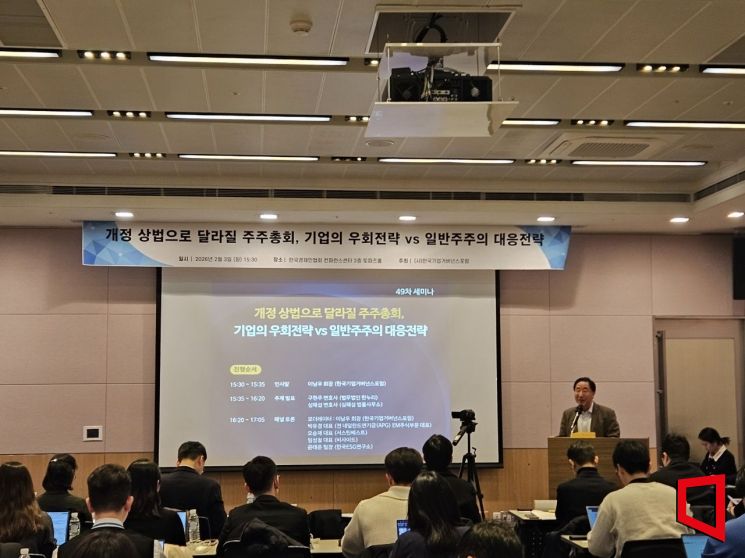 Lee Namwoo, chairman of the Korea Corporate Governance Forum, is delivering opening remarks at the seminar "Shareholders' Meetings under the Amended Commercial Act: Corporate Evasion Strategies vs Ordinary Shareholders' Response Strategies", held on the 3rd in Yeouido, Seoul.
© The Asia Business Daily(www.asiae.co.kr). All rights reserved.