Approved by Central Committee Two Months After Initial Setback
"A Historic Era of One Person, One Vote Has Opened"
The core pledge of Democratic Party of Korea leader Jung Cheongrae, the "one person, one vote system," was finally approved on the 3rd after one failed attempt. Jung explained that it will have the effect of dismantling factions within the party and that anyone will be able to have an opportunity for nomination without having to read the room.
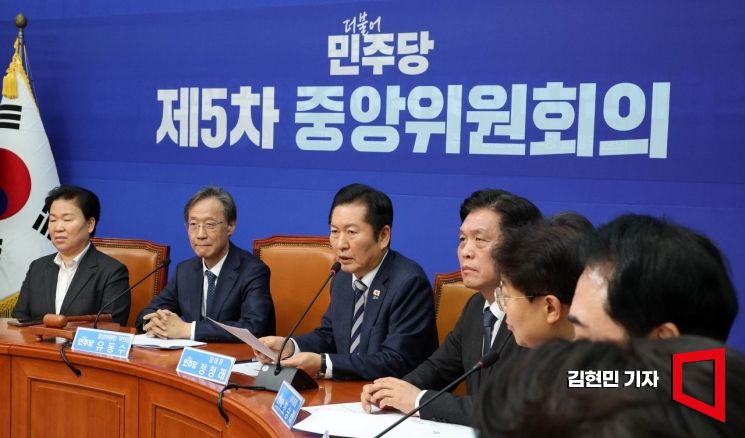
The Democratic Party of Korea announced that, as a result of a vote by the Central Committee, the amendment to the party constitution introducing a one person, one vote system for delegates and dues-paying party members passed on this day with the approval of a majority of incumbent members.
According to the Democratic Party of Korea, 515 out of a total of 590 Central Committee members, or 87.29%, took part in the vote held over two days on the 2nd and 3rd. Of these, 312 members, or 60.58%, voted in favor and 203 members, or 39.42%, voted against, thereby meeting the requirements for passage.
This amendment was pursued as part of Jung's pledge to expand party members' sovereignty. Its main point is to abolish the weighting previously given to delegates' votes in elections for the party leader and Supreme Council members (the party convention).
The amendment to the party constitution was voted down once at the Central Committee in early December last year. Afterward, Jung immediately pushed for it again, and it passed the Central Committee hurdle two months later.
With the passage of this amendment, starting from the party convention in August, both delegates and dues-paying party members will each exercise one equal vote. Jung explained that this will make it possible to realize party democracy in which the party leader and Supreme Council members are elected on a one person, one vote basis.
Immediately after the announcement of the Central Committee vote results, Jung held an emergency press briefing and stressed, "A historic era of one person, one vote in the Democratic Party of Korea has opened." He added, "The most direct effect will be the dismantling of factions within the party."
Jung emphasized, "From now on, it is an era in which party members decide the nominations," and said, "The structure has been changed so that no one can form factions and exercise interests or vested rights over nominations."
He continued, "From now on, the Democratic Party of Korea's elected public officials, members of the National Assembly, local council members, and heads of basic and metropolitan local governments will no longer have to watch the faces of faction bosses, nor will they have to line up behind them."
He also said, "If they are recognized by the party members, anyone will have an equal opportunity for nomination," and added, "Rather than engaging in factional activities, they will devote themselves more faithfully to legislative activities that meet the expectations of the public in order to win the hearts of party members and the people."
In addition, he said, "I feel a sense of fulfillment that I have been able to keep the one person, one vote system, my first key pledge from the party convention, within my term," and added, "Now the Democratic Party of Korea is also able to realize broader and more equal democracy, and better democracy."
This amendment also includes supplementary measures for strategic regions such as Yeongnam. One of the two appointed Supreme Council member positions will be preferentially allocated to a strategic region, and votes cast in strategic regions will be given additional weight, with the exact ratio to be decided by the party convention preparation committee.
Meanwhile, on this day the Central Committee also approved the agenda item concerning the Central Party's financial management plan and budget review. This item passed with 491, or 95.34%, of the 515 Central Committee members who participated in the vote voting in favor.
© The Asia Business Daily(www.asiae.co.kr). All rights reserved.