English and Korean Notices Thank Customers for Their Support
Chinese Notice Uses Blunt Phrases Like "No Entry"
Views Split Between "Deliberate Discrimination" and "Simple Misunderstanding"
All Foreign-Language Notices Removed as Controversy Grows
Amid ongoing diplomatic tensions between China and Japan, a coffee shop in Tokyo, Japan has come under fire after posting a closure notice in multiple languages. In particular, the fact that only the Chinese notice used a stiff, blunt expression has drawn criticism.
On February 3, Yonhap News TV, citing foreign media outlets including Taiwan's TVBS and Hong Kong's Sing Tao Daily, reported that a coffee shop in Tokyo is facing an online backlash for using an unusually blunt closure phrase only in its Chinese notice.
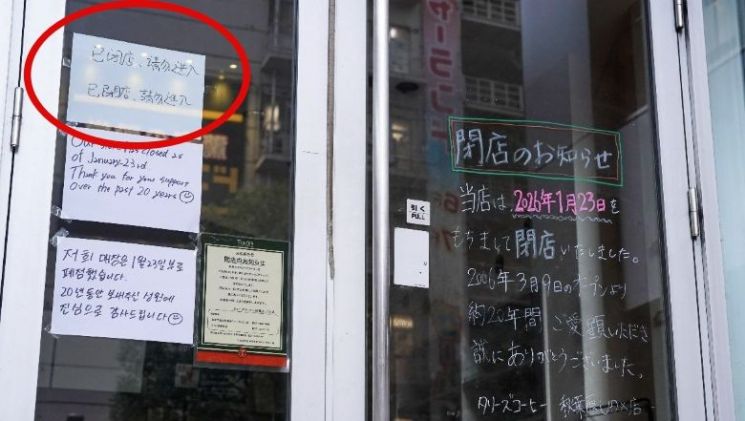
Earlier, on January 23, the Tokyo Akihabara branch of the Japanese coffee franchise Tully's Coffee closed down after about 20 years in business. The controversy centered on the closure notice posted outside the store. The notice was written in Japanese, English, Korean, and Chinese, but the wording differed markedly by language.
The English and Korean notices, accompanied by a smiling face illustration, carried the phrase, "We sincerely appreciate your support over the past 20 years," conveying a relatively warm tone. In contrast, the Chinese notice, without any illustration, contained only a short phrase along the lines of "Closed, no entry." This discrepancy spread quickly across social media. A photo of the notices posted on X (formerly Twitter) by one user had garnered more than 3.4 million views as of February 3, drawing significant attention.
Online reactions have been divided. Some users argued that "the feelings toward Chinese people are plainly reflected in the notice," or that "if the no-entry rule is not clearly stated, there could be concerns about unauthorized entry." Others suggested that "an employee unfamiliar with Chinese may have chosen the simplest wording to avoid misunderstandings," or that "the expression may sound stiff, but it cannot be categorically labeled as rude." As the controversy grew, Tully's Coffee removed all the Chinese, English, and Korean notices from the store door, leaving only the Japanese announcement in place.
This controversy has drawn even more attention as it coincides with the recent deterioration in China-Japan relations. The two countries have continued to clash over issues such as the discharge of contaminated water from the Fukushima nuclear power plant, as well as various security and economic matters. In the wake of these tensions, there have been a series of cases in Japan where warning signs or restriction notices apparently targeting Chinese people at certain shops and facilities have sparked controversy. Previously, some restaurants and lodging facilities in Japan posted entry restrictions or additional notices specifically for Chinese customers, triggering accusations of discrimination, and many users on Chinese social media have reacted by interpreting such signs as "unofficial signals of exclusion."
© The Asia Business Daily(www.asiae.co.kr). All rights reserved.