After 'Black Monday' Triggered by Hawkish Fed Chair Nominee
Experts Say "Korean Stock Market May Pause After Short-Term Surge"
"KOSPI's Sustained Uptrend Hinges on US Rate Cut Policy"
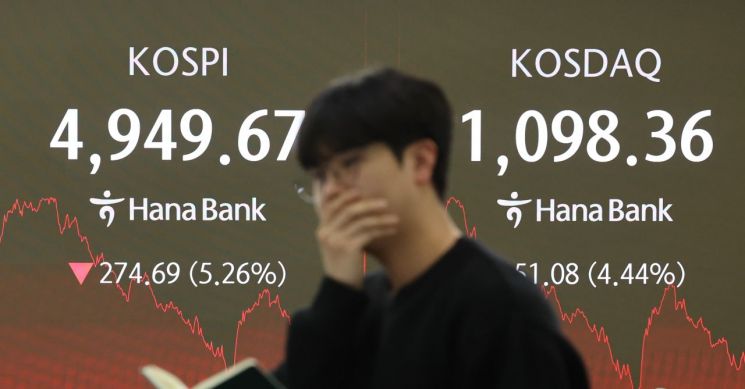 On the 2nd, due to the weak performance of the US stock market, the KOSPI fell below the 5,000 mark. The closing prices of KOSPI and KOSDAQ are displayed on the status board in the dealing room of Hana Bank in Jung-gu, Seoul. Photo by Yonhap News
After the nomination of Kevin Warsh, a former Fed governor known for his hawkish (monetary tightening) stance, as the next chair of the US Federal Reserve, the Korean stock market plunged on February 2 but is attempting a rebound on February 3. Experts have pointed out that, given the Korean stock market has risen the most among global markets recently, a period of price correction may occur in the short term.
However, many also forecast that, since the business outlook for major industries including semiconductors remains strong, the market could resume its upward trend after a period of consolidation. In particular, if Warsh and other Fed officials send positive signals regarding interest rate cuts, a sustained rebound could follow, with the KOSPI expected to challenge the 6000-point mark again.
After 'Black Monday' Triggered by Hawkish Fed Chair Nominee, Market Attempts Rebound
On February 3, the KOSPI index opened at 5114.81, up 165.14 points (3.34%) from the previous session. The KOSDAQ also started at 1135.94, up 37.58 points (3.42%) from the previous close.
This is interpreted as the result of a rise in the US stock market the previous day, which influenced the Korean market. On February 2 (local time), the Dow Jones Industrial Average rose 1.05% from the previous session, and the Nasdaq climbed 0.56%. The January Manufacturing Purchasing Managers' Index (PMI) announced by the Institute for Supply Management (ISM) came in at 52.6, a significant increase from 47.9 in the previous month, which boosted technology stocks such as semiconductors.
Although the Korean market succeeded in rebounding, securities analysts believe that a period of volatility with repeated ups and downs may persist for some time. On the previous day, the KOSPI closed at 4949.67, down 274.69 points (5.26%) from the previous session, falling below the 5000-point level. Due to the sharp drop, the first stock market sell-sidecar (a program trading sell order suspension mechanism) of the year was triggered at 12:31 p.m. This was the first time the KOSPI sell-sidecar had been activated in about three months, since November 5 of the previous year. At that time, concerns about US monetary tightening also led to a steep decline in the index.
The news that former Fed Governor Warsh, known for his hawkish stance, was selected as the next Fed chair by US President Donald Trump acted as a destabilizing factor in the market. Warsh had previously expressed critical views during his tenure at the Fed in 2010, warning that quantitative easing could trigger inflation. His hawkish track record emerged as a negative factor for the market.
Additionally, the prices of silver and gold, which had surged due to speculative trading since last year, plummeted by more than 30% in a single day, sending shockwaves through the stock market. On January 30, at the COMEX (a metals futures exchange under the Chicago Mercantile Exchange Group), April gold futures and March silver futures plunged by 11.4% and 31.4%, respectively.
Suh Sangyoung, a researcher at Mirae Asset Securities, explained, "The starting point of the Asian market plunge is believed to be not economic or corporate fundamentals, but rather a collapse in collateral and leveraged structures triggered by the sharp drop in gold and silver prices." He added, "Investors who jumped on the bandwagon of speculative price surges and bought large amounts of silver futures are now facing forced liquidation due to margin calls, leading them to quickly sell off stocks, index futures, and cryptocurrencies that can be easily converted to cash, which is impacting the market."
The reason the KOSPI's decline was steeper than other markets is attributed to the fact that it had surged more than 75% last year and rose another 24% in January alone this year, creating short-term overheating concerns. Han Jiyoung, a researcher at Kiwoom Securities, diagnosed, "The burden from the rapid rise in the index and the desire to realize profits became linked with negative factors from the Fed and commodity markets, intensifying selling pressure."
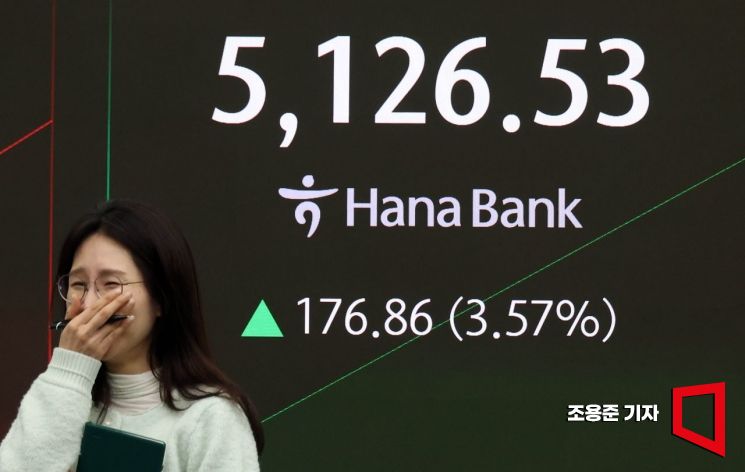 On the 3rd, at the dealing room of Hana Bank headquarters in Jung-gu, Seoul, an employee is monitoring the stock market and exchange rates as the KOSPI started with a 3% rise, reclaiming the 5000 mark just one day after a sharp plunge. On this day, the KOSPI index opened at 5114.81, up 165.14 points (3.34%) from the previous session. February 3, 2026 Photo by Jo Yongjun
Experts Say "Korean Stock Market May Pause After Short-Term Surge"
Experts believe the Korean stock market may experience a correction for the time being. As the market's growth rate last month was the highest since the 2000s, analysts expect that the current situation will lead to a period of consolidation in February.
Lee Jinwoo, head of the research center at Meritz Securities, said, "The ambiguous policy stance of the new Fed chair is the reason for this correction," adding, "Internally, there was already fatigue from the rapid rise in the domestic stock market, and the uncertainty has increased volatility." He continued, "While this may not be a sustained downtrend, volatility in the stock market could remain elevated for some time."
Jo Suhong, head of research at NH Investment & Securities, commented, "Gold and silver prices have risen significantly, and our stock market has also surged recently, so the accumulated fatigue seems to have triggered the correction." He added, "Nevertheless, we do not expect the semiconductor and artificial intelligence (AI) cycles to end in the short term, and with positive policy factors such as the third amendment to the Commercial Act, the market outlook remains positive."
Some analysts say that for the Korean stock market to resume a sustained upward trend, dovish comments from Warsh or further indications of rate cuts from Fed governors will become increasingly important influences from the US market. Lee Kyungmin, a researcher at Daishin Securities, said, "For now, we must consider the possibility of increased volatility in asset prices and financial markets due to liquidity concerns," but added, "As the market cools off from short-term overheating and profit-taking, if the Fed's independence is ensured and Warsh's stance becomes more dovish than before, volatility will gradually subside."
Lee Jaeman, a researcher at Hana Securities, stated, "The replacement of the Fed chair served as a trigger for the correction at a time when investors' desire to realize profits was heightened by the KOSPI's record-breaking returns in January." However, he added, "A bull market typically ends with an actual Fed rate hike, the spread of credit risk, or when the leading sector's profit and profitability cycle peaks, but there are no such signs yet."
Meanwhile, the Korean government announced that, in light of significant volatility in the domestic financial and foreign exchange markets, it will continue to operate a 24-hour monitoring system to closely track trends in domestic and international markets, given global uncertainties such as US tariff policies and geopolitical conflicts. On this day, the Ministry of Economy and Finance held a market situation review meeting chaired by First Vice Minister Lee Hyungil to assess the impact of the Fed chair nomination on the domestic financial market.
The meeting was attended by the Deputy Governor of the Bank of Korea, the Vice Chairman of the Financial Services Commission, and the Senior Deputy Governor of the Financial Supervisory Service. Participants assessed that the previous day's correction in the KOSPI was due to the decline in the US stock market following the Fed chair nomination and short-term profit-taking after the recent steep rise in stock prices. They also noted that volatility in the won-dollar exchange rate has increased in line with recent global financial market trends.
© The Asia Business Daily(www.asiae.co.kr). All rights reserved.














![The Special Connection Between the Statue of Martyr Lee Jun in Jangchungdan Park and Mayor Oh Sehoon ③ [Current Affairs Show]](https://cwcontent.asiae.co.kr/asiaresize/319/2026012110001599450_1768957215.jpg)

