"India to Halt Russian Oil Purchases and Increase Imports from the U.S."
On February 2 (local time), U.S. President Donald Trump announced that the reciprocal tariff on India would be reduced from 25% to 18%. This decision follows India's agreement to halt purchases of Russian crude oil. As a result, the 25% punitive tariff imposed on oil transactions with Russia will also be lifted, and tariffs on Indian imports will be significantly lowered from 50% to 18%.
President Trump stated on his social networking service, Truth Social, that he spoke with Indian Prime Minister Narendra Modi that morning and discussed a range of topics, including an end to the Russia-Ukraine war.
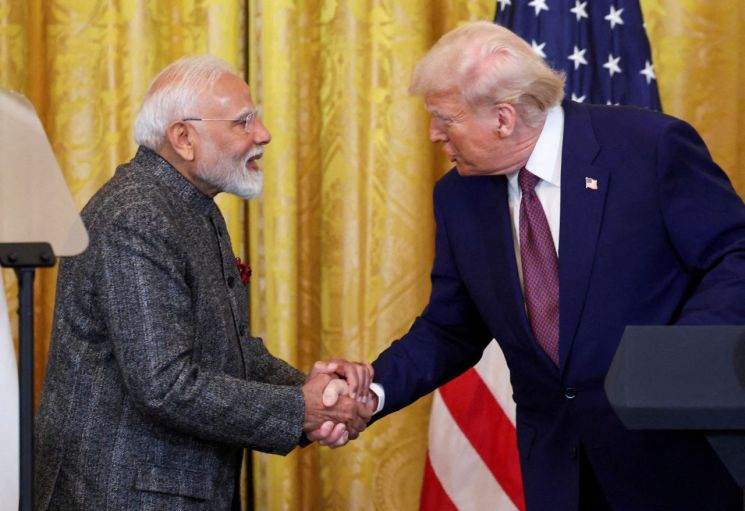 U.S. President Donald Trump (right) and Indian Prime Minister Narendra Modi. Photo by Reuters Yonhap News
He said, "Prime Minister Modi has agreed to stop purchasing Russian crude oil and to buy more from the United States and, potentially, Venezuela," adding, "This will help bring an end to the war in Ukraine, which is claiming thousands of lives every week."
He continued, "Based on my friendship and respect for Prime Minister Modi, and at his request, I have agreed to a U.S.-India trade deal that will take effect immediately," and added, "The United States will reduce the reciprocal tariff on India from 25% to 18%."
President Trump has repeatedly urged India to stop buying Russian crude oil, arguing that such purchases are funding Russia’s war effort. The United States had imposed a high tariff rate on India, totaling 50%, which included a 25% reciprocal tariff and an additional 25% punitive tariff for oil transactions with Russia.
According to White House officials, the United States will lower the reciprocal tariff from 25% to 18% and withdraw the 25% punitive tariff on imports of Russian crude oil. As a result, tariffs on Indian exports to the United States will be sharply reduced from 50% to 18%.
President Trump stated, "India will also work to bring tariffs and non-tariff barriers on U.S. goods down to zero," and added, "Prime Minister Modi has pledged to pursue an even higher level of 'Buy American,' in addition to purchasing over 500 billion dollars’ worth of American energy, technology, agricultural products, coal, and other goods." He also said, "Our remarkable relationship with India will only grow stronger in the future."
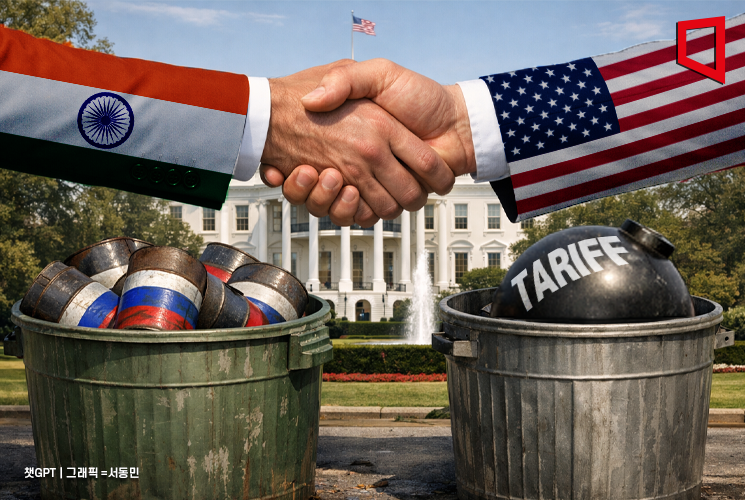
Although President Trump said the agreed measures would take effect without delay, CNBC pointed out that the specific details of the agreement have not yet been released and it remains unclear whether it has been signed.
Prime Minister Modi also revealed on social media platform X (formerly Twitter) that he had spoken with President Trump, saying, "I am pleased that the tariff on Indian goods has been reduced to 18%," and added, "On behalf of 1.4 billion Indians, I thank President Trump for this excellent announcement." However, Prime Minister Modi did not mention halting Russian crude oil imports or plans to lower tariffs on American products.
President Trump’s announcement of a tariff reduction for India comes just one week after India signed a free trade agreement (FTA) with the European Union (EU) on January 27. At the time, some experts predicted that the India-EU negotiations could spur India and the United States to pursue a bilateral agreement.
Meanwhile, on January 26, President Trump warned of a tariff increase on South Korea, citing delays in the passage of the Special Act on Investment in the United States. This stands in stark contrast to the tariff reduction announced for India. Even as the U.S. Supreme Court is reviewing cases involving its ally South Korea and partner nation India, the United States continues to use tariffs as a tool for diplomatic pressure and leverage.
© The Asia Business Daily(www.asiae.co.kr). All rights reserved.














![The Special Connection Between the Statue of Martyr Lee Jun in Jangchungdan Park and Mayor Oh Sehoon ③ [Current Affairs Show]](https://cwcontent.asiae.co.kr/asiaresize/319/2026012110001599450_1768957215.jpg)

