Study Released Ahead of Japan’s Lower House Election
Survey of 1,500 Japanese Citizens Conducted
"Unconscious Bias: Voters Expect More Smiles from Women"
A study from Japan has found that female politicians experience a decline in approval ratings when wearing masks. This effect was not observed for male politicians, indicating that the same condition-wearing a mask-has contrasting impacts on political evaluations depending on gender.
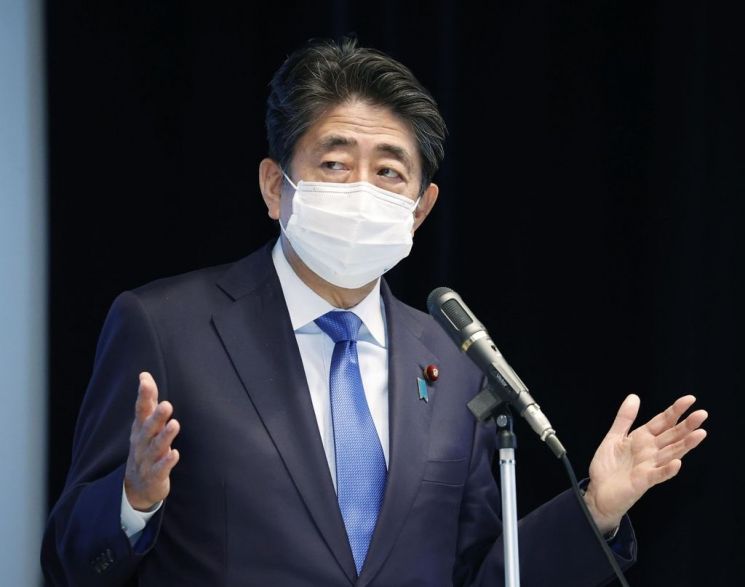
According to Kyodo News on February 2, the study was jointly conducted by Associate Professor Muroga Kiho of Kyushu University (Labor Economics) and Professor Charles Crabtree of the Department of Political Science at Dartmouth College in the United States. The researchers surveyed 1,508 Japanese men and women aged 18 to 74 in August 2020, during the spread of COVID-19.
In the survey, respondents were shown photos of major Japanese politicians, including then-Prime Minister Shinzo Abe and Tokyo Governor Yuriko Koike. The photos were divided into those with and without masks. Respondents rated each figure on six items-approval, attractiveness, competence, intelligence, strength, and trustworthiness-on a five-point scale.
The results showed that for male politicians, there was no significant difference in evaluations based on whether or not they wore a mask. In contrast, for female politicians, approval ratings were found to be statistically significantly lower in photos where they were wearing masks.
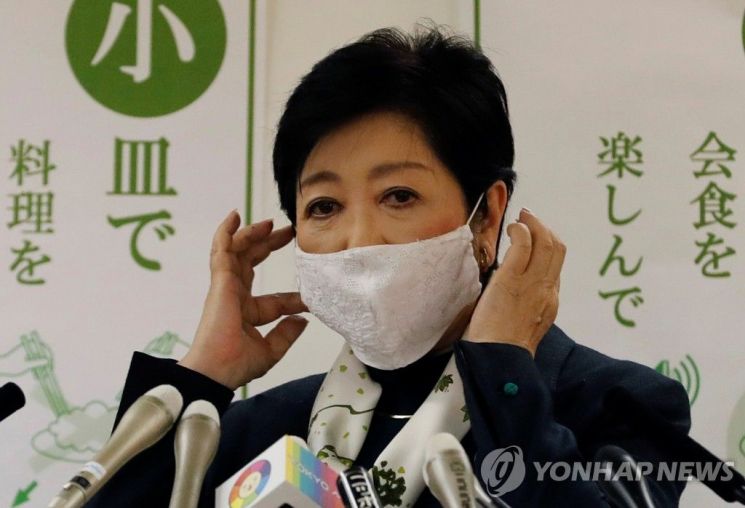 Governor Yuriko Koike of Tokyo, Japan, wearing a mask during a COVID-19 countermeasure press conference in 2020. Photo by Reuters and Yonhap News Agency
The researchers noted that it is difficult to definitively determine the cause of this difference, but suggested that unconscious voter bias may play a role, with voters possibly expecting more smiles from female politicians. They explained that when facial expressions are obscured by a mask, this may be perceived as failing to meet such expectations.
Associate Professor Muroga explained, "The difference in perception due to mask-wearing may disadvantage only female politicians." He added, "Strategic consideration of communication methods is necessary in election campaigns." He also stated, "Voters should be mindful of their unconscious biases toward female politicians."
The results of this study were published in an international academic journal last month.
Meanwhile, Japan will hold its House of Representatives general election, equivalent to the lower house, on February 8. This election was triggered when Prime Minister Sanae Takaichi abruptly dissolved the House of Representatives on the first day of the regular session on January 23. Whether the ruling Liberal Democratic Party will secure a single-party majority of 233 out of 465 seats is emerging as a key point of interest.
© The Asia Business Daily(www.asiae.co.kr). All rights reserved.









![The Special Connection Between the Statue of Martyr Lee Jun in Jangchungdan Park and Mayor Oh Sehoon ③ [Current Affairs Show]](https://cwcontent.asiae.co.kr/asiaresize/319/2026012110001599450_1768957215.jpg)

