European Researchers: "Long-Term Observation Over One Year and Liver Cancer Data Are Essential"
Increased Time, Cost Burden, and Higher Risk of Failure
Few Cases of Domestic Companies Reflecting This in Preclinical Design
There have been calls to fundamentally reassess the preclinical approaches to developing new drugs for MASH (Metabolic Dysfunction-Associated Steatohepatitis), a field where global pharmaceutical companies have invested trillions of won but have repeatedly failed. Experts argue that, beyond simply reducing liver fat or improving liver enzyme levels, it is necessary to verify the potential for suppressing hepatocellular carcinoma (HCC) starting from the preclinical stage.
Analysts have also pointed out that the current preclinical methods, which artificially induce the disease in a short period, make it difficult to meet such criteria. There are concerns that the preclinical designs commonly used by domestic pharmaceutical and biotech companies have limitations in predicting clinical success.
According to the bio industry on February 3, a European research team supported by Boehringer Ingelheim recently published a paper in the international journal 'Nature Reviews Gastroenterology & Hepatology,' arguing that widely used short-term preclinical models cannot accurately predict the clinical success of MASH therapeutics. They insist that the entire progression of MASH to liver cancer should be replicated from the preclinical stage, and it must be confirmed whether the drug can suppress disease progression itself.
Although the MASH therapeutics market is expected to grow to 40 trillion won annually in the future, development results so far have fallen far short of expectations. Leading drug candidates, including Gilead Sciences’ Selonsertib, which received massive investments, have repeatedly failed in Phase 3 clinical trials. While efficacy was confirmed in preclinical animal studies, the same results could not be replicated in humans.
The research team identified excessive reliance on short-term indicators such as liver fat content or enzyme levels during the preclinical stage as a cause of failure. They explained that inducing the disease in most cases within 8 to 12 weeks to check for changes in these indicators does not adequately reflect the decades-long progression of the disease in humans.
For successful new drug development, the researchers highlighted long-term observation and acquisition of liver cancer data as key preclinical requirements. They emphasized that it is necessary to observe for more than 54 weeks, equivalent to half the lifespan of laboratory mice, and provide actual data on disease progression and suppression of liver cancer development.
The preclinical criteria suggested by the research team could become a new barrier to entry for domestic biotech companies. This is because the need for long-term observation of more than a year would extend development timelines and significantly increase costs. Additionally, the requirement to confirm the occurrence of liver cancer raises the risk of failure.
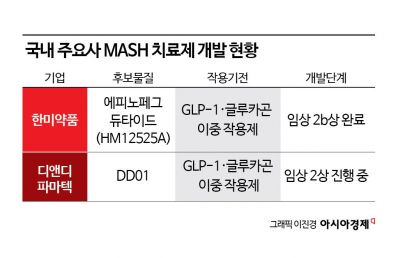
In fact, there are reportedly still few domestic cases where such preclinical designs have been fully applied in the development process. For example, Hanmi Pharmaceutical’s candidate epinopegdutide, which was licensed out to Merck (MSD) in the United States, did not undergo long-term observation exceeding 54 weeks during the preclinical stage.
Similarly, D&D Pharmatech’s candidate DD01, currently under development, also did not include long-term observation in the preclinical phase. The company explained that it evaluated the drug’s efficacy over about eight weeks using a representative MASH animal model, and its main development target is the F2-F3 patient group, which is at the intermediate stage of fibrosis. F2-F3 refers to the stage where inflammation and fibrosis have progressed in the liver, but before the onset of cirrhosis or liver cancer. As a result, long-term natural history models that extend to cirrhosis or liver cancer were not included in the preclinical design.
Domestic companies also agree with the overall direction of the preclinical criteria proposed by the research team. However, they state that in actual development, they have no choice but to prioritize the speed of clinical entry and indication strategy.
A Hanmi Pharmaceutical representative said, "The key in MASH preclinical studies is how well the effects observed in animal experiments translate to humans, and the connection to human disease is critical." The company explained that it has evaluated reproducibility across various MASH models. A D&D Pharmatech representative stated that liver cancer-related evaluations may be determined according to the partner company’s development strategy after technology transfer. The company added that the current preclinical design is a strategic choice to quickly confirm the efficacy of candidate substances and expedite clinical entry.
© The Asia Business Daily(www.asiae.co.kr). All rights reserved.