Supplier Deliveries Restricted Amid Liquidity Crisis
Shortened Settlement Periods and Supply Based on Payment Status
Stark Contrast with Rivals Expecting Lunar New Year Gift Set Boom
Worsening Situation with Unpaid Wages and Overdue Bills
#A distribution company that supplies livestock products to department stores and large supermarkets recently reduced the volume supplied to Homeplus by about 40 to 50 percent compared to before. This decision was made due to concerns that it may be difficult to receive payment on time amid worsening liquidity. On February 2, a representative from a supplier stated, "Previously, Homeplus would settle payments within 30 to 40 days after delivery, but now we only supply limited quantities that can be settled within 10 days." The representative added, "Ahead of the Lunar New Year, Homeplus requested popular beef gift sets with the condition of settling payments within two to three days, so we are supplying only set products on a limited basis, depending on payment status, instead of supplying by individual cuts."
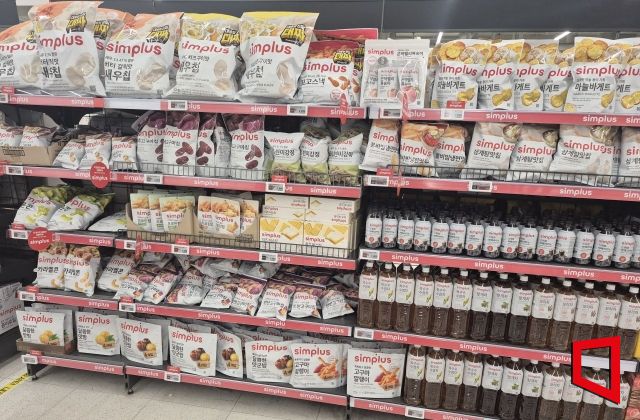 A processed food shelf at a Homeplus store in the Seoul metropolitan area is filled with Homeplus private brand (PB) products. Photo by Heungsun Kim
While offline distribution channels are intensifying their discount campaigns and strengthening their gift set offerings ahead of the Lunar New Year, the atmosphere at Homeplus is quite different. At a Homeplus store in the Seoul metropolitan area, supplier products were mostly limited to fresh foods with short shelf lives, such as fruits, vegetables, and fish. Most of the shelves in other product categories were filled with Homeplus’s private brand (PB) “Simple Plus” products.
Simple Plus products were concentrated in key grocery items such as milk, snacks, and beverages, while national brand (NB) products were only occasionally seen among processed foods with relatively longer shelf lives. A store representative explained, "Due to payment issues, product supply has not been smooth, so except for items we already have in stock, the empty spaces have been replaced with PB products for quite some time." Even when products are brought in with difficulty, customer traffic has decreased compared to before, so stores are encouraging purchases with 1+1 promotions or additional discounts. In the meat section, a sign announced a 30 percent discount on domestic pork belly compared to the regular price, and an additional 10 percent discount is offered only on weekends.
One Year Since Homeplus Entered Corporate Rehabilitation... Delayed Wages and Unpaid Social Insurance Premiums
On March 4, it will be one year since Homeplus filed for corporate rehabilitation, and the company's financial situation is showing its limits. In December last year, the monthly salaries, which had been paid on the 21st of each month, were distributed in two installments, and the salary for last month, the first payday of the new year, has yet to be paid. A Homeplus representative said, "Not only salaries, but also the annual bonuses that used to be paid a week before the Lunar New Year will definitely not be given this year, which is causing great concern among employees. Those who are in urgent need of living expenses are considering canceling their savings accounts or looking into personal loans, but even this is difficult because the four major social insurance premiums have not been paid on time."
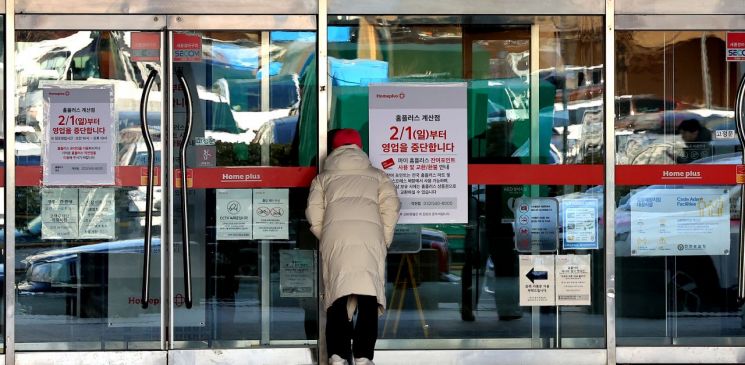 A notice announcing the suspension of operations is posted at the Homeplus Gyesan branch in Gyeyang District. Photo by Yonhap News
Homeplus and its major shareholder, private equity fund manager MBK Partners, have recently closed 17 stores, separated and sold the supermarket (SSM) division, and submitted a rehabilitation plan to the court that includes closing 41 underperforming stores over the next six years. On January 27, they announced a voluntary retirement program for managers at the deputy general manager level and above. MBK Partners has also provided 100 billion won in emergency debtor-in-possession (DIP) financing and requested an additional 100 billion won each from its largest creditor, Meritz Financial Group, and the state-run Korea Development Bank, for a total of 300 billion won in support, but these institutions have not responded.
A supplier representative commented, "Homeplus says that if emergency operating funds are injected, there will be no issues with normal business operations such as payment, but with not only employee wages but also taxes and utility bills already in significant arrears, it is questionable how effective this will be." The representative added, "Partner companies will have no choice but to continue supplying products on a limited basis while monitoring the situation."
Intensive Restructuring and Corporate Rehabilitation Plan... Labor Union Conflict Persists
As liquidity pressures surrounding the company reach their peak, the voices of divided employee groups are becoming increasingly polarized. Currently, there are two Homeplus labor unions: the Homeplus branch of the Mart Industry Labor Union under the Korean Confederation of Trade Unions, and the General Labor Union. Last month, the General Labor Union announced that 87 percent of employees supported the restructuring-focused rehabilitation plan. The Hanmaeum Council, the employee representative body, also agreed with the General Labor Union, stating, "We recognize the crisis the company is facing, and although painful decisions and hardships will inevitably follow in order to implement the rehabilitation plan, we fully agree that this is the last opportunity for Homeplus to recover."
In contrast, the Homeplus branch of the Mart Labor Union maintains that the rehabilitation plan proposed by management is essentially aimed at liquidation and is therefore unacceptable. Starting February 3, Ansuyong, head of the Homeplus branch of the Mart Labor Union, has announced another hunger strike, following a similar protest in November last year.
© The Asia Business Daily(www.asiae.co.kr). All rights reserved.









![The Special Connection Between the Statue of Martyr Lee Jun in Jangchungdan Park and Mayor Oh Sehoon ③ [Current Affairs Show]](https://cwcontent.asiae.co.kr/asiaresize/319/2026012110001599450_1768957215.jpg)

