Government Moves to Revise Enforcement Regulations
Expansion to Central Seoul Announced
Supply Methods and Pricing to Be Unveiled Next Month
For the 60,000 housing units planned for central areas of the Seoul metropolitan area, including the Yongsan International Business District, as announced in the January 29 housing supply measures, a public equity accumulation-type housing scheme is expected to be applied, allowing residents to move in by paying only 10% of the sale price upfront. The Ministry of Land, Infrastructure and Transport is currently working on revising the enforcement rules to establish a quota system for special supply within the equity accumulation-type model. According to the proposed revision, 70% of future equity accumulation-type housing units will be allocated for special supply. Attention is focused on whether this equity accumulation-type model, which has so far been promoted mainly in suburban areas such as Gwangmyeong and Suwon in Gyeonggi Province, will be expanded to central districts like Yongsan in Seoul.
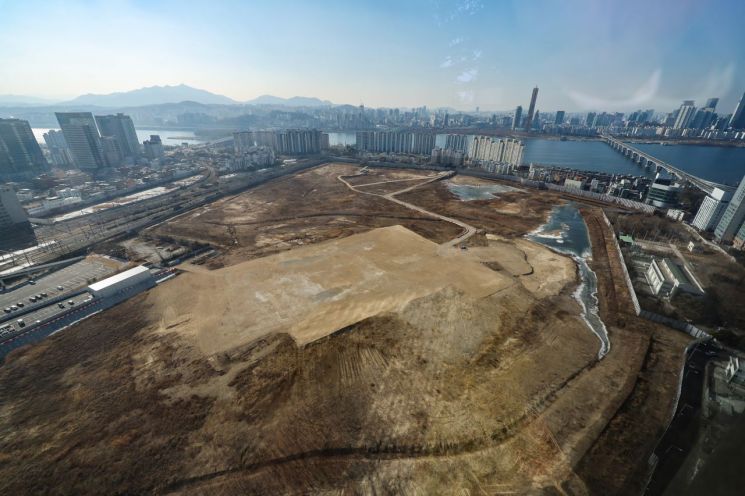 Recently, the government announced the "Plan to Expand and Accelerate Urban Housing Supply," which includes plans to start construction on approximately 60,000 housing units by utilizing idle land and aging government buildings in Seoul, Gyeonggi Province, and Incheon. The photo shows the site of the Yongsan International Business District in Seoul, where 10,000 housing units are scheduled to begin construction in 2028. Photo by Yonhap News
According to the Ministry of Government Legislation on February 3, the draft amendment to the Enforcement Rules of the Special Act on Public Housing, which is open for public comment until February 9, stipulates that 70% of equity accumulation-type housing units will be allocated for special supply. For example, in a complex of 1,000 units with 500 equity accumulation-type units, 350 units (70%) would be allocated for special supply, and the remaining 150 units for general supply. This is the first time a separate special supply system has been established exclusively for equity accumulation-type housing.
A new category for young people (unmarried individuals aged 19 to 39) has been introduced within the special supply, accounting for 15% of the allocation. Even if they live with their parents, as long as the applicant is a non-homeowner, they are eligible to apply, but only for units of 60 square meters or less. The applicant's income must be no more than 140% of the previous year's average monthly income of urban workers, and they must have been enrolled in a subscription savings account for at least six months with at least six deposits. Residents will be selected based on a scoring system that considers income, length of residence, number of subscription deposits, and period of income tax payment.
Other special supply categories include 20% for households with children under the age of two, 15% for newlyweds, engaged couples, and single-parent families, 10% for multi-child families, 7% for first-time homebuyers, and 3% for those supporting elderly parents. The remaining 30% will be for general supply, but half of these will also be prioritized for households with children under two. If a child is born after June 19, 2024, applicants can apply one additional time even if they have previously won a special supply allocation, and current homeowners may also apply if they agree to sell their existing home before moving in. The revised rules are expected to take effect as early as March or April, following the end of the public comment period and further review by the Ministry of Government Legislation.
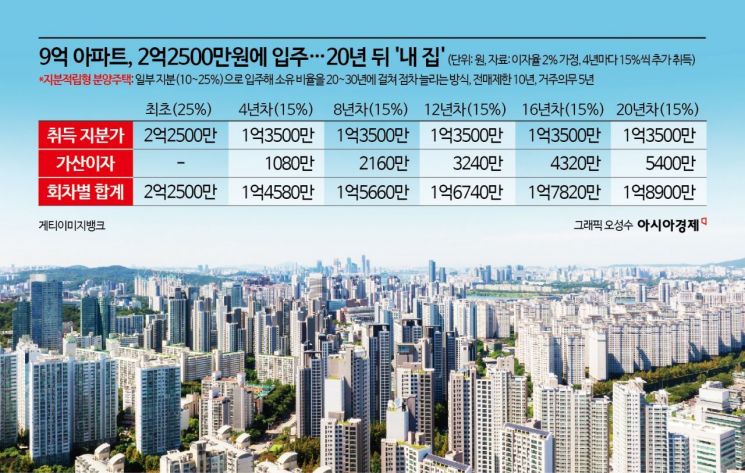
The legal framework for equity accumulation-type housing was established in 2021, but there have been no government-led supply cases until now. The Lee Jaemyung administration has made this a core housing policy and is moving to expand it in earnest. Under this model, residents pay only 10 to 25% of the sale price at the time of move-in, and acquire the remaining equity over 20 to 30 years in installments. Legally, these are classified as "for-sale housing," but the nature is different. Until full ownership is achieved, residents must pay rent to the public institution for the remaining shares, making it a hybrid model that combines elements of both rental and for-sale housing. Once the resident has accumulated 100% equity, they gain full ownership of the home.
The Ministry of Land, Infrastructure and Transport is also set to announce a comprehensive housing welfare roadmap in March, which will include the full-scale implementation of the equity accumulation-type model. On the day the January 29 measures were announced, Minister Kim Yoonduk stated at a briefing, in response to a question about the ratio of rental to for-sale units for young people and newlyweds, "We plan to announce the housing welfare roadmap in the first half of the year," and added, "We will prepare an active housing welfare plan for young people and newlyweds." Previously, at his confirmation hearing in July last year, Minister Kim said, "There are various forms of public for-sale housing, such as equity accumulation-type and profit-sharing-type models," and "We will diversify supply methods to suit their characteristics."
First Vice Minister Kim Itak went a step further the next day. In a recent radio program, when asked, "How many of the 60,000 units will be supplied to young people and newlyweds?" he replied, "To restore the housing ladder for ordinary citizens, we will include that information in the 'housing welfare plan' to be released around March," and added, "We will announce a comprehensive plan that considers whether the units will be public for-sale or public rental, equity accumulation-type or general for-sale, and what constitutes an affordable price."
However, at the roadmap stage, only the total supply, principles, allocation by type, and price standards will be presented, and the final quantity and method for each project site have yet to be determined. A Ministry of Land, Infrastructure and Transport official said, "In line with the March 'housing welfare plan,' we will also further develop the supply plans for the 60,000 units under the January 29 measures and other individual projects," adding, "The specific supply method and allocation for each project will be finalized through consultations with local governments and project sites."
© The Asia Business Daily(www.asiae.co.kr). All rights reserved.














![The Special Connection Between the Statue of Martyr Lee Jun in Jangchungdan Park and Mayor Oh Sehoon ③ [Current Affairs Show]](https://cwcontent.asiae.co.kr/asiaresize/319/2026012110001599450_1768957215.jpg)

