Addressing Housing Blind Spots Through Integrated Housing Policy
51 Projects Including Risk Accommodation Grading System and Fall Prevention
Seongdong District in Seoul (Mayor Jung Wono) announced that it will establish and implement the "2026 Comprehensive Housing Plan" with the goal of guaranteeing housing rights for all residents.
This plan sets three main objectives: housing safety, housing security, and a housing welfare ecosystem. The district has finalized nine strategies and 51 detailed projects, allocating a total budget of 28.1 billion KRW to build a robust housing welfare safety net.
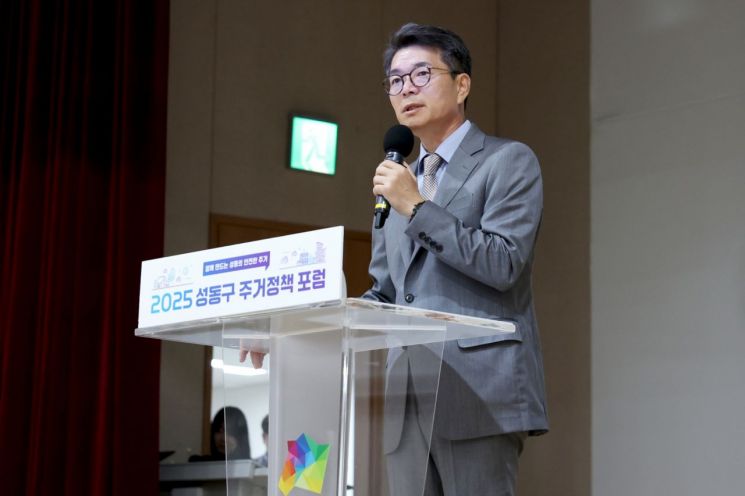 Jung Wono, Mayor of Seongdong District, is delivering the opening remarks at the '2025 Seongdong District Housing Policy Forum' held in October last year. Provided by Seongdong District.
The initiative was prepared to proactively respond to rapidly changing housing conditions such as low birth rates, an aging population, the increase in single-person households, and rising housing costs in the metropolitan area, as well as disaster risks caused by climate change. The district aims to address housing blind spots through an integrated housing policy that encompasses safety, welfare, and culture.
In 2025, based on the nation’s first “risk accommodation standards” developed by the district, Seongdong will conduct a survey of vulnerable housing types such as old houses, semi-basement units, and rooftop rooms, assigning grades from A to D and continuously carrying out customized home repairs according to each grade.
The district will also strengthen community-based programs to ensure the safety and health of vulnerable residents. The "Fall Prevention Home Care Project" will be a key focus, installing anti-slip facilities and safety handles so that seniors with mobility difficulties can live safely at home. By linking this with the Safe Home Repair and Hopeful Home Repair projects, the district will enhance residential convenience, while also strengthening disaster prevention and management systems such as installing flood prevention facilities for basement homes and supporting subscriptions to natural disaster and earthquake insurance.
Energy welfare support for those vulnerable to the climate crisis will also be expanded. The district will continue to provide heating and cooling care and cool roof projects for rooftop and semi-basement households. The "Eco-Friendly Boiler Installation Support Project" will be expanded compared to last year, and energy voucher support will be provided in parallel to ease the energy cost burden for vulnerable groups.
Alongside ongoing housing benefits and monthly rent support for young people, the district will operate the "Hopeful Housing Ladder" project, which links emergency housing support and housing upgrades for homeless individuals and young people preparing for independence, thereby providing a practical foundation for self-reliance. Customized housing support will also be provided through projects such as Majang Happy Village and Seongdong Youth Coexistence Dormitory.
Mayor Jung Wono stated, "Housing is the starting point of life and a basic right that all residents should enjoy," adding, "Through this comprehensive plan, which covers the entire process from physical improvements to risky accommodations, support for housing upgrades, and the fostering of a healthy housing culture, we will build an inclusive ‘housing welfare city, Seongdong’ where no one is left behind."
© The Asia Business Daily(www.asiae.co.kr). All rights reserved.












