Construction of 75% of Planned Units to Begin After 2029
Seoul’s Scheduled Occupancy Volume to Drop 30% Year-on-Year
The government has announced a plan to supply 60,000 housing units centered in downtown Seoul, but there are widespread assessments that this will not be enough to resolve short-term supply instability. This is because most of the construction is scheduled to begin after 2028, and there is a possibility of further delays due to various variables that may arise during the project process.
Given that it typically takes about two years from groundbreaking to occupancy, the point at which a substantial supply will actually reach the market will be well after 2030. While this may somewhat reduce speculative buying driven by concerns over a supply cliff, experts point out that in order to achieve results that can be felt in the market, the project must be carried out according to the established schedule.
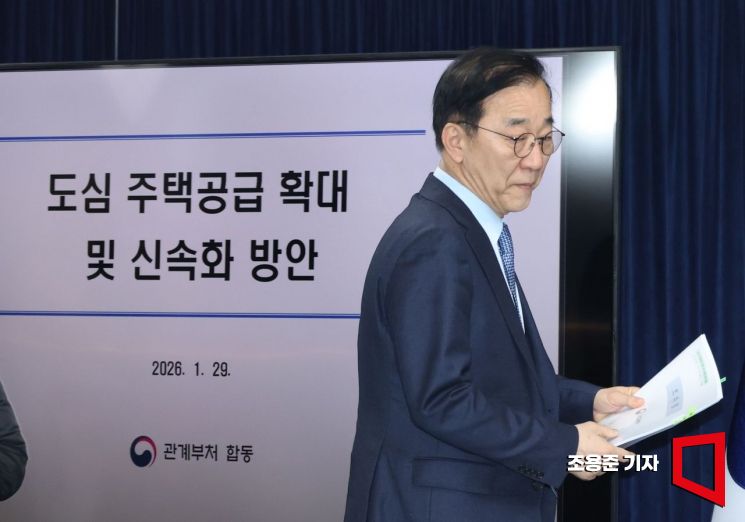 Kim Yoonduk, Minister of Land, Infrastructure and Transport, is attending a joint briefing on housing supply promotion at the Government Seoul Office in Jongno-gu, Seoul on January 29, 2026. Photo by Jo Yongjun
According to the government's recently announced annual plan for urban housing supply as of January 31, 2026, construction will begin on 2,934 units in 2027. In 2028, 11,610 units are planned, followed by 14,624 units in 2029, and 30,494 units in 2030. About 75% of the total supply is concentrated in 2029 and 2030.
Kwon Youngsun, Team Leader at Shinhan Bank Real Estate Investment Advisory Center, said, "Looking at the previous third-generation new towns, large-scale public housing projects tend to experience schedule delays." Yoon Jihae, Head of Research Lab at Real Estate R114, commented, "There is a high possibility that there will be a shortage of new housing supply entering the market from 2026 to 2028, and overall housing prices are likely to trend upward."
The Ministry of Land, Infrastructure and Transport and other government agencies have previously announced a plan to supply a total of 59,662 housing units in key locations in Seoul and the surrounding metropolitan area by 2030. This is a follow-up measure to the government's September 7 supply plan last year, which proposed breaking ground on 1.35 million units between 2026 and 2030, and increases the original plan by about 50,000 units. By region, the plan includes 31,762 units in Seoul, 27,761 units in Gyeonggi Province, and 139 units in Incheon. In some areas, such as Yongsan, existing project plans have been expanded. There are also project plans contingent on the relocation of sites such as the Taereung Country Club in Nowon-gu and the Gwacheon Racecourse and military sites, which had previously failed to proceed. The government has even collected small parcels of land, such as old government office sites, throughout the city, earning the description of an "all-in" approach.
Nevertheless, a look at occupancy indicators shows that concerns about a supply gap remain difficult to dispel. According to Real Estate R114, apartment occupancy in Seoul (based on tenant recruitment announcements) began to decline after peaking in the first half of last year. The number of units scheduled for occupancy in Seoul this year is estimated at 25,967, about a 30% decrease from last year's 37,178 units.
Experts expect this situation to continue until 2028. The sharp decline in construction starts due to the economic downturn and worsening financial environment in 2023, as well as the dismantling of redevelopment zones in the 2010s, have disrupted the housing supply pipeline, leading to a reduction in redevelopment project starts. By region, except for Seocho-gu (7,071 units) and Songpa-gu (2,527 units), most districts are expected to see new occupancy numbers hover around 1,000 units. In particular, Gwanak-gu and Nowon-gu are estimated to have virtually no new occupancy this year. There are concerns that supply imbalances between districts within Seoul could become even more pronounced.
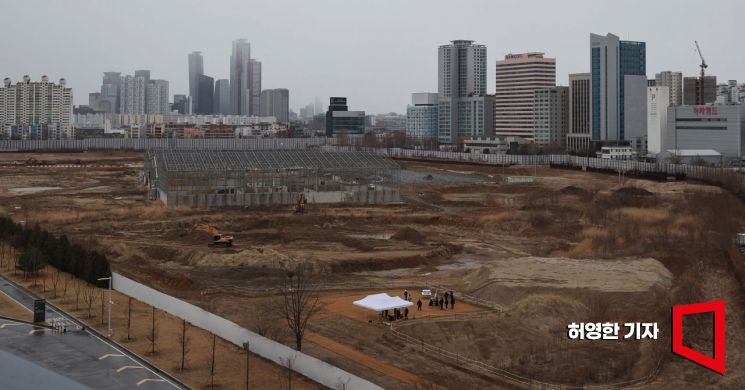 A panoramic view of the Yongsan Maintenance Depot site, planned as an international business district. Photo by Younghan Heo younghan@
There are also forecasts that the government will find it difficult to begin construction on all planned units as scheduled. Some sites designated for large-scale supply were included in the August 4 supply plan during the Moon Jae-in administration. After the plan was announced, various reasons prevented proper progress. Some areas were announced before final coordination was completed during the process of drafting this new supply plan. The government has acknowledged insufficient collection of opinions from some local governments and residents, and added that it will address these issues during the project implementation process, such as district designation.
Shin Daehyun, a researcher at Kiwoom Securities, said, "Sites like Yongsan Camp Kim and Taereung Country Club have faced ongoing resident opposition and have been difficult to develop," adding, "Given that many projects were abandoned during the Moon Jae-in administration due to difficulties in utilizing idle land and creating new housing sites, it will be difficult for all sites to proceed to groundbreaking."
It is also expected to take considerable time to coordinate differences between the government and Seoul Metropolitan Government regarding the Yongsan International Business District. For the Yongsan International Business District, the government has finalized a plan to supply '10,000 units plus alpha,' but the Seoul Metropolitan Government argues that, realistically, 8,000 units is the maximum. The Seoul government explains that if the supply scale is increased to 10,000 units, additional administrative procedures such as changes to the land use plan will be unavoidable, inevitably extending the project period.
Kim Yonghak, Director of Future Spatial Planning at the Seoul Metropolitan Government, explained, "The Yongsan International Business District has already received project implementation approval, but increasing the supply to 10,000 units would require changes to the land use plan, which could take at least two additional years just for the necessary permits. In contrast, 8,000 units can be achieved simply by adjusting the residential ratio, without the need for changes to the land use plan."
© The Asia Business Daily(www.asiae.co.kr). All rights reserved.













