"As Korea's Second Growth Axis and the New Economic Center"
National Assemblyman Koo Jageun (Chairman of the Gyeongbuk Provincial Party Committee for the People Power Party, representing Gumi Gap) has sponsored the "Special Act on the Establishment of Daegu-Gyeongbuk Special City and the Creation of the New Economic Axis of the Korean Peninsula." This bill aims to institutionalize the administrative integration of Daegu and Gyeongbuk, focusing on securing national support and the transfer of authority.
This special act was jointly proposed by 22 National Assembly members representing constituencies in Daegu and Gyeongbuk, as well as two proportional representatives with ties to the region. Assemblyman Lee Inseon, Chairman of the Daegu City Party Committee, and Assemblyman Koo Jageun, Chairman of the Gyeongbuk Provincial Party Committee, visited the Legislative Affairs Committee together to submit the bill.
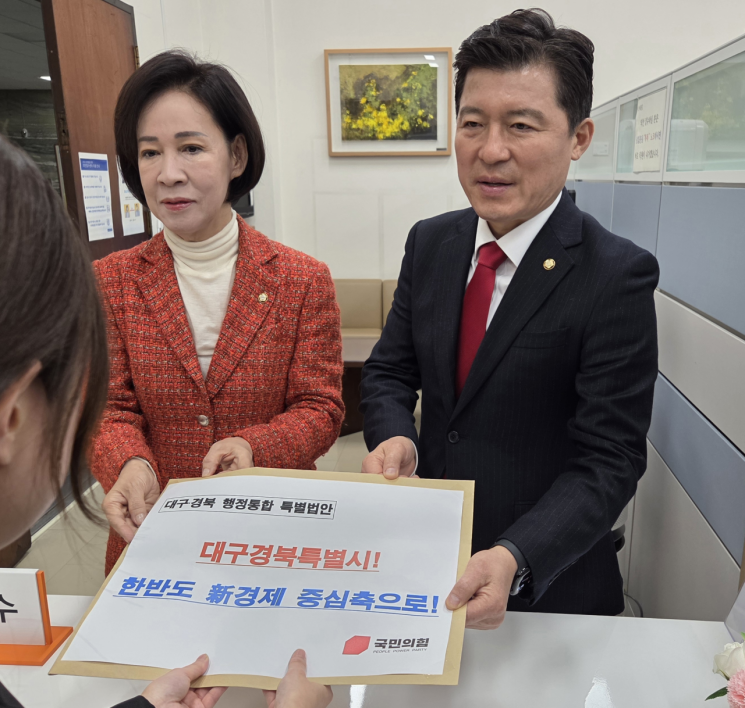 Chairman Lee Inseon of Daegu City Party Committee (left) and Chairman Koo Jagun of Gyeongbuk Provincial Party Committee (right) submitting a bill to the Legislative Affairs Committee / Photo by Kim Ewhan
The Daegu-Gyeongbuk Integration Special Act aims to integrate the existing Daegu Metropolitan City and North Gyeongsang Province to establish the "Daegu-Gyeongbuk Special City," which will be granted a high degree of autonomy. The purpose is to lay the institutional foundation at the national level to foster this new entity as the central axis of the new economy on the Korean Peninsula.
This is a large-scale special act consisting of 335 articles, featuring a more comprehensive framework than the Daejeon-Chungnam Integration Special Act (which has 296 articles). It includes a total of 319 special provisions, providing unprecedented autonomy and grounds for national support across all sectors, including finance, industry, urban affairs, transportation, environment, education, and administration.
The special provisions by sector include: ▲organization and finance (43 cases), ▲forestry and environment (34 cases), ▲culture and welfare (30 cases), ▲urban affairs and transportation (36 cases), ▲agriculture, forestry, and fisheries (17 cases), ▲economy and industry (64 cases), and ▲education and others (95 cases). Of these, 192 special provisions were newly developed specifically for the integration of Daegu and Gyeongbuk.
To address concerns that have been raised, particularly in northern Gyeongbuk, regarding "post-integration marginalization" and "Daegu-centric absorption integration," the act incorporates significant institutional measures. It legally stipulates a balanced regional development system, mandates the allocation of strategic industries, social overhead capital, and public institutions by region (including the northern area), and establishes mechanisms to prevent the concentration of fiscal allocation and investment in specific areas.
In particular, the act includes provisions that allow for the prioritization of administrative, industrial, transportation, medical, and educational infrastructure in the northern region, ensuring that integration is designed not as a "centralized model" but as a "co-growth model for all of Gyeongbuk." This is a key feature of the special act.
Koo Jageun, Chairman of the Gyeongbuk Provincial Party Committee for the People Power Party, stated, "This special act is not simply a bill for administrative district integration, but a 'national administrative system reform project' that fundamentally changes the structure of local government authority." He emphasized, "It is a national strategy to develop Daegu and Gyeongbuk as the second growth axis of Korea, counterbalancing the dominance of the capital region and serving as the new economic axis of the Korean Peninsula."
Lee Inseon, Chairman of the Daegu City Party Committee for the People Power Party, stressed, "The administrative integration of Daegu and Gyeongbuk has been discussed for the longest time and is the most thoroughly prepared, so it should be at the center of this effort." He added, "Above all, it is essential that the special act faithfully includes region-specific special provisions, expanded autonomy, and sufficient financial support." He further stated, "We will work together with National Assembly members from Daegu and Gyeongbuk to ensure that meaningful administrative integration is achieved at the parliamentary level."
© The Asia Business Daily(www.asiae.co.kr). All rights reserved.












