Shortage of One-Room Apartments Around Campuses as International Student Numbers Surge
"We'll Pay More Rent": Students Forced Into a Bidding War
Housing Costs Up 21%... "1 Million Won a Month Is the New Baseline"
Kim, a 24-year-old Hanyang University student preparing to return to school, recently felt the harsh reality of living in a rented room. After viewing a one-room studio offered at a monthly rent of 700,000 won with a 10 million won deposit, Kim called their parents, but before long received a call from the agent saying the room had been taken. The notice was that a Chinese international student had signed the contract by lowering the deposit to 4 million won in exchange for paying 800,000 won in monthly rent. Kim said, "It was devastating to lose the room I had barely managed to find right before my eyes," adding, "These days, university districts are like a battlefield where you are forced to make rushed decisions, rather than choosing a room at your own pace."
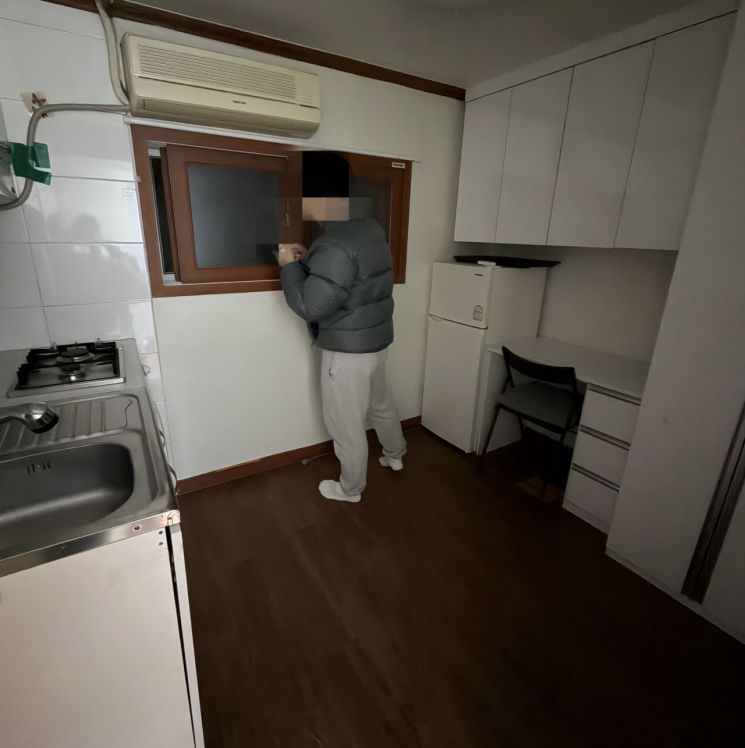 On the 28th of last month, a college student inspected a tiny one-room studio near Hanyang University in Seongdong-gu, Seoul, so small that their outstretched hands touch the walls. The landlord explained, "This is the only room left at the moment." Photo by Park Hosu
As the number of international students surges, the so-called "one-roomflation" (one-room + inflation) phenomenon is intensifying in the rental markets around universities in Seoul. There is growing criticism that as international students, who are relatively better off financially, increasingly secure rooms by offering monthly rents higher than the going rate, domestic college students, who are more vulnerable to housing costs, are being pushed to the outskirts in a kind of "housing gentrification."
According to the Korean Educational Development Institute (KEDI) on the 4th, as of April last year there were 253,434 international students in Korea, an increase of about 44,000 from a year earlier. Among them, Chinese nationals numbered 76,541, accounting for 30.2%, the largest share. In particular, at Hanyang University and Kyung Hee University, the number of Chinese students has each surpassed 5,000.
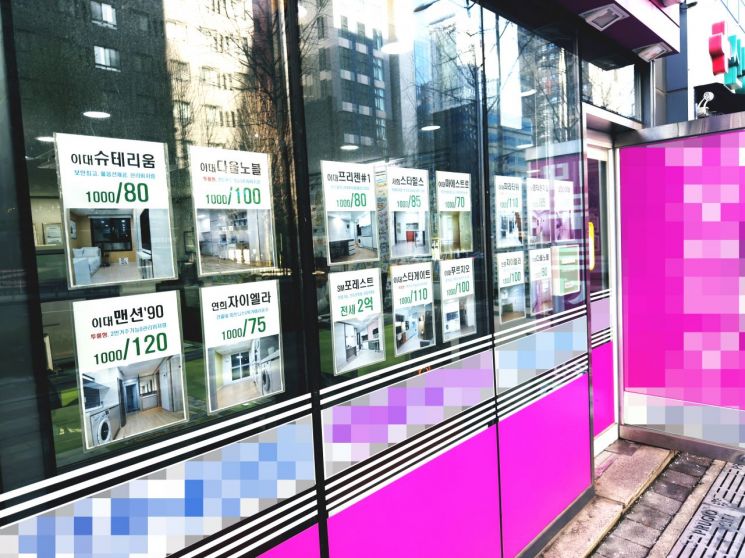 On the afternoon of the 28th of last month, a sign displaying monthly rental prices was posted at a real estate agency near Ewha Womans University Station in Seodaemun-gu, Seoul. Due to increased demand from international students and the fallout from the disappearance of jeonse, high monthly rents are spreading across university districts in Seoul. Reporter Park Hosu
Industry insiders explain that the way international students structure their contracts is a factor that fuels price increases. Because they tend to regard the deposit not as an "asset to be refunded later" but as a "consumption expense," they prefer to lower the deposit and raise the monthly rent. Kwak, a 52-year-old licensed real estate agent in Dongdaemun-gu, Seoul, said, "Some international students engage in so-called 'monthly rent shopping' at newly built officetels, offering up to 1.5 million won in monthly rent regardless of the prevailing rate," adding, "These deals set the upper end of the price range and pull up the surrounding market prices as well."
There are also concerns that the involvement of illegal brokers, mainly targeting Chinese students, is exacerbating market distortions. Many unlicensed brokers in Korea are said to recruit international students through Chinese social networking services such as Xiaohongshu and then steer them into signing "advance contracts" based only on photos before they enter the country. Park, a 66-year-old licensed real estate agent near Kyung Hee University, said, "Because the three months before the semester practically determine the entire year's sales, competition is fierce," adding, "When we try to accommodate broker fees, we end up raising the monthly rent after consulting with the landlord."
Given this situation, landlords' perceptions are also changing. Jung, a 72-year-old landlord who operates 13 one-room units in Seongdong-gu, has rented 8 of them to Chinese students. Jung said, "Among building owners, there is already a widespread perception that, in terms of monthly rental income, international students are more advantageous than Korean students."
College students, already squeezed by higher food costs due to inflation and mounting pressure for tuition hikes, are now facing "downward housing mobility." Park, a 22-year-old student currently enrolled at Kyung Hee University, said, "When you add up rent, maintenance fees, and transportation costs, I spend 1.2 million won a month just to breathe," adding, "I have no other choice but to lower my housing standards and opt for places farther from school or cramped one-room-tel units."
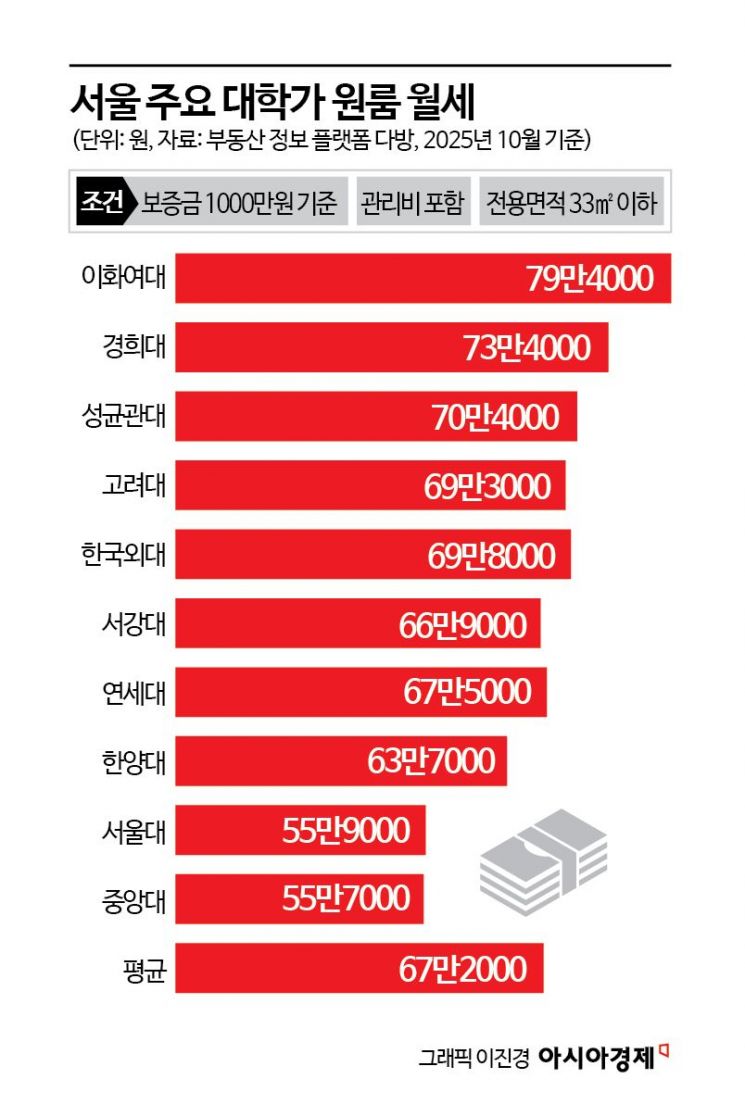
According to the real estate platform Dabang, the average housing cost (monthly rent plus maintenance fees) across 10 major university districts in Seoul rose 21.1%, from 555,000 won in October 2019 to 672,000 won in October last year. The area around Ewha Womans University was the most expensive at 794,000 won, followed by Kyung Hee University at 734,000 won and Sungkyunkwan University at 704,000 won. When maintenance fees are added to a monthly rent of 800,000 won, the actual burden comes close to 1 million won.
Experts analyze that this phenomenon is the result of a combination of stronger preference for monthly rent over jeonse in the wake of jeonse fraud, and the rising demand from international students. Kim Jekyung, head of Tumi Real Estate Consulting, said, "For foreigners unfamiliar with jeonse, paying high monthly rent is a rational choice," pointing out, "In a situation where even college students and young workers are flocking to the monthly rental market, if high rents driven by international students solidify the upper price range, the housing conditions of domestic students will inevitably deteriorate."
© The Asia Business Daily(www.asiae.co.kr). All rights reserved.














