Twice the Field of View and 20 Times the Survey Efficiency of the Rubin Observatory
A Major Step Forward in Observing the "Dark Universe"
A domestically developed telescope designed to capture celestial objects thousands of times fainter than the night sky has achieved its first successful observations in Chile, opening new possibilities for ultra-low surface brightness exploration. Unlike the conventional paradigm centered on large telescopes, this approach implements wide-field and high-efficiency capabilities using Korean technology, which is regarded as highly significant.
The Korea Aerospace Administration and the Korea Astronomy and Space Science Institute announced that the first-generation K-DRIFT (Korean-Developed Reflective Imaging Field Telescope), a telescope specialized for ultra-low surface brightness and developed entirely with domestic technology, has succeeded in its first imaging observations at the El Sauce Observatory in Chile. K-DRIFT is an independently developed Korean telescope that specializes in minimizing internal scattered light and suppressing fluctuations in the background sky value, enabling it to clearly capture extremely faint celestial objects.
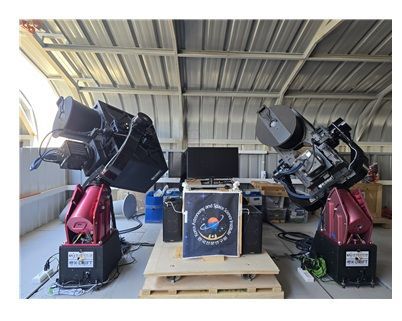
The first-generation K-DRIFT, which has now acquired its first images, is a compact optical telescope with a 0.5-meter aperture, but its field of view is more than twice as wide as that of the Vera Rubin Observatory (8.4-meter aperture). By combining wide-field capability-enabling the observation of an area equivalent to about 100 full moons at once-with ultra-low surface brightness technology, its survey efficiency per unit time is estimated to be about 20 times higher than that of the Rubin Observatory. The research team explained that K-DRIFT has a particular advantage in capturing very faint and widely spread structures.
The K-DRIFT project was led by a research team headed by Dr. Koh Jongwan. After verifying its performance through trial observations at the Bohyunsan Observatory, the team installed the telescope in Chile to take advantage of the southern hemisphere's observing conditions and succeeded in acquiring its first images.
The technological core is the world's first 0.5-meter-class "unobscured freeform three-mirror telescope" design. By adopting an unobscured structure that places the secondary mirror obliquely off the primary axis, the design reduces light loss and distortion. The optimized internal structure further minimizes scattered light and maintains uniform background sky values even with a wide field of view.
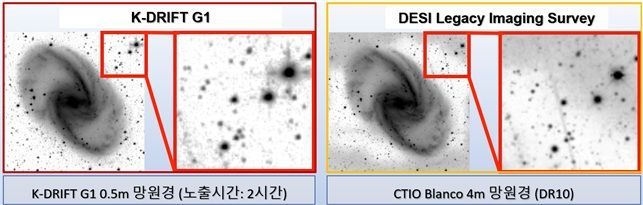 Comparison between K-DRIFT and the existing DESI Legacy Imaging Survey images. A comparison of the galaxy NGC 1365 in the Fornax galaxy cluster region observed with K-DRIFT G1 (first generation) and the latest (DR10) images taken by the Blanco 4m telescope at CTIO. While the DESI Legacy Imaging Survey images show significant fluctuations in the background sky values, the K-DRIFT G1 images exhibit uniformity. The technology to obtain uniform background sky values over a wide range is one of the core techniques in ultra-low surface brightness data processing. Provided by the Korea Astronomy and Space Science Institute.
The optical system was developed entirely with domestic technology, with the Korea Astronomy and Space Science Institute leading the mission planning and design, and the Korean company Green Optics responsible for mirror fabrication and measurement technology. The research team emphasized that this achievement is significant because it marks the independent acquisition of foundational technology for ultra-low surface brightness observations in Korea.
Starting in the first half of this year, the team plans to launch a full-scale ultra-low surface brightness imaging survey of the southern hemisphere night sky and, in the future, expand their research to develop a "Korean-type wide-field space telescope" and conduct all-sky deep space imaging surveys.
Kang Kyungin, Director of Space Science Exploration at the Korea Aerospace Administration, stated, "K-DRIFT, developed with purely domestic technology, is highly significant in that it has secured foundational technology for ultra-low surface brightness observations. We will continue to support so that the achievements of ground-based observations can lead to the development of wide-field telescopes for space orbit in the future."
© The Asia Business Daily(www.asiae.co.kr). All rights reserved.












