"Major Player" NPS Adjusts Domestic and Overseas Investment Ratios
Domestic Stock Allocation Up 0.5%p, Overseas Stocks Down 1.7%p
Reduction of 24 Trillion Won in Overseas Stocks Based on Total Assets
"Dollar Exchange Demand to Drop, Improvi
As the National Pension Service (NPS), a major player in the foreign exchange market, adjusts its domestic and overseas investment ratios by increasing its holdings of domestic stocks and bonds while reducing overseas equities, there is growing interest in how this will affect the future won-dollar exchange rate. In the market, there are expectations that the structural supply-demand imbalance-previously cited as a reason for the rise in the exchange rate-will be largely resolved over time as demand for dollar exchange decreases. However, with other factors such as renewed U.S. tariff risks and bargain hunting by individuals and corporations coming into play, these changes are expected to have the effect of limiting the upper bound of the exchange rate rather than pulling it down significantly.
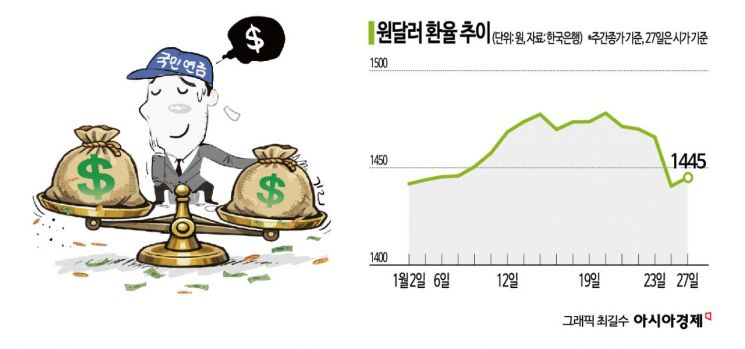
On January 27, the won-dollar exchange rate opened at 1,450.0 won in the Seoul foreign exchange market, up 9.4 won from the previous trading day. After a sharp drop of about 25 won the previous day, the exchange rate opened higher, but as of 10:00 a.m., it was moving around the 1,450 won level, showing only a limited upward trend.
This appears to be partly influenced by the recent rare move of foreign exchange market cooperation between the United States and Japan, as well as the adjustment of domestic and overseas investment ratios by the NPS Fund Management Committee (the Committee) announced the previous day.
The Committee held its first meeting of the year the previous day and changed the target portfolio in its fund management plan. The main point is a reduction of the overseas equity target ratio from the originally planned 38.9% to 37.2%, a decrease of 1.7 percentage points. Instead, the domestic equity ratio will be raised from 14.4% to 14.9%, and domestic bonds from 23.7% to 24.9%.
This decision is expected to affect the foreign exchange market over time. The NPS’s overseas investments have long been criticized for causing structural supply-demand imbalances in the exchange rate by generating demand for dollar exchanges. However, with the NPS now deciding to reduce its overseas equity ratio, dollar demand will decrease accordingly. Based on the NPS fund size of approximately 1,438 trillion won at the end of November last year, a simple calculation suggests that the scale of overseas equities will decrease by about 24.446 trillion won. Using the previous day's weekly closing exchange rate, this translates to a reduction in dollar exchange demand of approximately 16.8 billion dollars.
Market participants believe that if the NPS, a major force in the foreign exchange market, reduces its dollar exchange volume, the previous concentration of dollar demand could ease. Park Sanghyun, a researcher at iM Securities, said, "Although there is some controversy, the reduction in the NPS’s overseas investment ratio will help improve dollar supply and demand," adding, "If this adjustment influences other pension funds, it could also have a positive effect in alleviating the persistent weakness of the won." If the NPS also proceeds with foreign currency bond issuance, the impact of its investment activities on the foreign exchange market could be further reduced.
However, some point out that it will be difficult to completely resolve the structural supply-demand imbalance with the NPS alone. This is because, whenever the won-dollar exchange rate is adjusted downward, individual investors tend to increase overseas investments and importers expand their dollar purchases, a pattern that consistently repeats. In addition, the announcement by U.S. President Donald Trump on the morning of January 27 that he would raise tariffs on automobiles and reciprocal tariffs back to 25%, citing issues with the ratification of the Korea-U.S. trade agreement by the National Assembly, could also be a negative factor for exporters selling dollars.
© The Asia Business Daily(www.asiae.co.kr). All rights reserved.












